
Bookkeeping Isn’t Paperwork — It’s How You See Your Business Before It Becomes a Problem
Most business owners treat bookkeeping as a once-a-year tax chore. Receipts get shoved in a folder (or a shoebox, if we’re being honest), handed off to an accountant in March, and forgotten about for the other eleven months of the year.
The owners who actually scale their companies do something different. They treat bookkeeping as a dashboard — a live instrument panel they check regularly to understand what’s really happening inside the business, not just what happened to it last year.
That difference in mindset changes everything about how useful your numbers actually are.
Two Very Different Questions
There are really two kinds of bookkeeping, and they exist to answer two very different questions.
Tax bookkeeping asks: Did we stay out of trouble?
It’s backward-looking, compliance-driven, and built around a filing deadline. It exists to satisfy the CRA or IRS, not to help you make decisions. It’s necessary — but it’s reactive by design.
Operator bookkeeping asks: Are we making good calls this week?
It’s forward-looking and decision-driven. It’s built around the rhythm of the business itself — weekly, sometimes daily — not around a once-a-year filing deadline. It exists so that you, the owner, always know where you stand.
Only one of those actually helps you run the company. The other just keeps you legal.
Here’s the problem: most small business owners only have the first kind. They can tell you whether last year was profitable, months after the fact, but they can’t tell you whether this week was a good one. By the time tax bookkeeping tells you something’s wrong, the damage is already done — you’re just finding out about it later.
What Changes When Your Numbers Are Current
When your books are up to date and easy to read — not buried in a spreadsheet only your bookkeeper understands — a few things become possible that simply aren’t possible when your numbers are stale.
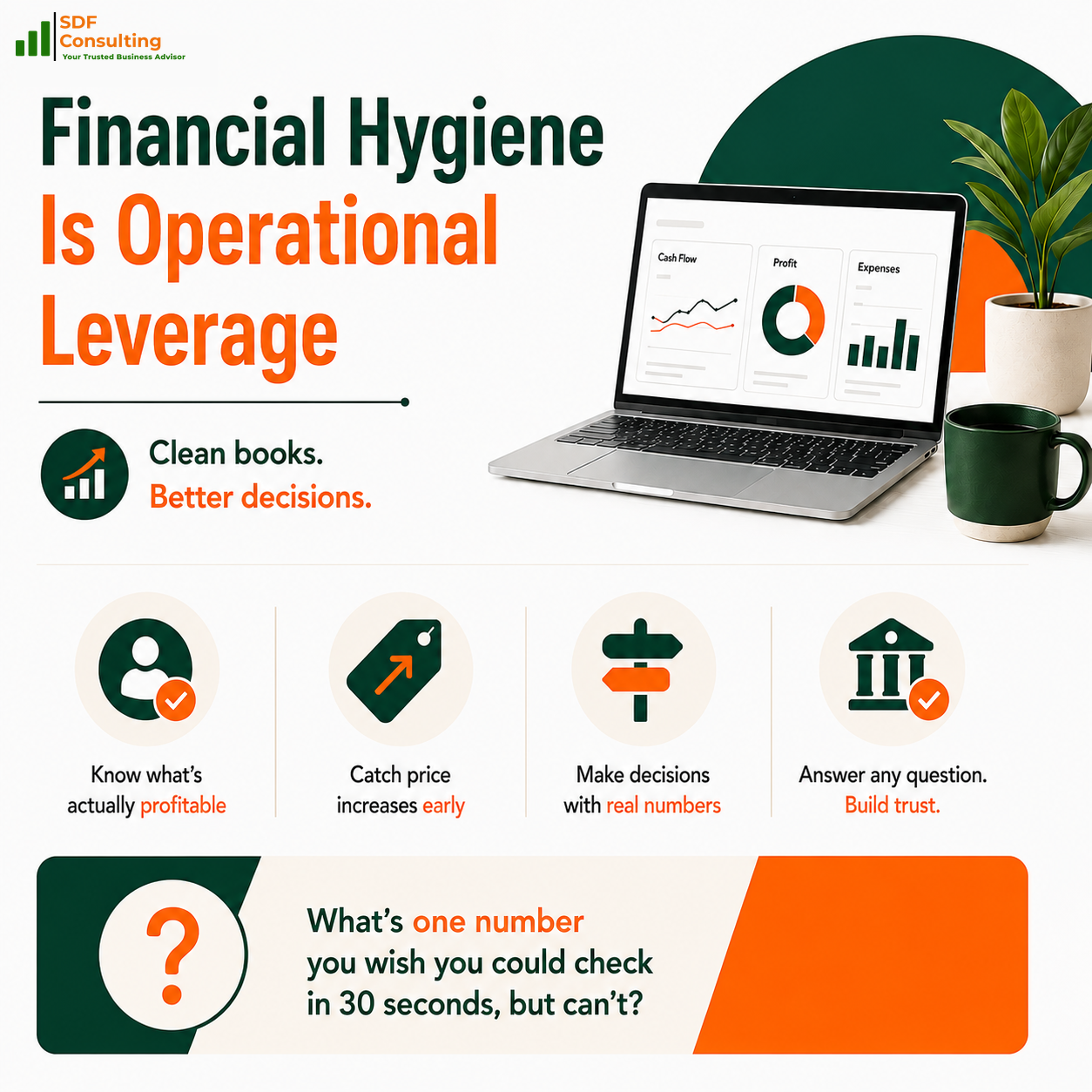
You know which jobs or clients are actually making you money. Revenue isn’t profit. A client that brings in a lot of top-line revenue can quietly be your least profitable relationship once you account for the time, rework, and overhead they consume. Without current numbers broken down by job or client, you’re guessing. With them, you know exactly where to lean in and where to walk away.
You catch a supplier quietly raising prices in month one, not month eight. Vendor costs creep. A 3% increase here, a “fuel surcharge” there — none of it looks alarming in isolation. But if you’re only looking at your numbers once a year, that creep compounds for months before you even notice it happened, let alone do anything about it. Current books turn a slow leak into a visible line item you can act on immediately.
You can decide on a hire, a location, or a price change with real numbers, not a gut feeling. Every major operating decision — bringing on a new employee, opening a second location, raising your prices — carries real risk. Owners without current financials make these calls on instinct and hope. Owners with a live dashboard make them with evidence: current margins, current cash position, current trends. Same decision, very different odds of getting it right.
You can answer a bank’s or a buyer’s questions on the spot, no scrambling. This is the one that quietly costs owners the most, and it’s the one most easily overlooked.
Why That Last Point Matters More Than It Seems
At some point, almost every business owner ends up across the table from someone deciding whether to give them money: a bank evaluating a loan application, an investor sizing up an opportunity, or a buyer doing due diligence before an acquisition.
In that moment, your books are your credibility.
If you can pull up clean, current financials on the spot — margins by job, monthly cash flow, a clear trend line — you look like an operator who is in control of their business. If you have to say “let me get back to you” and spend the next two weeks reconstructing a year of transactions, you don’t just look disorganized. You look risky.
And risk has a price. Lenders price it into your interest rate. Buyers price it into your valuation. Investors price it into the terms they offer. Messy books don’t just slow you down internally — they actively cost you money in every conversation where someone else is deciding how much to trust your business.
The irony is that the fix isn’t complicated. It’s not about hiring a bigger finance team or buying expensive software. It’s about treating your books as something you check regularly, not something you reconcile once a year under deadline pressure.
The Real Difference: A Chore vs. A Dashboard
Think about the difference between checking your car’s fuel gauge while you’re driving versus finding out you ran out of gas after you’re already stranded on the highway.
Tax bookkeeping is the second scenario. You find out what happened after it’s already happened, when your only options are to clean up the mess or explain it away.
Operator bookkeeping is the first. You see the gauge dropping in real time, and you have the chance to do something about it before it becomes an emergency.
That’s the whole difference between bookkeeping as paperwork and bookkeeping as operational leverage. One is a compliance exercise. The other is a tool that actively makes you a better decision-maker — which, over enough decisions, is the thing that actually determines whether a business scales or stalls.
A Question Worth Sitting With
Here’s a simple gut check: what’s one number about your business you wish you could check in 30 seconds, but can’t?
Maybe it’s your current gross margin by service line. Maybe it’s how much cash you’ll have on hand in 60 days. Maybe it’s which of your three biggest clients is actually your least profitable.
If there’s a number you care about but can’t get to quickly, that’s not a knowledge gap — it’s a systems gap. And it’s a fixable one.
Financial hygiene isn’t about being obsessive over spreadsheets. It’s about building a business where the answers to your most important questions are always thirty seconds away, not two weeks and a scramble away.
That’s the real leverage. Not the bookkeeping itself — what the bookkeeping lets you see, and how fast you can see it.