
Growing Too Fast Can Break a Business
We’re taught to chase growth. More sales, more clients, more work. So it comes as a shock to many owners when I tell them that a really good year can be one of the most dangerous things that happens to a business.
It sounds backwards. But I’ve seen it enough times to know it’s real. Some of the most stressful moments I’ve watched business owners go through didn’t come from a slow patch. They came from success arriving faster than the cash could keep up.
Let me show you what I mean.
When a good year turns into a cash problem
I worked with an owner whose sales nearly doubled over a few months. New contracts, bigger clients, the phone ringing off the hook. From the outside, it looked like everything was finally clicking into place.
Then one Thursday she called me because she couldn’t make payroll.
The confusing part, for her, was that nothing had gone wrong. There was no disaster, no lost client, no bad month. The business was more successful than it had ever been. So how could there be no money in the account?
Here’s what was actually happening.
To deliver all that new work, she’d had to spend more, and spend it first. More staff on the payroll. More materials ordered. More stock sitting in the warehouse. All of that money went out the door before a single new invoice got paid.
And her new clients — the bigger, more impressive ones — paid on 30 and 60-day terms. So the cash was leaving quickly and coming back slowly. The faster she grew, the wider that gap became.
She wasn’t failing. She was growing faster than her cash could follow.
Why growth eats cash
This surprises people because we tend to think of a growing business as a business swimming in money. Usually it’s the opposite.
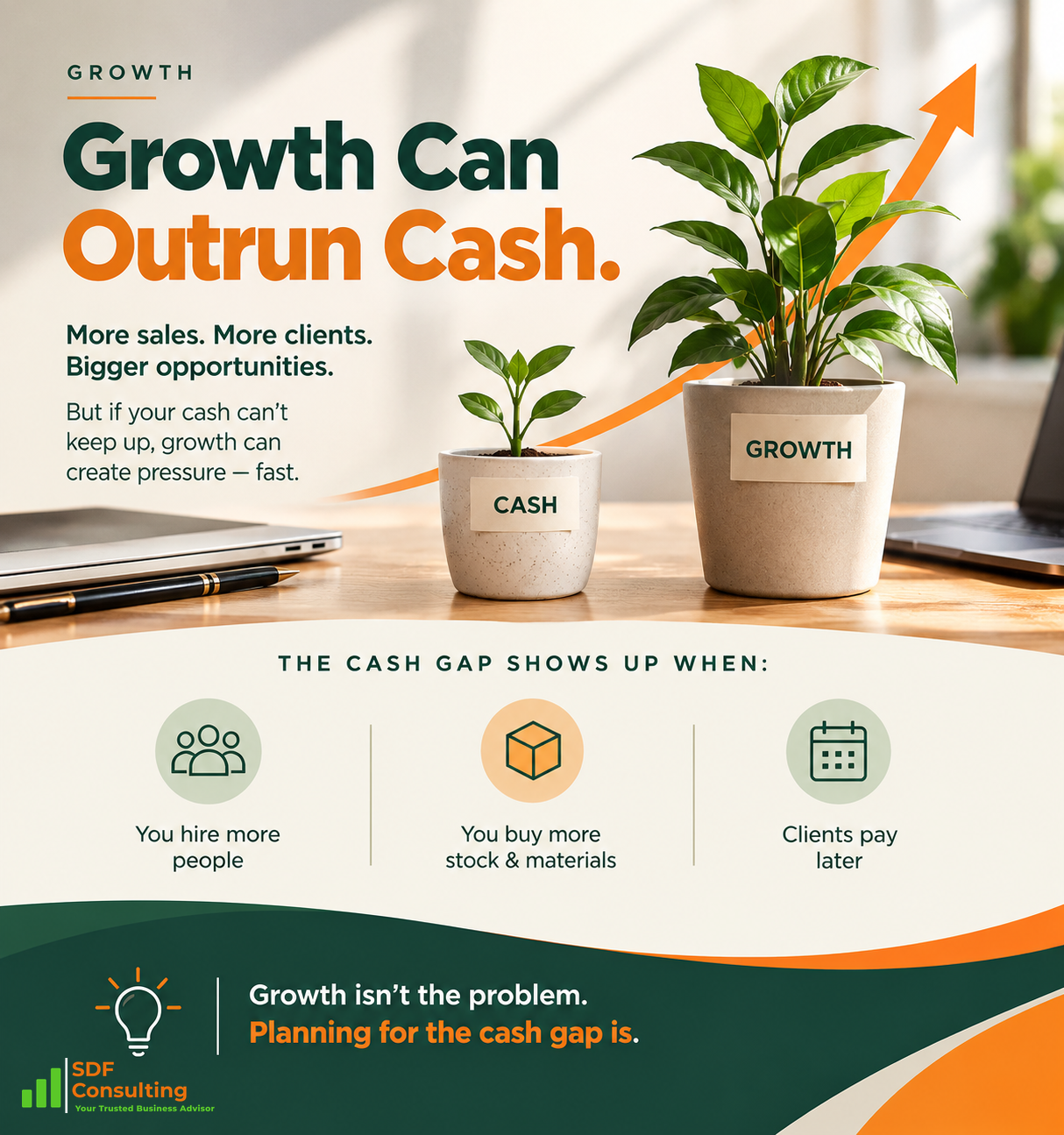
Growth almost always costs money up front. You pay for the extra people, the extra materials, and the extra stock before the extra sales turn into cash in your account. The bigger the leap in sales, the bigger the gap between what you’ve spent and what you’ve collected.
There’s a simple way to picture it. Imagine you have to spend a dollar today to earn a dollar-ten next month. One order like that is easy. But if you suddenly have ten of those orders at once, you now need ten dollars today — and you might not have ten dollars today, even though every one of those orders is profitable.
That’s the trap. The business can be genuinely profitable on paper and still run out of cash, purely because it grew quickly. Profit and cash are not the same thing, and growth is exactly the moment that difference bites.
What to check before you step on the gas
The answer is not to be afraid of growth. Growth is the goal. The answer is to see the cash gap coming so you can plan for it, instead of being caught off guard on a Thursday afternoon.
A few honest questions go a long way here.
Before you take on a big jump in work, ask: what will I have to spend up front to deliver this, and when will that money actually come back? If you’ll be paying staff and suppliers weeks before your customers pay you, you’ve found your cash gap. That’s not a reason to say no. It’s the number you need to prepare for.
Then ask: how will I bridge that gap? Sometimes it’s savings you’ve set aside. Sometimes it’s a line of credit arranged in advance, while the bank still sees a calm, healthy business — not a panicked one. Sometimes it’s simply asking new clients for a deposit up front, or shorter payment terms. The point is to decide this before the pressure hits, not during.
And keep half an eye on the runway. A simple cash flow forecast — even a rough one that looks a few months ahead — turns “I hope we’ll be okay” into “I can see we’ll be tight in March, so let me handle it in January.” That bit of foresight is the whole game.
The bottom line
Growth is a good thing. But it isn’t free, and it doesn’t fund itself. It spends your cash before it ever pays you back, and that’s precisely why so many good, profitable businesses get into trouble at the very moment they’re succeeding.
If you’ve got a big opportunity in front of you and a quiet worry about whether the cash will stretch, that worry is worth listening to. It usually means it’s time to look ahead — calmly, with the numbers in front of you — so the good year stays a good year.
*At SDF Consulting, we help founder-led businesses see what’s coming in plain language, so they can grow with confidence instead of crossing their fingers. If you’d like a second set of eyes on your numbers, we’re always happy to talk.*