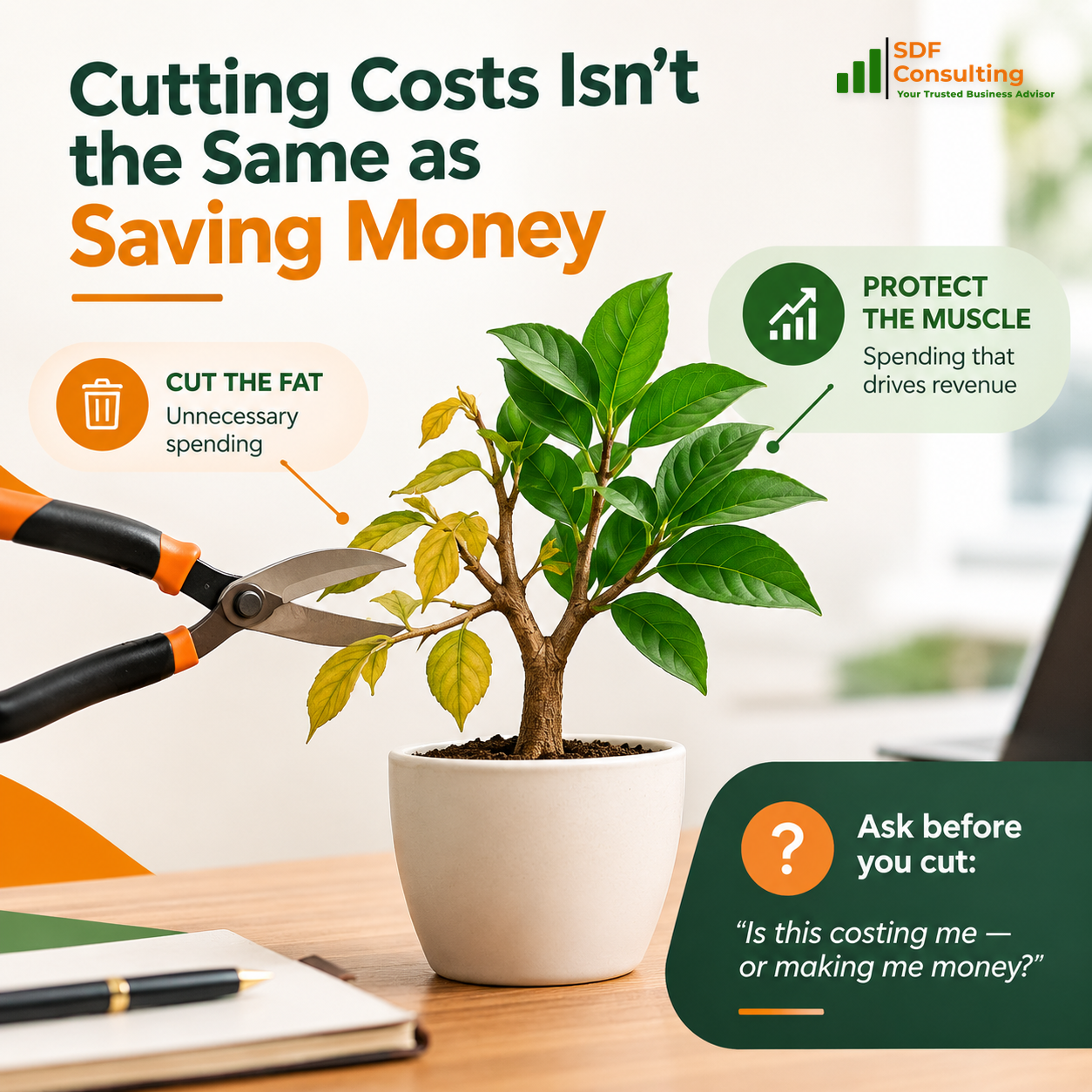

Cutting Costs Isn’t the Same as Saving Money
By Arshad Mirza, SDF Consulting — Your Trusted Business Advisor
When money gets tight, the first instinct for most owners is to start cutting. It feels responsible. It feels like taking control. And often it is the right thing to do.
But here’s the catch I see again and again: cutting a cost and saving money are not always the same thing. Some cuts genuinely put money back in your pocket. Others save you a little today and cost you a lot more down the road. The hard part is telling them apart when you’re under pressure and every expense looks like a target.
Let me show you what I mean.
The saving that wasn’t a saving
An owner I worked with was going through a slow quarter. Sales were down, the account was tighter than he liked, and he wanted to do something about it. So he did the sensible-sounding thing: he looked at his expenses and started cutting.
The marketing budget was one of the first to go. It felt like an easy win. Nobody phones you to complain that you’ve stopped advertising. There’s no immediate pain. The money just stops going out, and the bank balance looks a little healthier the next month.
For a little while, it worked. He’d “saved” that money.
Then something slower and quieter happened. The leads began to thin out. Fewer enquiries, fewer new customers, fewer quotes going out the door. By the time he noticed, the slow quarter had turned into a slow year — and the thing he’d cut to survive it was the very thing that used to bring customers in.
He hadn’t trimmed fat. He’d cut into muscle.
Fat versus muscle
That’s the way I like to explain this to owners, because it’s simple and it sticks.
- Fat is spending that doesn’t really do much for you. The software subscription nobody logs into anymore. The service you signed up for a year ago and forgot about. The “nice to have” that quietly renews every month while you’re not looking. Cut these and you feel nothing but the saving. This is the good stuff to go after first, and most businesses have more of it than they think.
- Muscle is spending that brings money in or keeps the business running properly. The marketing that keeps your pipeline full. The good people who actually do the work and keep your customers happy. The tool your team depends on every single day. Cut these and yes, the number goes down this month — but so does your ability to earn, and that bill always comes due later, usually larger than what you saved.
The trouble is that in the moment, fat and muscle both look the same on a bank statement. They’re both just money going out. The skill is in knowing which is which before you reach for the scissors.
How to tell the difference
You don’t need a complicated system for this. You need one honest question, asked of each expense:
Is this costing me money, or making me money?
If a cost isn’t earning its keep — it doesn’t bring in customers, doesn’t keep the business running, and nobody would notice if it vanished — that’s fat. Cut it with a clear conscience.
If a cost is pulling its weight — it fills your pipeline, keeps your customers served, or lets your team do their jobs — that’s muscle. Be very slow to cut it, even when times are tight. Especially when times are tight, actually, because that’s exactly when you need it working hardest.
A second question helps with the trickier ones: if I cut this, what happens in three months? A lot of cuts feel painless today and only show their true cost a quarter later. Marketing is the classic one, but so is skimping on the people or tools that keep your quality up. Playing it forward a few months usually makes the right answer obvious.
A calmer way to trim
When you do need to cut, it helps to go in order. Start with the obvious fat — the unused subscriptions, the forgotten services, the duplicate tools. You’ll often free up more than you expected, and none of it hurts.
Only after that’s done should you look at the bigger, harder items. And when you get there, don’t reach straight for the axe. Sometimes there’s a middle path — a smaller plan, a renegotiated rate, a pause rather than a cancellation. Muscle doesn’t always have to be cut off; sometimes it just needs to be managed more carefully for a while.
The goal isn’t to spend as little as possible. The goal is to spend on the things that keep you earning, and stop spending on the things that don’t.
The bottom line
Cutting costs is smart. But not every cut is a saving. Trim the fat and you’re genuinely better off. Cut the muscle and you’ve simply moved the cost to later — and added interest.
So before you cut anything, pause and ask the simple question: is this costing me money, or making me money? Get that right, and you’ll come out of a tight patch leaner and stronger, instead of just smaller.
At SDF Consulting, we help founder-led businesses see which costs are working for them and which aren’t, so tough decisions are made with clear numbers instead of guesswork. If you’d like a second set of eyes on your spending, we’re always happy to talk.