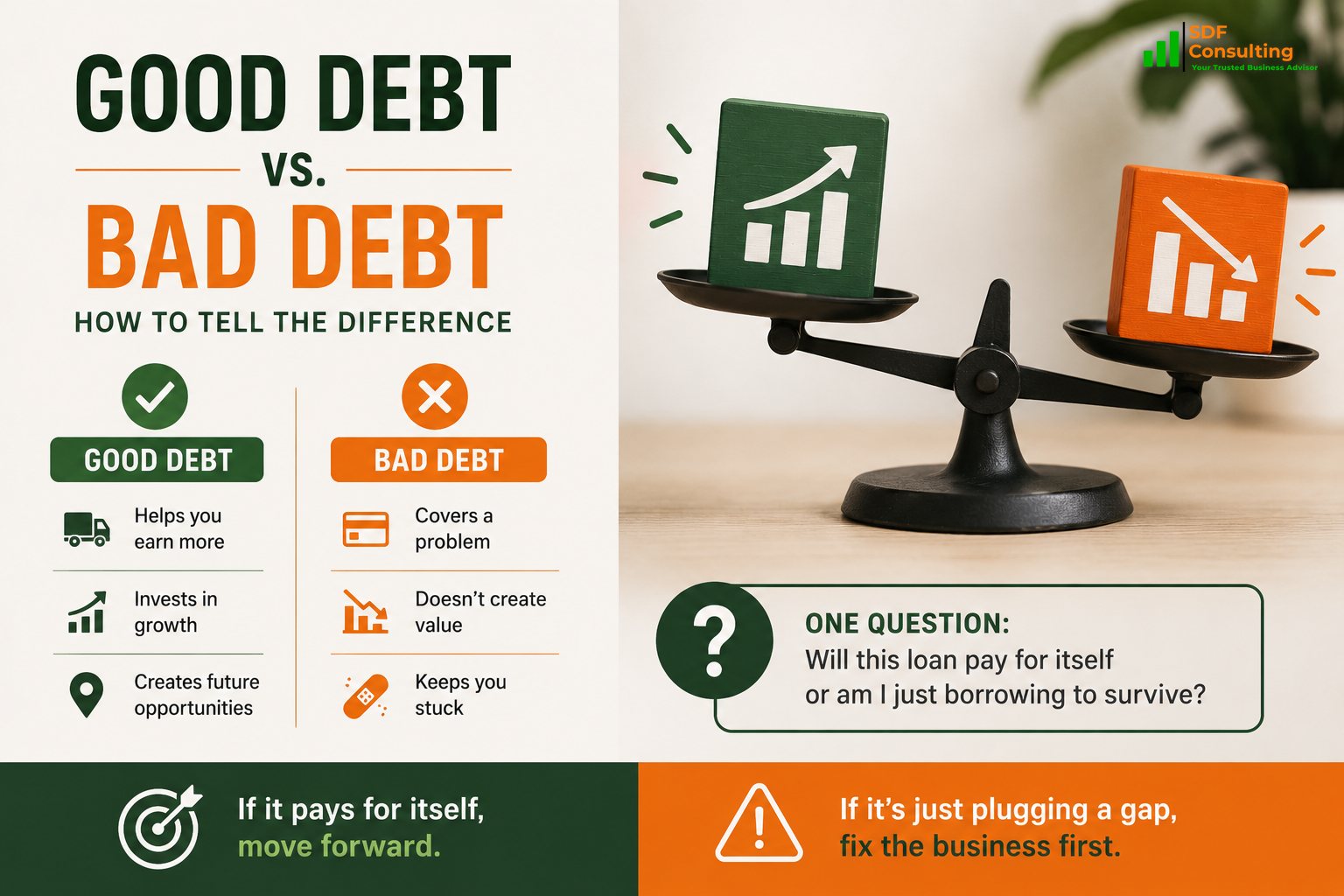

How to Tell the Difference
If you ask most small business owners how they feel about debt, you’ll get some version of the same answer: “I hate it.” Pay it off as fast as possible, avoid taking on more, and sleep better at night knowing you owe nothing to anyone.
It’s an understandable instinct. Debt feels risky. It feels like a leash. And for a lot of owners, it’s tangled up with memories of a stressful stretch when a loan or a credit card balance made things harder instead of easier.
But here’s the problem with treating all debt as equally dangerous: it leads to bad decisions in both directions. Some owners avoid financing that would genuinely grow their business, because “debt is debt.” Others take on financing that quietly drains them for years, because it felt necessary in the moment and they never stopped to ask what it was actually for.
The truth is that debt itself isn’t good or bad. What matters is what the debt is doing for your business. Once you separate debt by function instead of by feeling, the picture gets a lot clearer.
The Real Difference Isn’t the Interest Rate — It’s the Purpose
Most owners try to judge a loan by its terms: the interest rate, the monthly payment, the length of the term. Those things matter, but they’re not the first question you should be asking. The first question is much simpler:
What is this money going to do?
Debt that is used to generate more revenue or profit than it costs is fundamentally different from debt that is used to paper over a problem. Same balance sheet entry. Same monthly payment schedule. Completely different implications for your business.
Good Debt: Money That Pays for Itself
Good debt is financing that puts you in a stronger position than you were in before you borrowed. It funds something that generates a return — more capacity, more inventory, more revenue, more capability — and that return is bigger than what the debt costs you in interest and fees.
A few examples of what this looks like in practice:
- A truck that lets you take on more jobs. If you’re a contractor, landscaper, or service provider turning down work because you don’t have the vehicle or equipment to get to more job sites, financing that truck isn’t a liability — it’s a revenue engine. The truck pays for itself through the jobs it lets you say “yes” to.
- Inventory financing for an order you already have. If a customer has placed a real order and you need capital to buy the materials or stock to fulfill it, that financing is tied directly to money that’s already coming in the door. You’re not guessing whether the return will show up — you already know it will.
- A loan for a new location because you’re turning away business. If your current location is at capacity and you’re regularly turning away customers, opening a second location funded by debt can be one of the highest-leverage decisions you make. The debt is directly tied to demand you already know exists.
Notice the pattern in all three examples: in each case, there was already a signal of demand — a job you couldn’t take, an order you already had, customers you were already turning away — before the financing came in. Good debt doesn’t create demand out of thin air. It lets you capture demand that already exists but that you currently can’t serve.
Bad Debt: Money That Just Covers a Hole
Bad debt looks different. It’s not funding growth — it’s filling a gap. And when the money runs out, the gap is usually still there, because nothing about the underlying situation has changed.
Here’s what that tends to look like:
- A credit card covering payroll because customers pay late. This is one of the most common traps in small business. It feels like a cash flow problem, but it’s often a collections or contract-terms problem wearing a cash flow costume. Financing payroll with a credit card doesn’t fix why customers pay late — it just delays the reckoning, usually at a steep interest rate.
- Financing something that just sits there losing value. Equipment you don’t fully need yet, upgrades that don’t change your output, a vehicle that isn’t tied to any new job or client — if the thing you financed isn’t generating additional revenue, you’re paying interest on a depreciating asset with nothing to show for it.
- Borrowing to avoid fixing a pricing or cost problem. This is the quietest and most dangerous version of bad debt. If your margins are too thin, your prices are too low, or your costs are out of control, debt can mask the symptoms for a while. But borrowing doesn’t fix a broken unit economics problem — it just gives it more time to get worse before it becomes impossible to ignore.
The common thread in bad debt is that it treats a symptom, not a cause. The hole you’re filling today will likely still be there next quarter, except now you’re filling it and making debt payments on top of it.
The One Question That Cuts Through the Confusion
You don’t need a finance degree to tell good debt from bad debt. You need one honest question, asked before you sign anything:
“Is this loan going to pay for itself, or am I just borrowing to survive?”
If the answer is that the financing will generate more in revenue or profit than it costs — because it lets you serve more customers, fulfill more orders, or open up capacity you’re currently turning away — then it’s probably good debt. Sign the paperwork.
If the answer is that you’re borrowing because you’re short this month, or because something in the business isn’t working and debt is the easiest lever to pull, then pause. Bad debt doesn’t mean you’re a bad business owner. It’s a signal. And that signal is worth listening to.
When the Debt Isn’t the Problem, Something Else Is
This is the part that’s easy to miss: if you find yourself reaching for financing just to plug a gap, the debt was never really the issue. It’s a symptom pointing at something more fundamental — a pricing problem, a collections problem, an overhead problem, or a demand problem.
Paying off that piece of “bad debt” might make the immediate stress go away, but if the underlying issue isn’t addressed, you’ll likely be back in the same position again, reaching for the same kind of financing, a few months down the road.
That’s why the most useful thing you can do before taking on any debt — good or bad — is to ask why the need for cash exists in the first place. Sometimes the answer is genuinely exciting: “We have more demand than we can currently serve.” Other times the answer is uncomfortable: “Our pricing doesn’t cover our costs” or “We don’t have a system for collecting what we’re owed on time.” Either way, knowing the real answer changes what you should actually do next — and whether financing is even the right tool for the job.
A Simple Framework for Your Next Financing Decision
Next time you’re weighing whether to take on debt, run it through these three checks:
- Is there already demonstrated demand? A signed order, a waitlist, jobs you’re turning down, customers asking for something you don’t yet offer. Good debt is almost always downstream of demand that already exists.
- Will this generate more than it costs? Not just “will it help” — will the return, in dollars, exceed the interest and payments over the life of the loan?
- If I didn’t take this loan, what would happen? If the honest answer is “the business would keep running fine, just without this extra capacity,” it might be optional growth debt — worth considering, but not urgent. If the answer is “we’d struggle to make payroll,” that’s a flag to look at the root cause before you look at the loan.
None of these questions require complicated math. They just require slowing down enough to separate the feeling of urgency from the actual purpose of the money.
The Takeaway
Debt isn’t the enemy. Debt without a clear, revenue-generating purpose is the enemy. The owners who use financing well aren’t the ones who avoid it entirely or the ones who use it freely — they’re the ones who’ve trained themselves to ask what the money is actually for before they sign anything.
So the next time you’re considering a loan, a line of credit, or a financing offer, don’t start with the interest rate. Start with the question that actually matters: is this going to pay for itself, or am I just borrowing to survive?