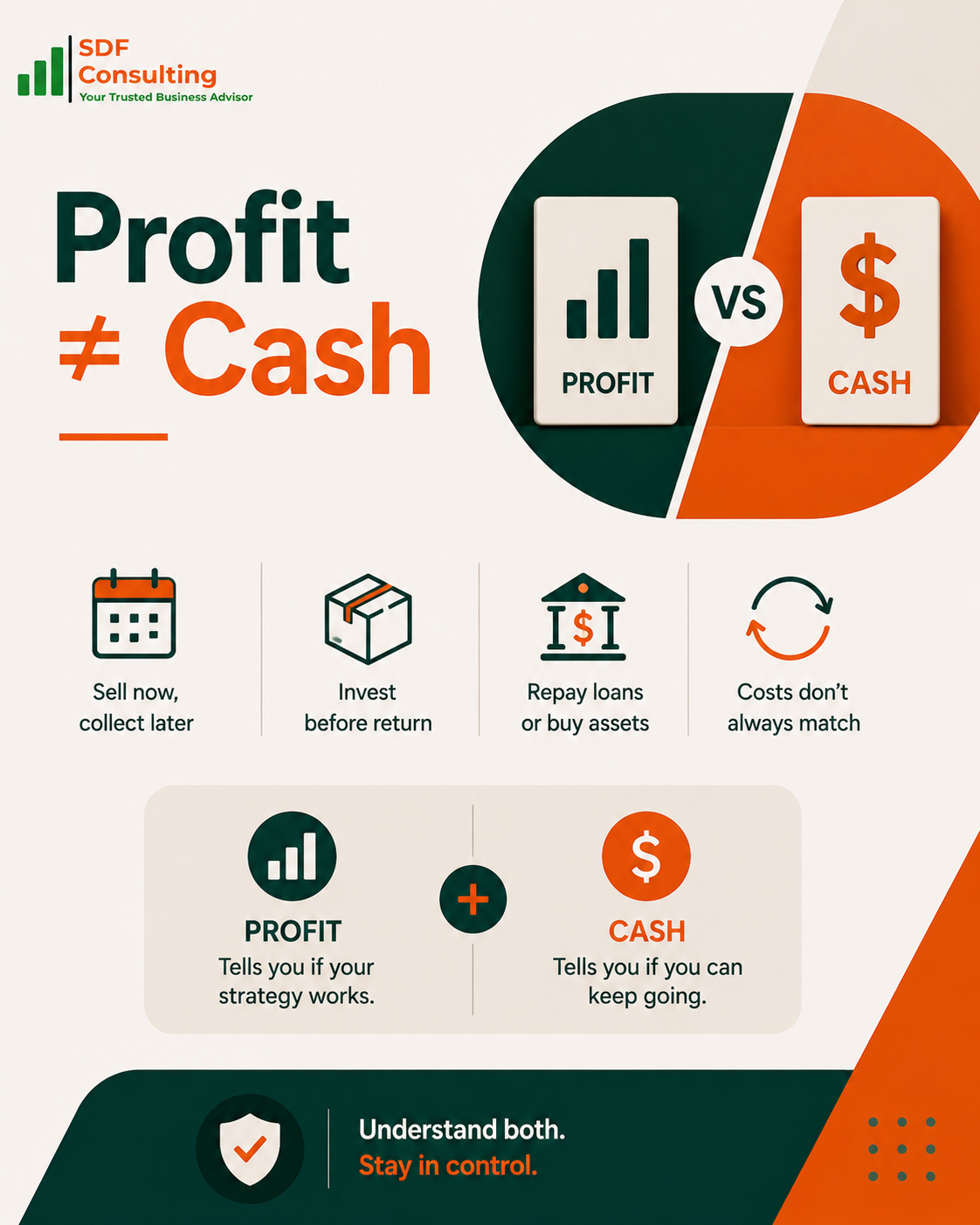

Profitability Does Not Equal Liquidity: Understanding the Gap That Undermines Growth
One of the most common—and most dangerous—assumptions in business is that profitability guarantees financial security.
It does not.
Many organizations find themselves asking a troubling question:
“If we’re profitable, why does cash still feel constrained?”
This confusion is understandable, but it is also a warning signal. The root cause lies in a critical distinction that is often overlooked until it becomes painful:
Profit and cash operate on different timelines.
Understanding—and managing—this distinction is not an accounting exercise. It is a leadership responsibility.
Profit Is a Measurement. Cash Is a Reality.
Profit is an accounting construct.
Cash is an operational fact.
Profit reflects the economic logic of your business model. It tells you whether revenue exceeds expenses over a defined period, according to accounting rules. It answers the strategic question: Is this business theoretically working?
Cash, on the other hand, determines whether your organization can meet its obligations in real time. It answers the operational question: Can we function tomorrow?
The danger arises when leaders treat these two measures as interchangeable.
A business can report strong profits while simultaneously experiencing cash pressure—or even insolvency—because profit does not indicate:
- When cash is received
- How long cash is tied up
- Where cash leaks occur outside the income statement
This is how profitable companies still fail.
Why Profitable Businesses Experience Cash Strain
The disconnect between profit and cash most often emerges during growth, investment, or transition. Common drivers include:
- Revenue Is Recognized Before Cash Is Collected
Sales made on credit increase profit immediately, but cash may not arrive for 30, 60, or even 90 days. Growth amplifies this gap, increasing receivables faster than cash inflows.
- Cash Is Deployed Before Returns Materialize
Inventory purchases, hiring, expansion initiatives, and marketing investments consume cash long before they generate revenue. Profitability may improve on paper while liquidity weakens in practice.
- Capital Payments Bypass the Income Statement
Loan principal repayments, equipment purchases, and owner distributions reduce cash without appearing as expenses. From a profit perspective, nothing looks wrong—yet cash steadily drains.
- Accounting Adjustments Do Not Reflect Cash Movement
Depreciation, amortization, accruals, and provisions affect reported profit without impacting cash. Conversely, certain cash outflows do not reduce profit at all.
Taken together, these forces explain why businesses can feel financially tight even in their most successful reporting periods.
The Question Leaders Must Ask
The most important financial question is not simply:
“Are we profitable?”
It is:
“How long does our cash stay out before it comes back in—and can we sustain that cycle?”
This is the essence of cash flow management. It defines:
- How aggressively you can grow
- How resilient you are to disruption
- How much risk your organization can absorb
Ignoring this dimension forces businesses to rely on external financing, emergency decisions, or reactive cost cutting—often at precisely the wrong moment.
Profit and Cash Serve Different Leadership Purposes
Enduring businesses respect both measures and understand their distinct roles:
- Profit validates strategy.
It tells leadership whether pricing, cost structure, and execution make economic sense. - Cash sustains operations.
It determines whether payroll clears, suppliers get paid, and commitments are honored.
Short‑term survival depends on cash.
Long‑term success depends on profit.
Sustainable growth requires disciplined control of both.
Managing Growth Starts With Financial Clarity
Many organizations do not fail because their strategy is flawed. They fail because they grow without understanding the cash consequences of that strategy.
Leaders who master the difference between profitability and liquidity gain a decisive advantage:
- They grow deliberately rather than reactively
- They invest with confidence rather than hope
- They make decisions based on timing, not just totals
In business, success is not defined solely by what you earn on paper. It is defined by whether you can continuously fund tomorrow while building for the future.
Understanding the difference between profit and cash is where sustainable leadership begins.