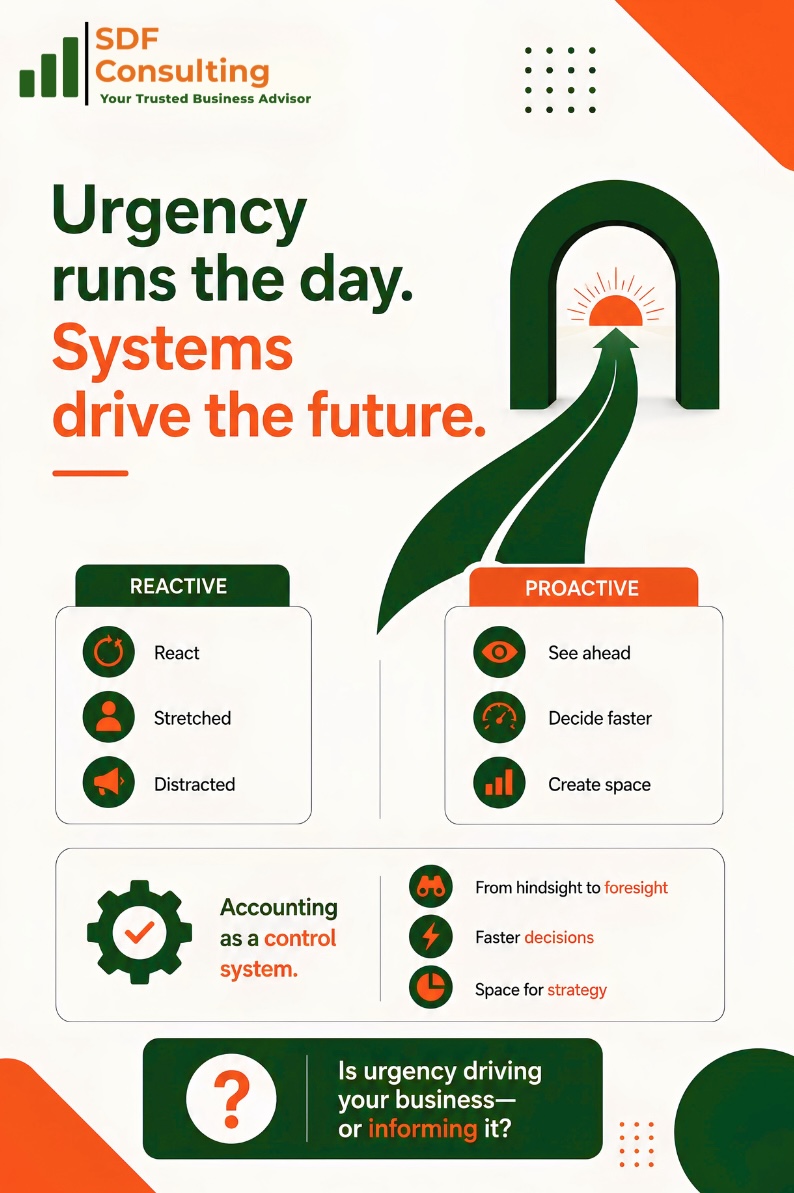

The Reality Most SMB Leaders Recognize—but Rarely Articulate
In theory, businesses are guided by strategy.
In practice—especially in SMBs—they are driven by urgency.
Client demands. Cash flow timing. Payroll cycles. Tax deadlines. Operational breakdowns.
These are not exceptions. They are the daily operating environment.
Over time, something subtle but powerful happens:
Urgency stops being a condition—and becomes the culture.
How Urgency Rewires Time, Capacity, and Focus
In urgency-led organizations, three critical levers begin to shift:
-
Time Becomes Reactive
Leadership calendars fill with immediate needs, not intentional priorities.
Strategic thinking is deferred—not by choice, but by pressure.
-
Capacity Becomes Distorted
Capacity is measured by effort rather than effectiveness.
Teams stay busy—but not necessarily productive.
Without clarity, every problem feels equally important.
-
Focus Becomes Fragmented
The loudest issue wins.
Not the most valuable one.
And over time, this fragmentation compounds:
-
-
- Decisions slow down
- Execution loses coherence
- Growth becomes inconsistent
-
The Accounting Perspective: Where the System Breaks
Accounting, at its core, is a time discipline.
It’s designed to:
- Translate activity into insight
- Connect past performance to future decisions
- Provide clarity on where the business is going—not just where it’s been
But in urgency-driven SMBs, accounting gets pulled into the same gravity field.
It becomes:
- Backward-looking instead of forward-guiding
- Compliance-focused instead of decision-enabling
- Periodic instead of continuous
This creates a critical gap:
The businesses that need real-time financial clarity the most are often operating with delayed insight.
The Leadership Shift: From Managing Urgency to Governing It
Eliminating urgency isn’t realistic.
But allowing it to dominate is a leadership decision—whether intentional or not.
High-performing SMB leaders operate differently.
They Treat Focus as a Finite Asset
Focus is no longer a byproduct of time—it’s a deliberate allocation of it.
Not every urgent issue earns executive attention.
They Redefine Capacity as a System
Capacity isn’t just people—it’s:
- Process efficiency
- Information clarity
- Decision velocity
Clean, reliable financials are a cornerstone of this system.
They Collapse Time-to-Insight
The faster the business understands itself, the less it is controlled by urgency.
Monthly reporting becomes insufficient.
Decision-grade visibility becomes the standard.
Why This Matters More Than Ever
SMBs don’t fail because of a lack of effort.
They struggle because effort is misaligned with impact.
Urgency creates motion—but not necessarily progress.
And the longer urgency defines the operating model, the harder it becomes to:
- Scale deliberately
- Allocate capital effectively
- Execute strategy with consistency
The Bottom Line
Urgency is not the enemy.
It’s a constant in SMB environments.
But when urgency becomes the operating system:
- Strategy becomes secondary
- Accounting becomes reactive
- Leadership becomes constrained
The shift isn’t about doing less.
It’s about seeing—and deciding—more clearly, faster.
Because the real advantage in SMBs isn’t working harder under pressure.
It’s building the clarity to decide what actually matters.