
Speed Is Not Strategy
In the early stages of building a company, speed often feels synonymous with success. Founders celebrate rapid product launches, aggressive hiring, and accelerating revenue curves. Movement is visible. Momentum is measurable. And externally, it signals progress.
But speed, in isolation, is not a strategy.
In fact, speed without direction can quietly amplify underlying inefficiencies, weak business models, or unsustainable economics. What appears as growth may, over time, become the compounding of structural flaws.
The highest-performing companies recognize a critical distinction: speed is a multiplier—not a corrective mechanism. It magnifies what already exists. If the foundation is strong, speed drives scale. If the foundation is flawed, speed accelerates failure.
The real discipline, therefore, is not simply moving fast—it is moving in the right direction.
The Shift from Activity to Intentional Growth
Many organizations fall into the trap of equating activity with progress:
- Expanding headcount becomes a proxy for scale
- Shipping features becomes a proxy for product-market fit
- Growing top-line revenue becomes a proxy for business health
Yet these signals, while important, can be misleading when disconnected from underlying quality.
True scaling requires a deliberate shift—from doing more to doing what works, repeatedly and profitably.
This is where financial clarity becomes indispensable.
Accounting as a Strategic Lever
Accounting is often positioned as a back-office function—focused on compliance, reporting, and historical recordkeeping. In reality, at scale, it becomes one of the most powerful strategic tools available to leadership.
It provides the lens through which founders can:
- Evaluate the durability of their growth
- Understand where value is truly created
- Identify inefficiencies before they compound
- Make informed decisions on capital allocation
When used effectively, accounting does not just tell you where you’ve been—it informs whether your current trajectory is worth accelerating.
The Metrics That Actually Matter
As companies scale, the emphasis must shift away from vanity metrics and toward indicators of long-term viability. The following principles define that transition:
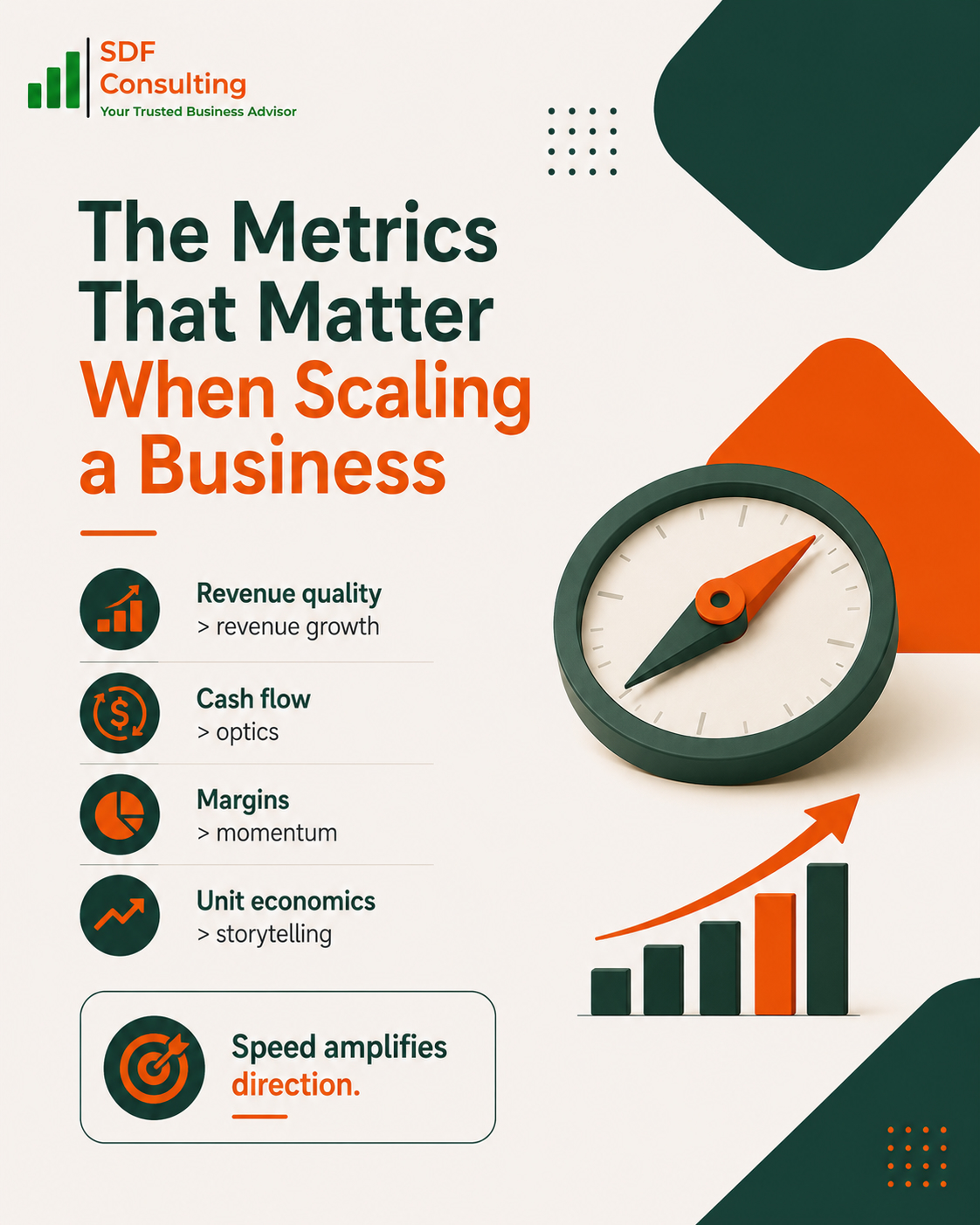
1. Revenue Quality > Revenue Growth
Not all revenue is created equal.
High growth rates can obscure fragile foundations—such as heavy discounting, unsustainable customer acquisition costs, or reliance on short-term contracts. Revenue quality, by contrast, reflects durability.
Key considerations include:
-
-
- Customer retention and churn rates
- Recurring vs. one-time revenue mix
- Pricing integrity and discount dependency
- Customer concentration risk
-
Scalable businesses prioritize predictable, repeatable, and high-margin revenue streams over rapid but unstable expansion.
2. Cash Flow > Optics
Profitability on paper does not guarantee operational health.
Cash flow is the ultimate constraint in any business. Companies that prioritize optics—headline revenue, valuation narratives, or superficial profitability—often overlook the reality of liquidity.
Strong operators focus on:
-
-
- Operating cash flow consistency
- Burn rate relative to growth efficiency
- Working capital dynamics
- Cash conversion cycles
-
The fundamental question shifts from “How does it look?” to “Can it sustain itself?”
3. Margins > Momentum
Momentum can be deceiving.
Rapid expansion often comes at the expense of margins—through increased costs, inefficiencies, or aggressive reinvestment strategies. While short-term margin compression can be intentional, ignoring margin structure entirely is a risk.
Margins reveal:
-
-
- Operational discipline
- Pricing power
- Scalability of the cost base
-
Healthy businesses design for margin expansion over time, ensuring that growth translates into increasing profitability—not diminishing returns.
4. Unit Economics > Storytelling
Narratives can raise capital. Unit economics build companies.
At its core, scaling is about replication. Each incremental customer, product, or transaction should contribute positively to the business.
Critical metrics include:
-
-
- Customer acquisition cost (CAC) vs. lifetime value (LTV)
- Contribution margin per unit
- Payback periods
- Incremental cost of growth
-
Strong unit economics validate that the model works at the smallest level, making it viable to expand at scale.
Without this foundation, growth becomes a story sustained by external capital—not internal strength.
Aligning Speed with Direction
When these metrics are aligned, speed becomes a powerful advantage. Growth compounds efficiently. Capital is deployed intelligently. Execution reinforces strategy rather than masking its flaws.
But without alignment, speed creates risk:
- Scaling unprofitable customers
- Expanding inefficient operations
- Reinforcing weak pricing models
- Accelerating cash burn
The key is not to slow down unnecessarily—but to ensure that acceleration is applied to a system that is fundamentally sound.
The Defining Question for Founders
At every stage of growth, founders face a deceptively simple but critical question:
“Are we scaling something that actually works?”
This question requires honesty. It demands looking beyond surface-level success and interrogating the underlying mechanics of the business.
It is not answered by dashboards alone—but by a disciplined interpretation of the right metrics, consistently applied.
Conclusion: Direction Determines Outcome
In the end, success in scaling is not determined by how fast a company moves—but by where it is headed.
- Speed dictates how quickly you arrive
- Direction determines where you end up
The most effective leaders internalize this distinction. They use metrics not as vanity indicators, but as strategic signals. They prioritize quality over appearance, sustainability over momentum, and clarity over noise.
Because in scaling a business, getting there fast only matters if “there” is worth reaching.