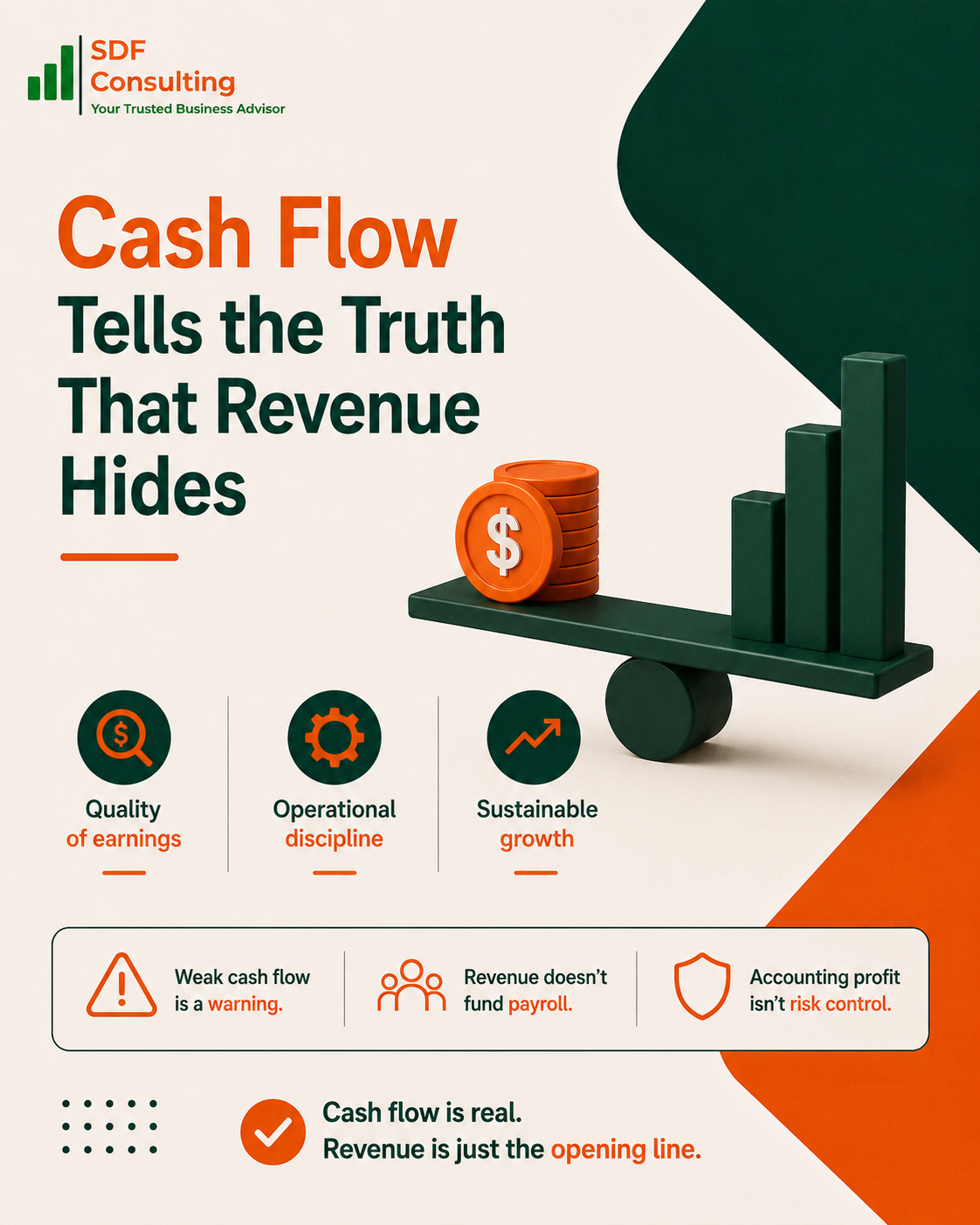

The Illusion of Revenue
Revenue attracts attention. It’s the number that headlines reports, fuels valuations, and signals growth to stakeholders. But while revenue may tell a compelling story, it does not always tell the truth.
Revenue can be shaped—recognized early, deferred strategically, or accelerated through accounting decisions. It reflects activity, but not necessarily health. And in many cases, it creates an illusion of strength that masks underlying fragility.
Experienced business leaders and finance professionals understand a critical distinction: growth does not equal stability.
Cash Flow as the Ultimate Reality Check
Cash flow, unlike revenue, is not subject to interpretation. It is binary. Cash is either in the bank—or it isn’t.
This is why the most important question is not:
How much did we make?
But rather:
How much of that revenue actually turned into cash?
A company can report strong profits and still face liquidity issues. It can show impressive top-line growth while quietly eroding its working capital position. Cash flow cuts through accounting narratives and exposes the operational truth beneath them.
What Cash Flow Really Reveals
Cash flow is more than a financial metric—it is a diagnostic tool. It reveals:
- The Quality of Earnings
Not all earnings are created equal. Strong revenue paired with weak cash flow often indicates aggressive revenue recognition, poor collections, or dependency on non-recurring transactions.
High-quality earnings, by contrast, consistently translate into cash. They signal that revenue is both real and realizable.
- Operational Discipline
Cash flow reflects how effectively a company manages its internal processes:
-
- Are receivables collected on time?
- Is inventory optimized or overstocked?
- Are expenses controlled and predictable?
Weak cash flow often points to inefficiencies that revenue alone cannot expose.
- The Sustainability of Growth
Growth can be deceptive. Rapid expansion without supporting cash flow can strain operations, stretch resources, and increase reliance on external financing.
When growth is healthy, it is supported by strong, consistent cash generation. When it’s not, it creates risk—no matter how impressive the revenue figures appear.
When Strong Revenue Masks Weak Cash Flow
A mismatch between revenue and cash flow is not merely a timing issue—it is a warning signal.
It may indicate:
- Overextension in credit terms
- Poor collections processes
- Rising costs hidden behind revenue growth
- Structural weaknesses in the business model
Left unaddressed, these issues compound over time, often surfacing only when liquidity becomes constrained.
Why Cash Flow Matters More Than Profit
Revenue and accounting profit are important—but they do not fund operations.
You cannot:
- Meet payroll with reported revenue
- Service debt with accounting earnings
- Manage risk with non-cash profit
Cash flow is what sustains the business day-to-day. It determines whether a company can invest, adapt, and survive periods of uncertainty.
The Real Scorecard
Ultimately, cash flow is the true measure of financial health.
It reflects:
- The effectiveness of strategy
- The discipline of execution
- The resilience of the business model
Revenue may be the opening line of the story—but cash flow is the ending that determines whether the business thrives or struggles.
Final Perspective
High-performing organizations don’t just chase revenue—they manage cash with intent and precision.
They understand that:
Revenue shows potential.
Cash flow proves performance.
In the end, cash flow doesn’t just support the business—it tells the truth about it.