
Are We Building Systems to Serve the Business—or the Other Way Around?
Every business eventually runs into this question.
Not dramatically. Not in a boardroom.
But quietly—somewhere between monthly closes, missed expectations, and another tool someone wants to add.
Are we building systems to serve the business?
Or are we slowly reorganizing the business to serve the systems?
This is where the conversation about tech stacks actually begins.
Not with tools.
Not with trends.
But with intent.
Tech stacks aren’t the problem. Blind stacks are.
Let’s clear this up.
Tech stacks, by themselves, aren’t bad. In many cases, they’re necessary.
What causes trouble is when stacks get built without being questioned.
At their best, a tech stack should do one thing well:
Help you make better, faster decisions—without adding noise or complexity.
That’s the bar.
If your stack doesn’t meaningfully improve how you:
- understand cash flow
- spot issues early
- reduce manual, error‑prone work
- run the business with confidence
then it’s not leverage. It’s friction.
How stacks quietly go wrong
Most stacks don’t fail loudly. They fail subtly.
A tool gets added because:
- “Everyone’s using it”
- A vendor makes a compelling pitch
- It looks modern and sophisticated
- Someone says, “We’ll grow into it”
Over time:
- Numbers stop tying
- Reports arrive later
- Fewer people trust the data
- Decision‑making slows down
- The business feels heavier to run
No single tool is “the problem.”
The problem is layers of complexity without a clear purpose.
Clarity erodes one tool at a time.
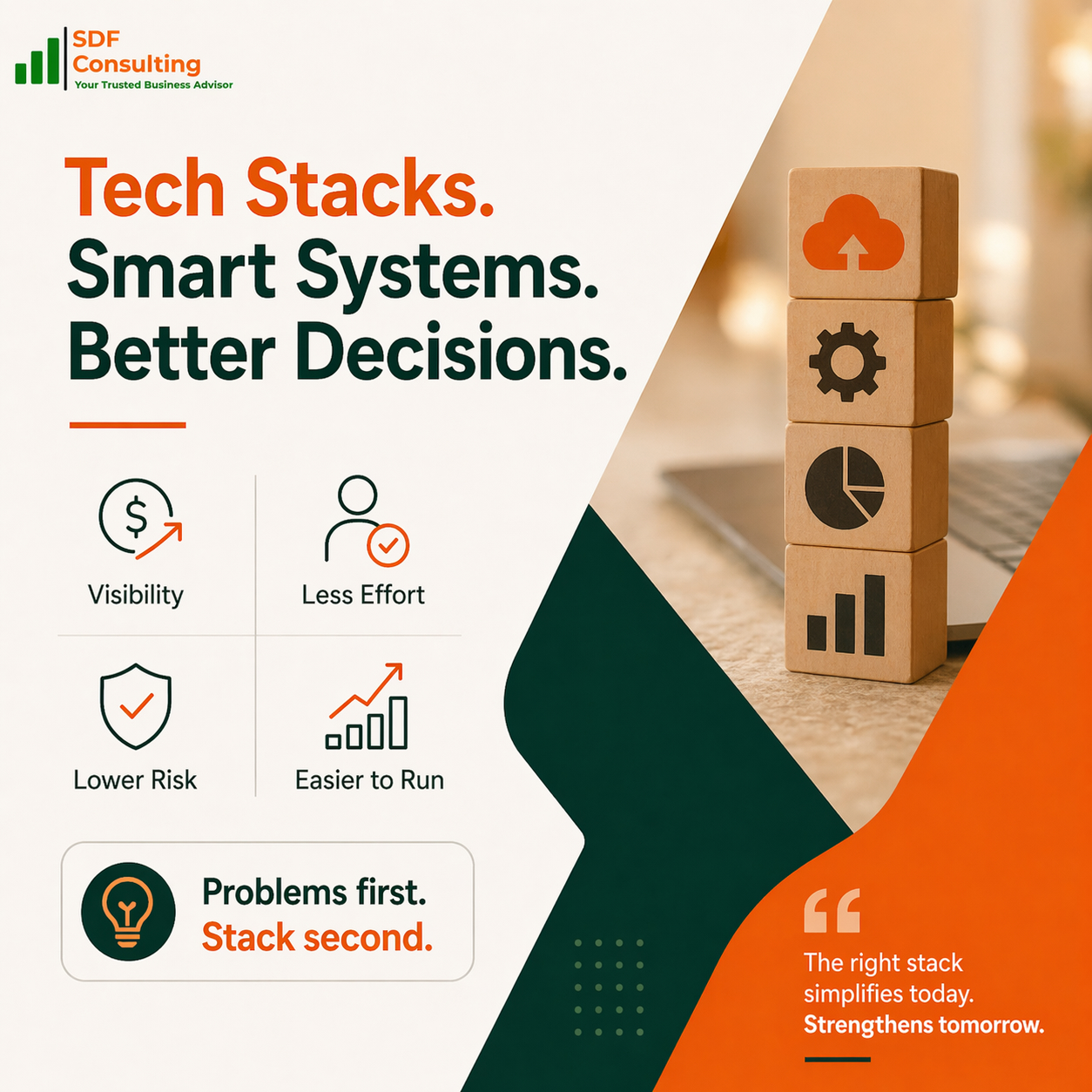
Problems first. Stack second.
This is the rule I keep coming back to.
Before choosing or adding any tool, the question shouldn’t be:
What stack should we be using?
It should be:
- What decision are we struggling to make right now?
- What risk feels unacceptable if it goes wrong?
- What part of the business feels harder to run than it should?
Only then does a tool make sense.
When you reverse that order—tools first, problems later—you end up managing software instead of managing the business.
The quiet power of “boring” systems
The most effective stacks I’ve seen aren’t impressive.
They’re boring.
They are:
- Simple enough that anyone on the team can understand them
- Clean enough that numbers reconcile without heroics
- Flexible enough to change as the business evolves
- Predictable enough to work the same way every month
They don’t demand attention.
They free up attention.
And that’s the real job of systems—to create space for thinking, not consume it.
A useful test
Here’s a simple question worth asking regularly:
What could we remove and still run the business better?
If removing a tool:
- speeds things up
- improves trust in the numbers
- simplifies workflows
that tool was adding drag, not value.
Good stacks reduce complexity felt by the business, even if there’s sophistication underneath.
Bad stacks do the opposite.
The real goal
No founder starts a business to manage software.
The goal is:
- clarity
- control
- confidence in decisions
- and the calm that comes from knowing where you stand
Technology should support that—not compete with it.
So if your team spends more time managing tools than managing outcomes, it’s worth pausing and asking:
Are these systems still serving us?
Or is it time to simplify—on purpose?