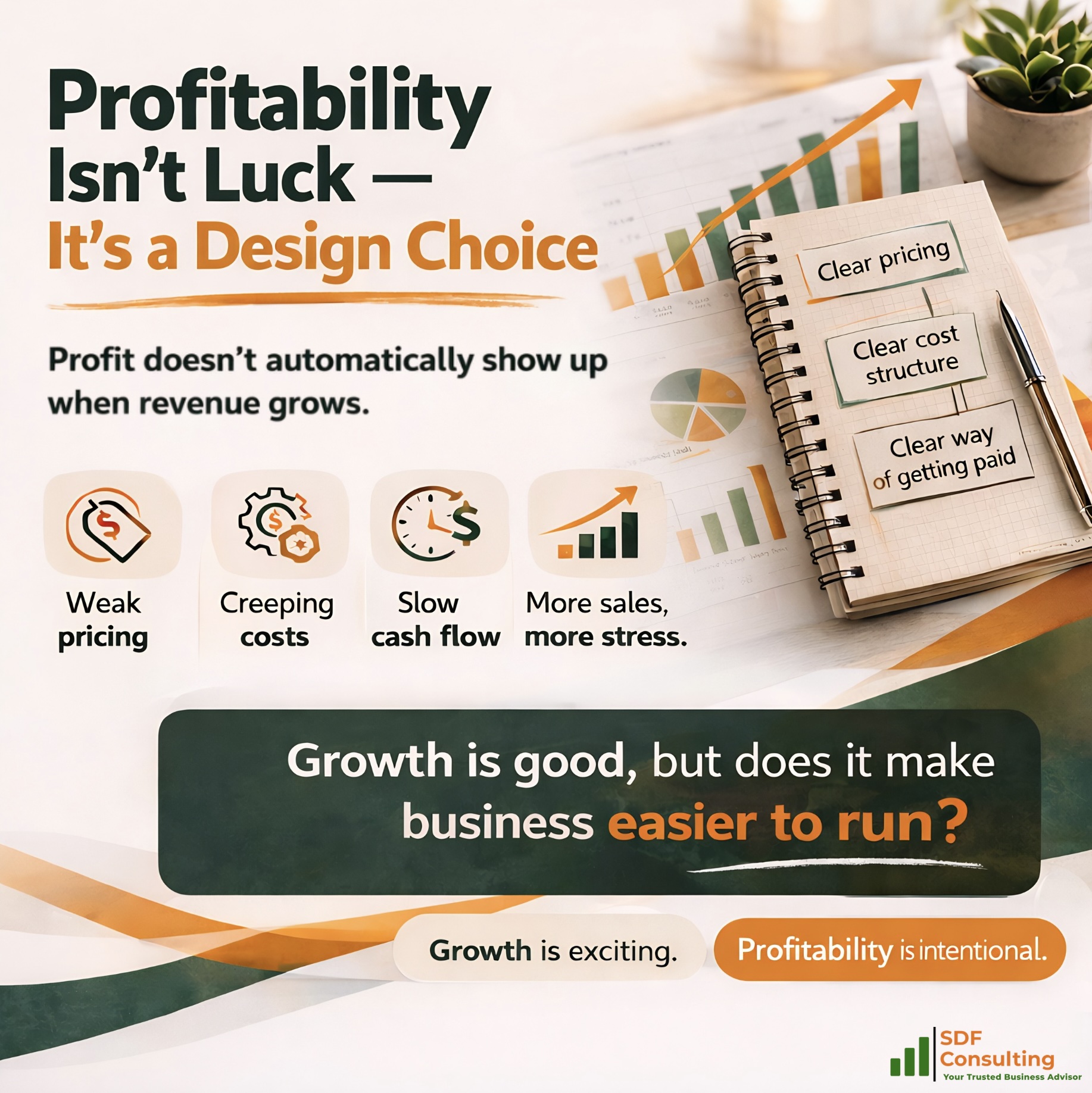

Profitability Isn’t Luck — It’s a Design Choice
Over the last 30+ years working with founders and operators, I’ve noticed a pattern that shows up across industries, sizes, and stages of business.
Many founders believe profitability will naturally follow growth.
That once revenue crosses a certain number, things will settle down. Margins will improve. Cash will feel easier. Stress will reduce.
In reality, it very rarely works that way.
More often, growth does the opposite.
It puts pressure on whatever hasn’t been properly thought through.
If pricing is unclear, growth highlights it.
If costs have crept up quietly, growth accelerates the pain.
If cash collection is loose, growth makes cash stress constant.
Growth doesn’t fix problems.
It magnifies them.
Profitable Businesses Don’t Happen by Accident
The most profitable businesses I’ve worked with didn’t stumble into profitability.
They didn’t rely on luck, timing, or hope.
They were intentionally designed that way.
And that design isn’t complicated. It’s practical and very operational.
It usually comes down to a few basic questions:
- Are we actually charging enough for the value we deliver?
- Do our costs still make sense as the business grows?
- Is work being done in a repeatable, efficient way — or recreated every time?
- Are we getting paid on time, or constantly waiting on cash?
When these questions aren’t answered clearly, growth creates chaos instead of leverage.
A Common Pricing Problem I See
Here’s a pricing situation I see often.
A business sets prices early on to “win work.”
They’re competitive. Clients don’t push back. Sales grow.
Years later, the business is much bigger — but pricing hasn’t changed.
Meanwhile:
- Costs have increased
- The team is more experienced
- The work is more complex
- The founder is personally involved in everything
Every new client adds revenue, but not much profit.
On paper, sales look good.
In reality, the business feels heavier.
We don’t fix this by doing anything extreme.
We simply redesign pricing:
- Align prices with today’s value, not yesterday’s fear
- Separate routine work from high‑touch work
- Make sure “extra effort” is no longer free
Once pricing reflects how the business actually operates, growth starts working for the founder instead of against them.
A Cost‑Structure Issue That Creeps Up Quietly
Cost problems usually don’t appear suddenly. They creep.
A hire here.
A tool there.
A role created because “we’re busy.”
Before long, fixed costs rise faster than revenue quality.
I’ve worked with businesses where:
- Sales were increasing
- Work was getting done
- But margins kept shrinking
Why?
Because costs were added without asking one key question:
“If we add more revenue at this level, do these costs still make sense?”
Once we redesigned the cost structure — clarifying which costs should grow with revenue and which shouldn’t — profitability stabilized.
Not overnight.
But predictably.
Again, not luck.
Design.
A Real Cash Flow Example I See Often
A business is growing. Revenue looks solid. Clients are happy.
But the founder feels constant pressure.
The bank balance never feels comfortable.
There’s anxiety before payroll.
Every large expense feels risky.
When we look closer, the issue usually isn’t sales.
It’s cash flow design.
Invoices go out late.
Payment terms aren’t clear.
Follow‑ups are inconsistent.
So even though the business is “doing well,” cash arrives unpredictably.
With a clearer process:
- On‑time invoicing
- Clear payment expectations
- Simple follow‑up rhythm
The business doesn’t change — but the stress does.
When Growth Feels Worse, Not Better
I’ve worked with businesses that doubled or tripled revenue and felt more stressed than ever.
More customers.
More work.
More people to manage.
More money coming in — and still no breathing room.
Not because growth failed.
But because profitability and cash flow were never built into how the business actually runs.
Without that design, growth simply increases complexity.
The Question Strong Operators Ask
The strongest founders and operators I work with don’t obsess over speed or scale.
They ask a much simpler — and much better — question:
“If we add more revenue, does the business actually get easier to run?”
That question forces clarity:
- Pricing that supports the work
- Costs that scale intentionally
- Systems that reduce effort, not increase it
When the answer is yes:
- Cash flow becomes calmer
- Decisions feel clearer
- Numbers stop being intimidating
- Founders get back to focusing on what they actually enjoy
Growth Is Optional. Profitability Is Intentional.
Growth can be exciting.
It can create opportunity.
But profitability doesn’t arrive automatically with revenue.
It has to be designed — deliberately and practically — into pricing, costs, delivery, and cash flow.
That’s not theory.
That’s experience.
A Personal Note
If your sales look good but cash still feels tight, you’re not alone.
In my experience, that’s almost always a design issue — not a sales problem.
And the good news is: design issues are fixable.