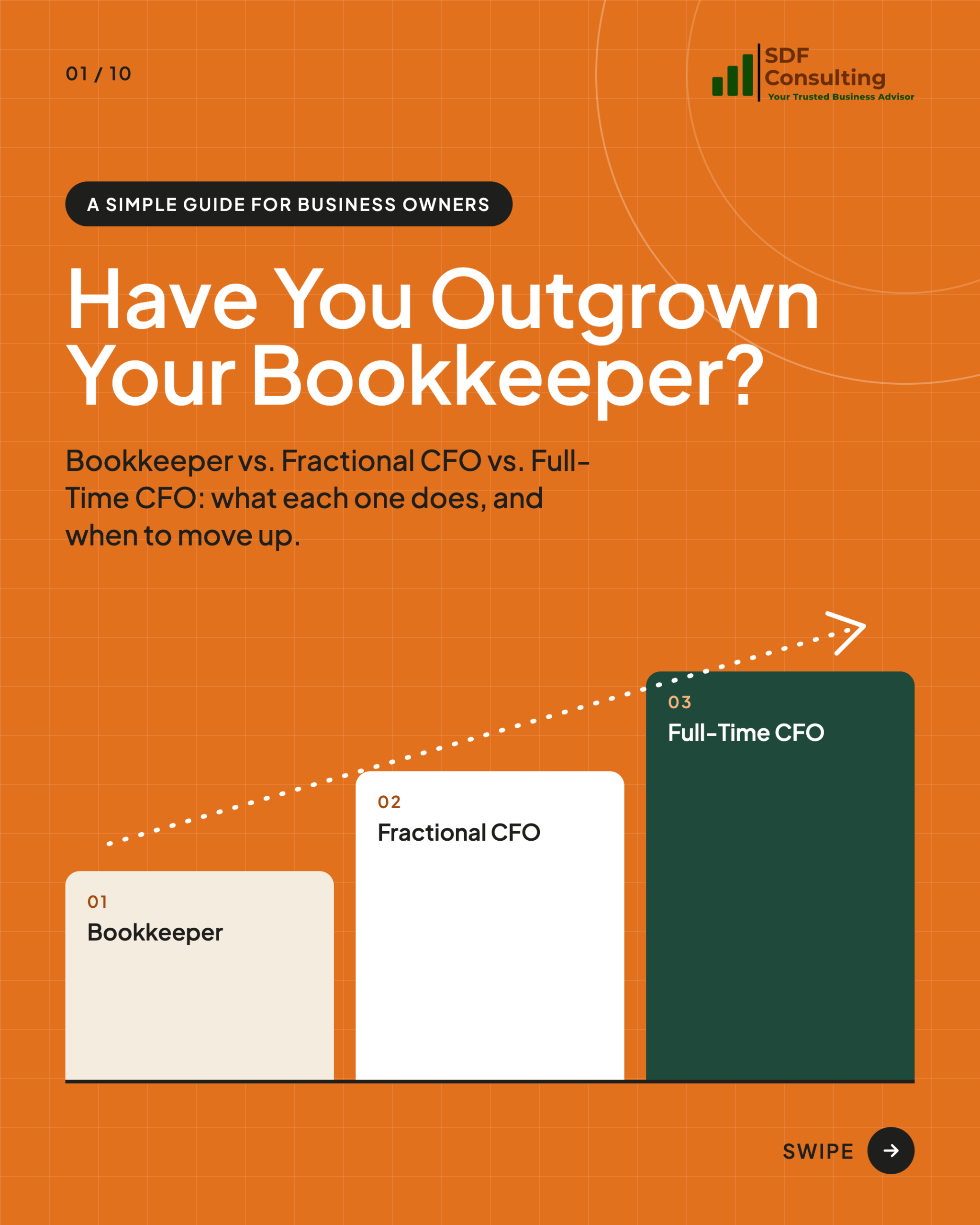

Three finance roles, three different questions, and how to tell which one your business needs right now.
Most owner-operators don’t have a finance problem. They have a “wrong person in the seat” problem.
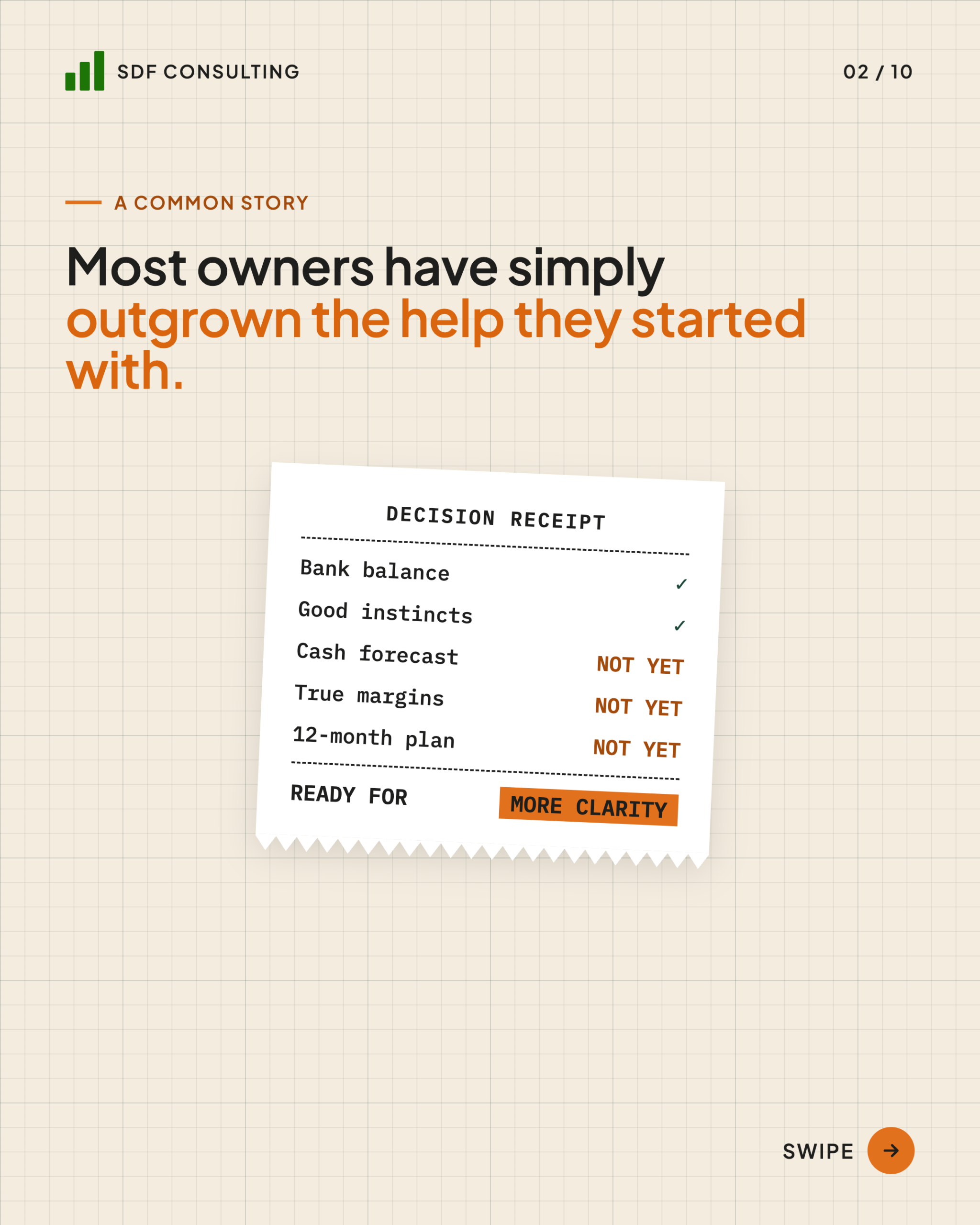
Every week I sit down with business owners who are in one of two situations. Some are paying for help they’ve outgrown, expecting their bookkeeper to answer strategic questions that were never part of the job. Others are making six- and seven-figure decisions about hiring, expansion, equipment or debt with nothing more than a bank balance and a gut feeling.
Neither is a character flaw. It’s usually a sign the business has grown faster than its finance function. The fix starts with understanding that “finance help” isn’t one thing. There are three distinct roles, and each one answers a different question.
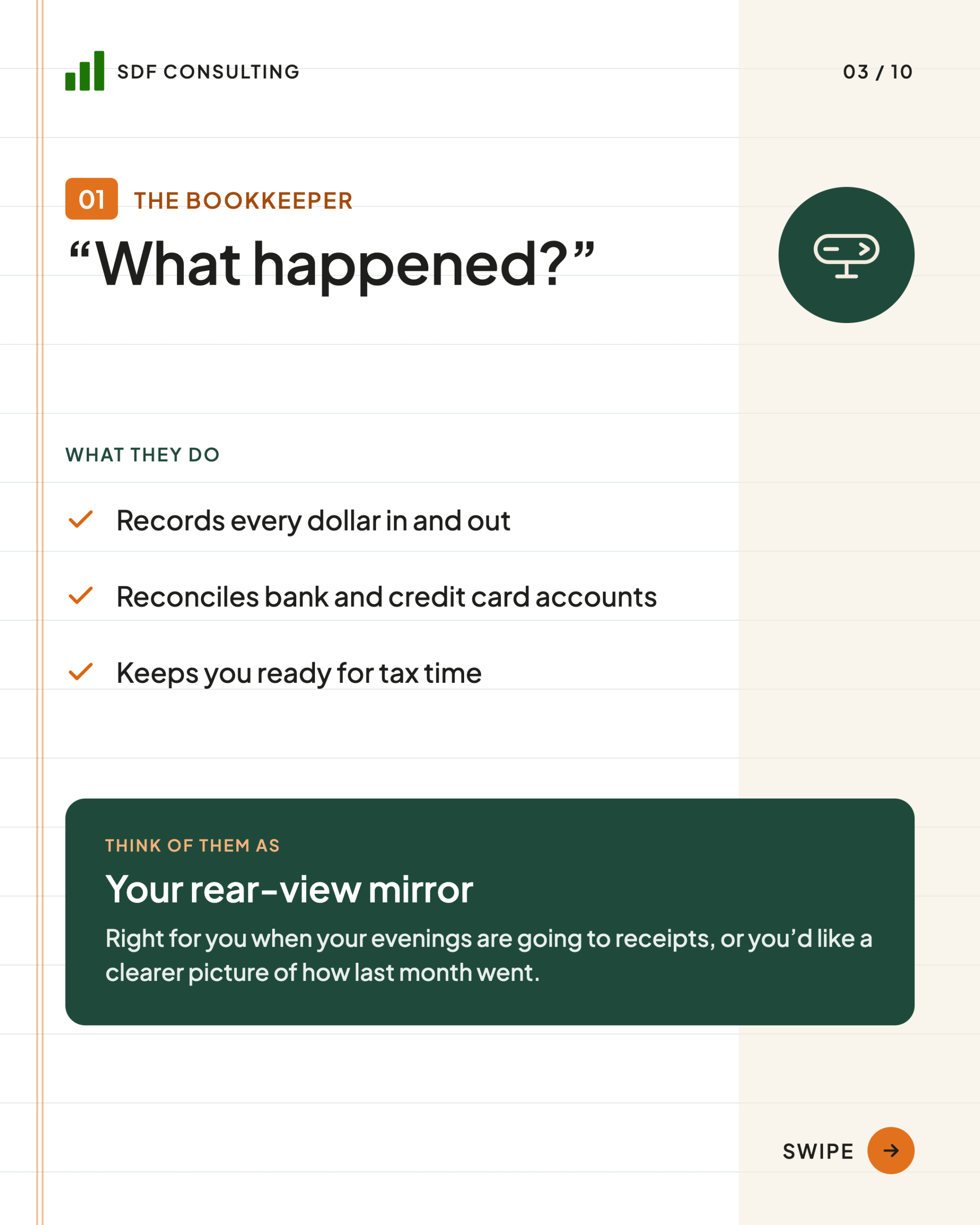
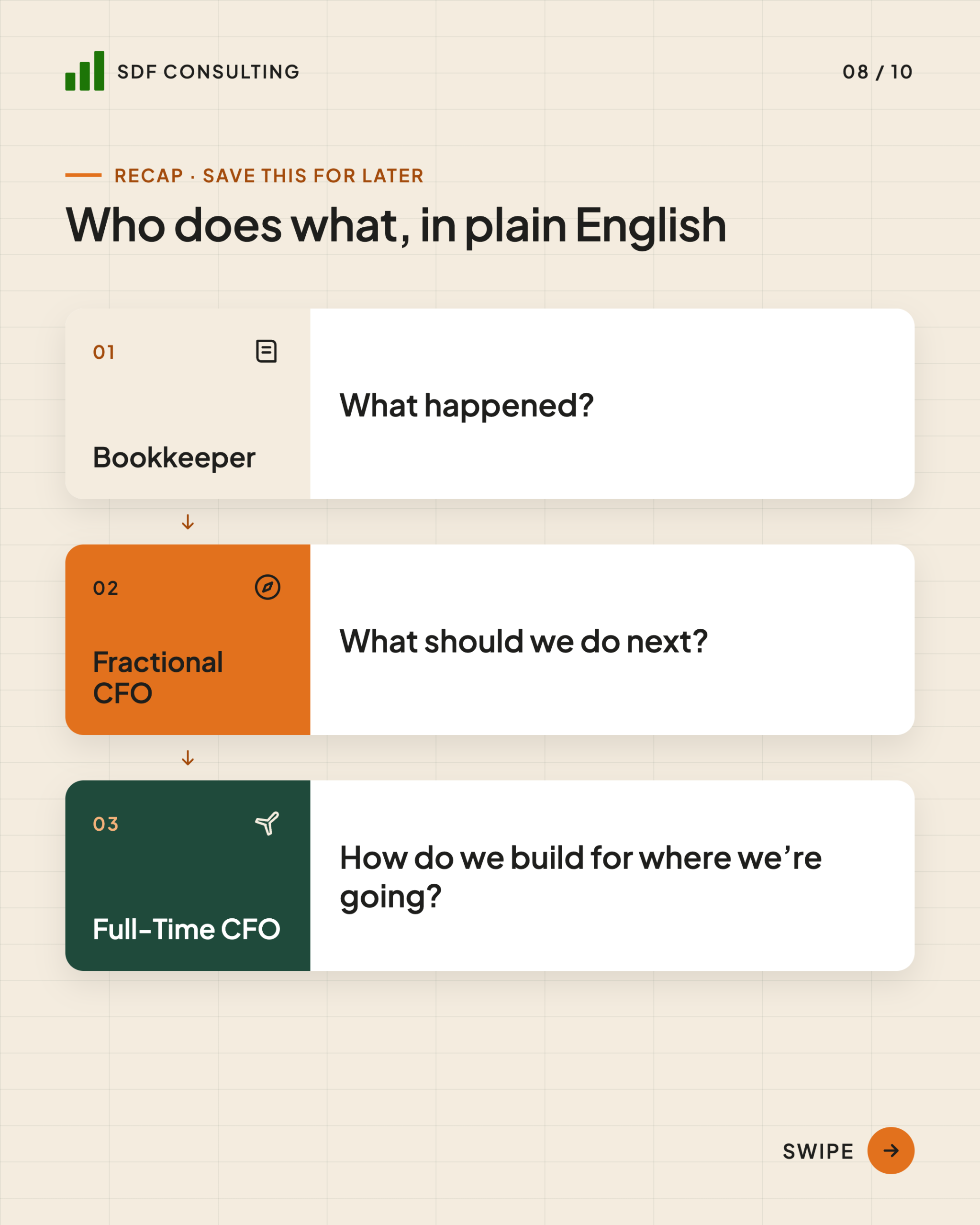
1. The Bookkeeper: “What happened?”
Your bookkeeper is the foundation of everything else. They record every dollar coming in and going out, reconcile your bank and credit card accounts, manage payables and receivables, and keep your records clean so tax season isn’t a scramble.
Think of your bookkeeper as your rear-view mirror. It’s essential, and you’d never drive without one. But it only shows you where you’ve been.
A good bookkeeper gives you accurate, timely records. What they typically don’t do is interpret those records, model scenarios, or tell you whether you can afford that next hire. That isn’t a weakness; it’s simply not the role.
You need one when:
- You’re spending your evenings sorting receipts instead of running your business
- You can’t say with confidence what you made last month
- Your accountant spends (and bills) hours cleaning up your books at year-end
- You’re not sure which customers owe you money or which bills are due
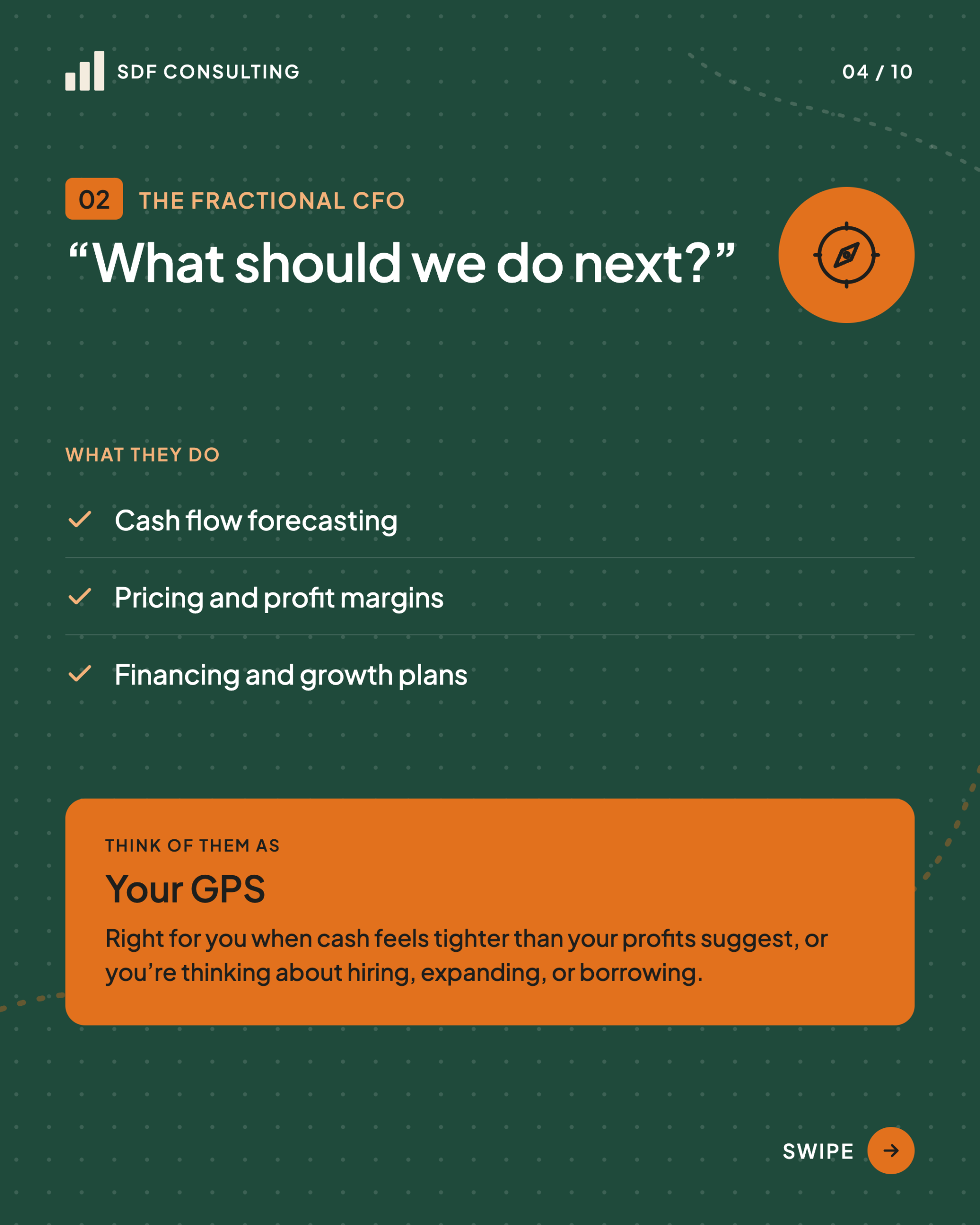
2. The Fractional CFO: “What does it mean, and what should we do next?”
A fractional CFO is a senior finance executive who works with your business part-time, often a few days a month. You get the experience and judgment of a CFO without the full-time salary, benefits and equity expectations that come with one.
Where your bookkeeper tells you what happened, a fractional CFO turns those numbers into decisions. Typical work includes:
- Cash flow forecasting, so you see shortfalls months ahead instead of days
- Pricing and margin analysis, so you know which products, services and customers actually make you money
- Budgeting and KPIs, so you have targets and can tell early when you’re off track
- Financing strategy, including preparing for conversations with your bank or investors
- Growth planning, so hiring, expansion and capital spending decisions rest on numbers, not hope
Think of a fractional CFO as your GPS. They show you the road ahead and warn you before the turn.
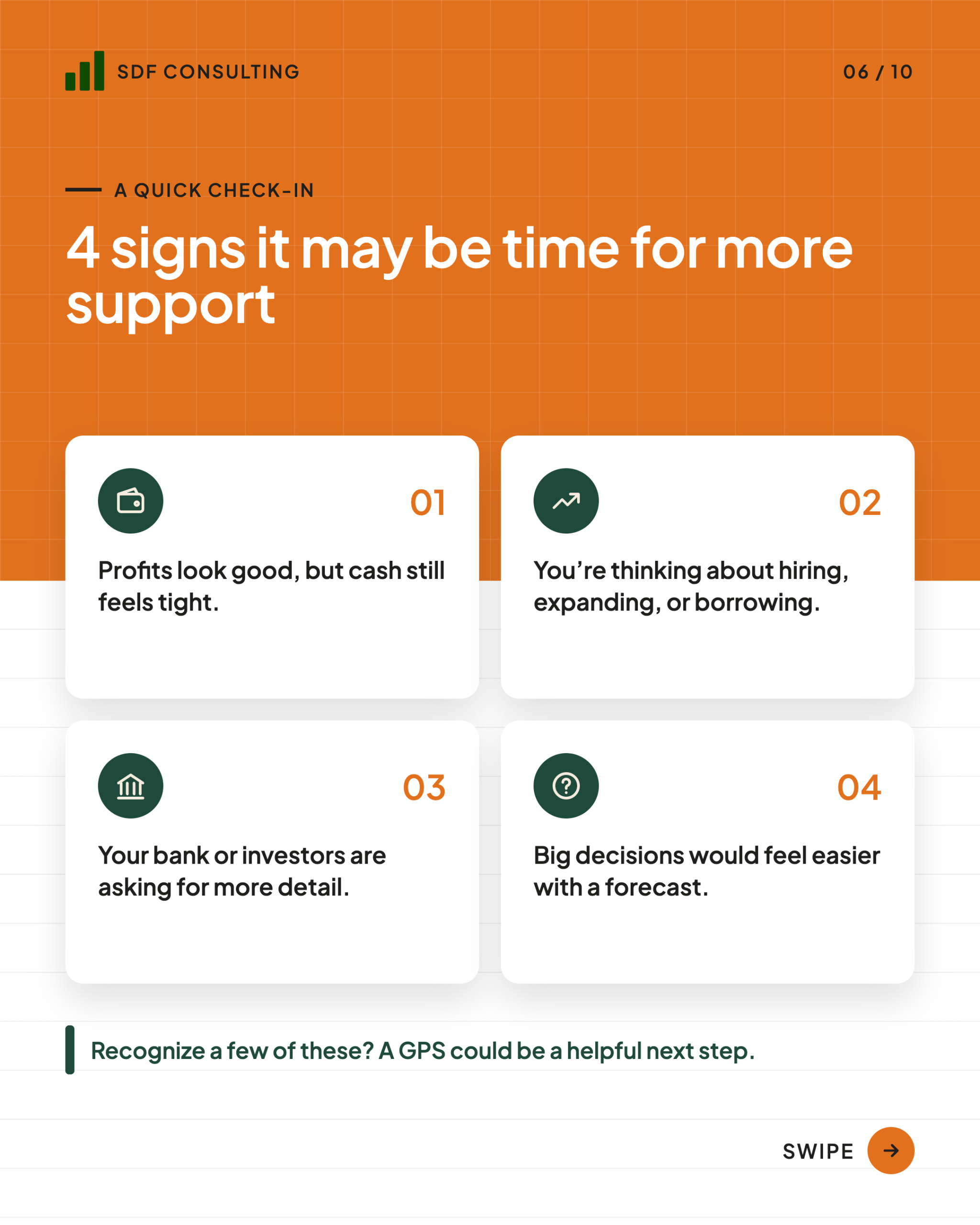
You need one when:
- You’re profitable on paper but always short on cash
- You’re thinking about hiring, expanding, or borrowing
- Your bank or investors are asking questions you can’t answer
- You’re making big decisions without a clear forecast
For many growing owner-operated businesses, this is the most underused seat at the table, and often the one with the biggest return.
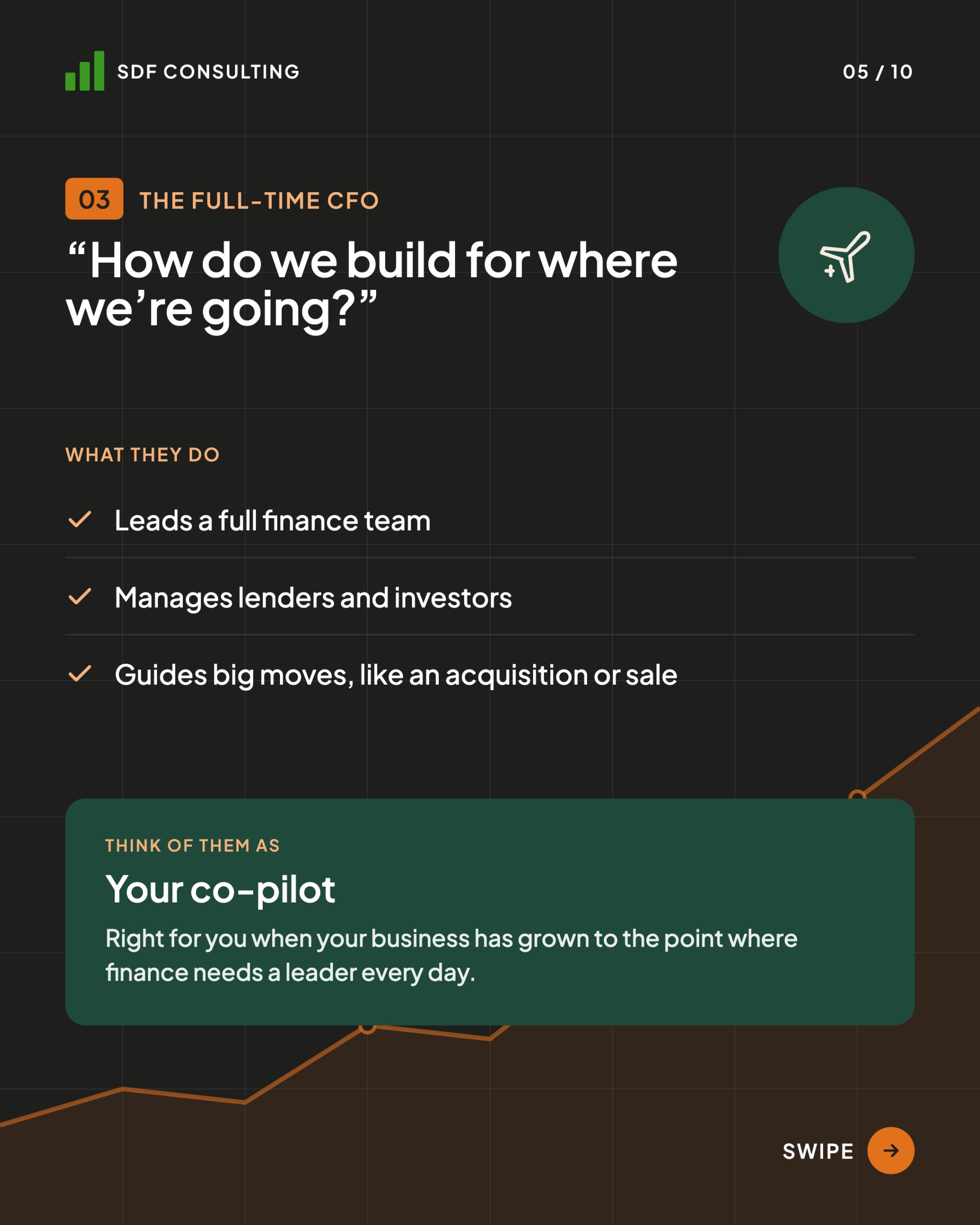
3. The Full-Time CFO: “How do we build the finance function for where we’re going?”
A full-time CFO lives inside the business every day. They lead a finance team, manage investor and lender relationships, oversee complex reporting and controls, and help drive major moves like acquisitions, capital raises, or an eventual sale.
Think of a full-time CFO as your co-pilot: strategy and finance at the leadership table, every single day.
This is a significant investment, and it should be. At this stage, the finance function isn’t just reporting on the business; it’s shaping where the business goes.
You need one when:
- Finance is complex enough that part-time leadership leaves real money, or real risk, on the table
- You’re managing multiple entities, locations, or significant debt and investor relationships
- You’re preparing for a major transaction such as an acquisition, raise or sale
- You have a finance team that needs day-to-day leadership
The mistake I see most often
Owners jump straight from “I have a bookkeeper” to “I can’t afford a CFO,” and then spend years in the gap between knowing what happened and knowing what to do about it.
That gap is expensive, even if it never shows up as a line item:
- Cash gets tight. Without a forecast, a slow quarter or a large order can catch you off guard, even when the business is profitable.
- Opportunities get missed. You hesitate on a hire, a contract or an acquisition because you can’t tell whether you can afford it.
- Owners burn out. When you’re the only person interpreting the numbers, every financial decision lands on your shoulders, usually late at night.
The fractional CFO exists precisely to close that gap. It gives you strategic finance leadership at a level of commitment, and cost, that fits where your business is today.
Ask a better question
The right question isn’t “Who can I afford?”
It’s “What decisions am I making without the information I need?”
If the honest answer is “I don’t really know what happened last month,” start with a bookkeeper. If it’s “I know my numbers, but I’m not sure what to do with them,” a fractional CFO is likely your next seat. And if your finance needs have outgrown part-time leadership, it’s time to bring a CFO in full-time.
Answer that question honestly, and you’ll know exactly which seat to fill next.
Which one is your business ready for? If you’re not sure, let’s talk. At SDF Consulting, we help owner-operators put the right financial leadership in place for where their business is today, and where it’s going. Reach out at arshad@sdfconsulting.ca