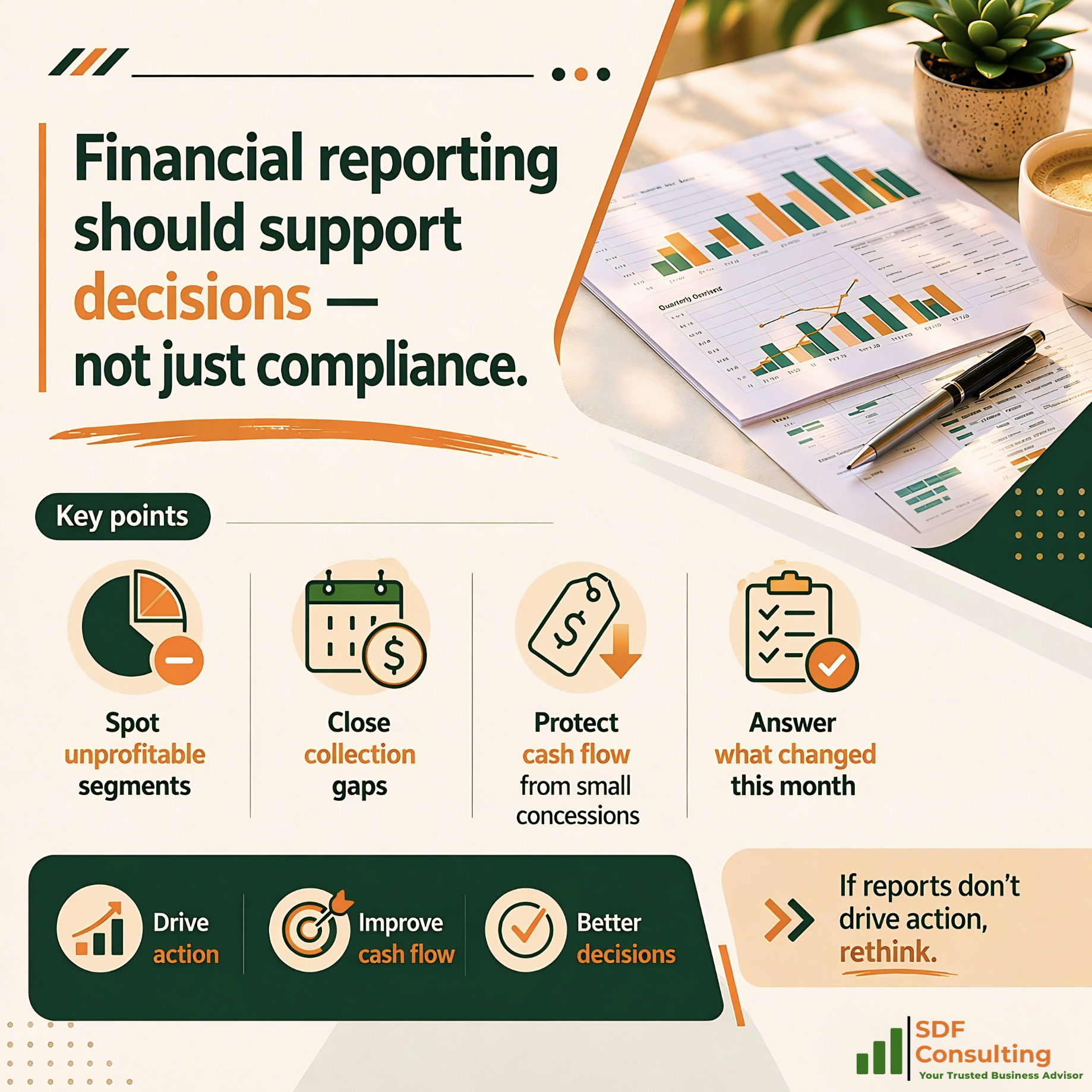

Financial reporting should support decisions—not just compliance.
Most financial reporting is built to meet compliance requirements.
Boards expect it. Auditors rely on it. Lenders require it.
That matters.
But compliance alone doesn’t help leaders run the business.
What founders and operators need from financial reporting is decision clarity—not just confirmation of what already happened.
When reporting is designed only to satisfy external requirements, it explains the past but rarely informs the next move.
When financial reporting looks right — but leads nowhere
Many businesses have accurate, well‑prepared financial statements that still fail to guide decisions.
Here’s a real‑world example.
A service business showed steady revenue growth and clean profitability. On the surface, performance looked solid.
But once the financial reporting was reframed for decision‑making, several issues became clear:
- One client segment had strong revenue but negative contribution margin
- Accounts receivable lagged payroll by several weeks, quietly tightening cash flow
- A pricing concession, made to stay competitive, reduced margins more than expected
The numbers weren’t wrong.
They just weren’t structured to answer operational questions.
The issue isn’t accuracy — it’s design
Traditional financial reports focus on totals, categories, and historical comparisons. That’s useful for validation and compliance.
It’s far less useful for leadership.
Decision‑driven financial reporting answers a different set of questions:
- What actually changed this month that requires action?
- Where are we truly making — or losing — money?
- Which decision will improve cash flow over the next 90 days?
Once reporting was rebuilt around these questions, the actions became obvious:
- Adjust pricing on one service line
- Tighten payment terms
- Pause a planned hire based on cash impact, not gut feel
Better decisions didn’t come from more data.
They came from better‑designed reporting.
How high‑performing companies use financial reporting
High‑performing companies treat financial reporting as a decision system, not a compliance exercise.
Their reports are:
- Built around operating levers, not just account balances
- Focused on trade‑offs, not perfect hindsight
- Designed for managers and owners, not just accountants
At the CFO level, the role isn’t to produce financial statements.
It’s to turn financial data into insight that improves outcomes.
Compliance protects the downside. Decision clarity creates momentum.
Compliance keeps the business safe.
Decision‑driven financial reporting moves it forward.
If your reports don’t clearly influence pricing, hiring, investment, or cash‑flow decisions, they aren’t doing their full job.
A simple way to assess your reporting:
What decision is this report meant to change?
If the answer isn’t clear, the report may be optimized for compliance — not leadership.
Final thought
Strong financial reporting isn’t about more detail.
It’s about surfacing the right information, at the right level, at the right time.
That’s when finance stops being a back‑office function
and becomes a leadership tool.