
How to choose the right kind of capital — and why the smartest owners switch between them as their business grows
At some point, every business owner runs into the same fork in the road. The business is growing, the opportunity is real, and there’s just one problem: you need money to get there. So you start asking the question almost every founder eventually asks:
“Do we borrow it, or do we sell a piece of the company?”
It sounds like a simple choice. In practice, it’s one of the most consequential decisions a business owner will make — because the type of capital you bring in doesn’t just fund your growth, it shapes how much control you keep, how much pressure you carry, and how much of the upside you get to hold onto later.
Let’s break it down.
The Two Paths: Debt and Equity
At a high level, there are two ways to bring outside money into a business: borrow it, or sell a stake in exchange for it. Each comes with a very different set of trade-offs.
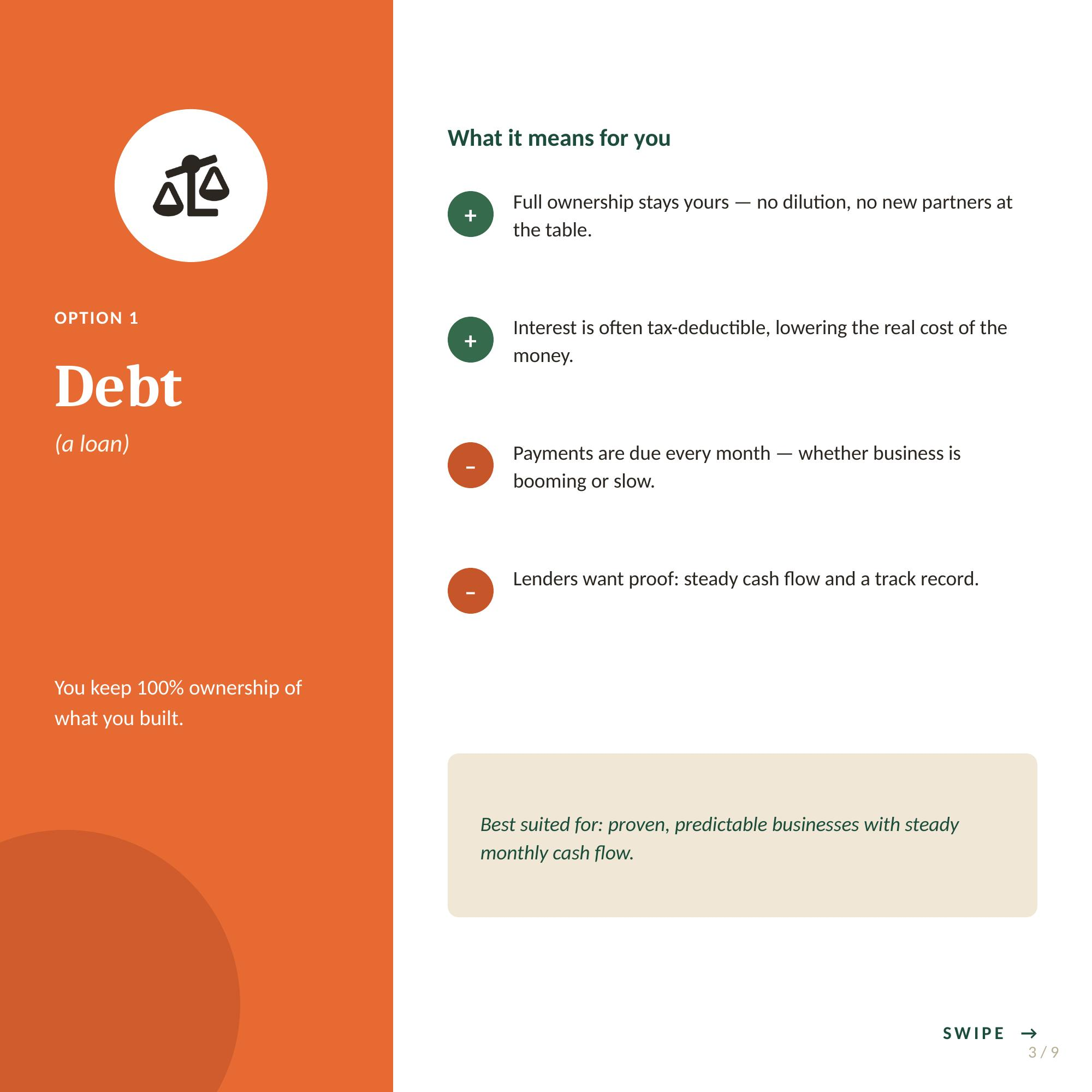
Debt (a loan)
When you take on debt, you’re borrowing money with the agreement that you’ll pay it back — usually with interest, on a set schedule.
The upside: You keep 100% ownership of your business. No investor gets a seat at the table, no one gets a slice of your future profits, and no one gets a say in how you run things. The business stays entirely yours.
The trade-off: That loan payment doesn’t care whether business is booming or slow. It’s due every single month, rain or shine. If revenue dips, the obligation doesn’t dip with it. Debt is predictable for the lender — and that predictability gets passed on to you as pressure.
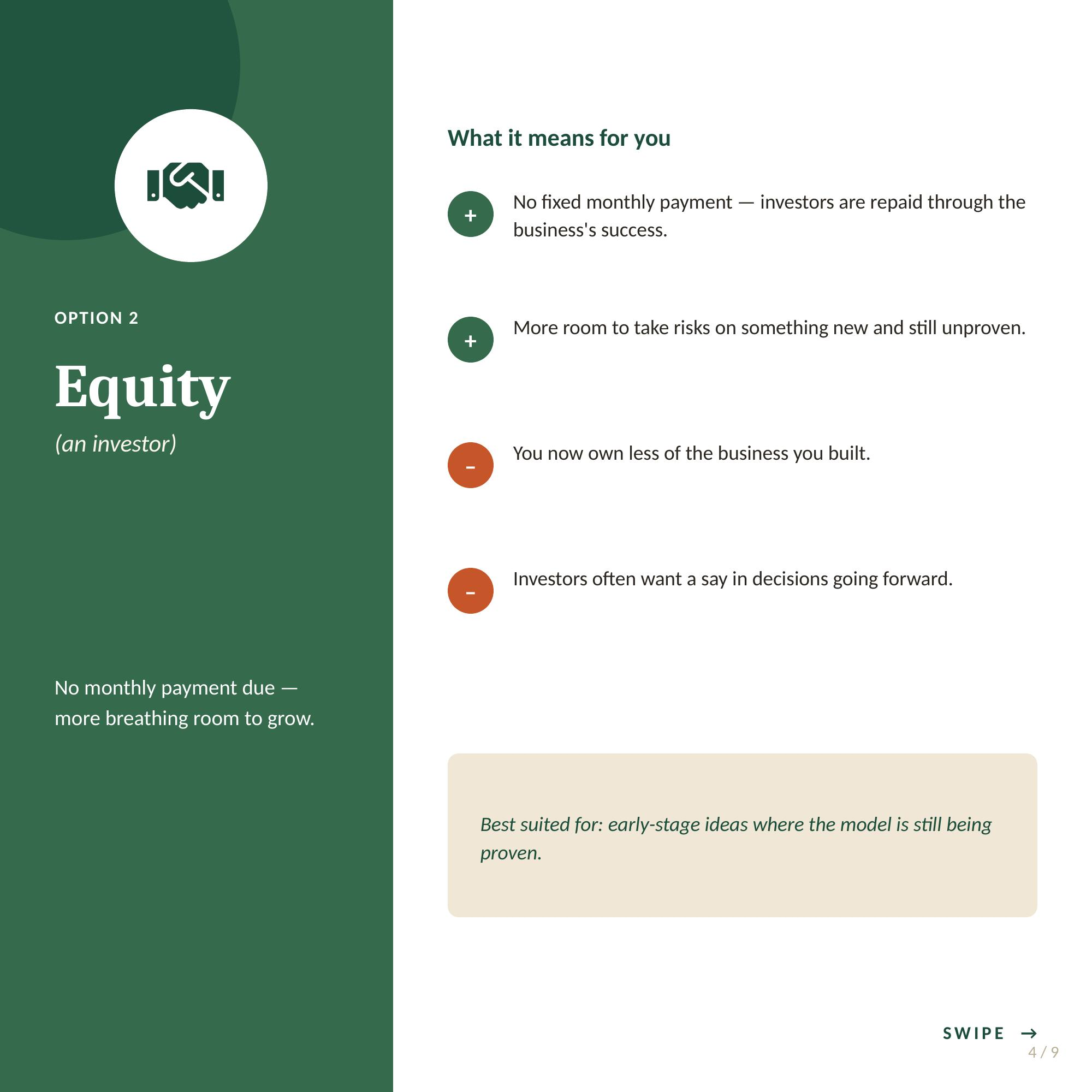
Equity (an investor)
When you raise equity, you’re bringing in a partner. In exchange for their capital, they get a percentage of ownership in your company.
The upside: There’s no monthly payment hanging over your head. If a slow month hits, you don’t have to scramble to make a fixed obligation. That breathing room can be the difference between a rough patch and a real crisis.
The trade-off: You now own less of your own business. And it’s not just about the ownership percentage on paper — an investor usually comes with opinions, expectations, and sometimes a say in decisions that used to be entirely yours to make.
Neither option is inherently “better.” They’re just built for different situations — and the smartest owners know the difference.
The Questions to Ask Before You Decide
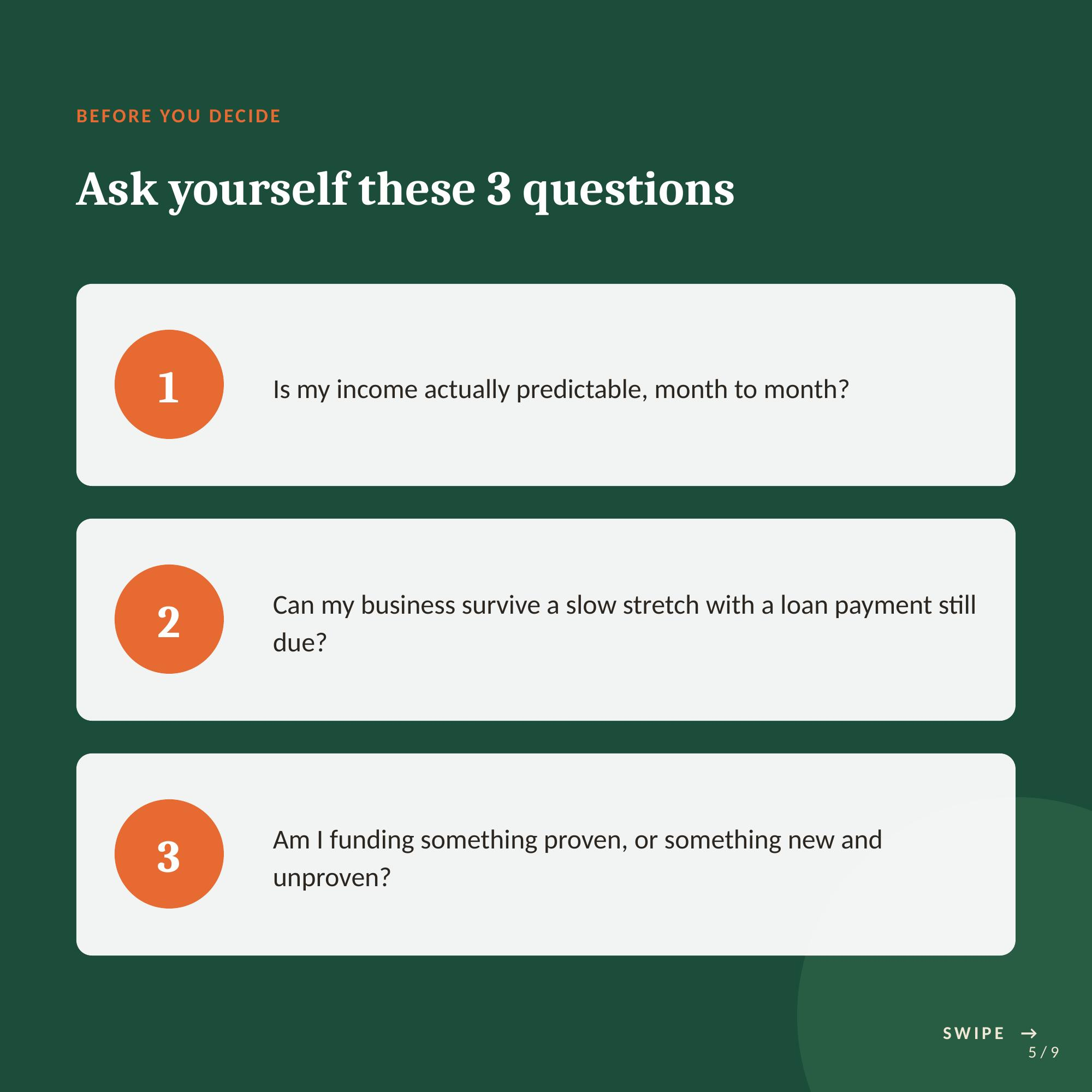
Before you sign anything — a loan agreement or a term sheet — it’s worth sitting down and honestly answering a few questions:
- Is my income actually predictable, month to month? Not “usually fine” or “mostly steady” — genuinely predictable, the kind of predictable a lender would agree with.
- Can my business survive a slow stretch with a loan payment still due? If your revenue dropped 30% for two months, would that fixed payment sink you or just sting a little?
- Am I funding something proven, or something new and unproven? Are you scaling a model that already works, or are you still testing whether the model works at all?
Your honest answers to these three questions will tell you far more about which path fits than any generic rule of thumb ever could.
Why the Best Owners Don’t Pick One and Stick With It Forever
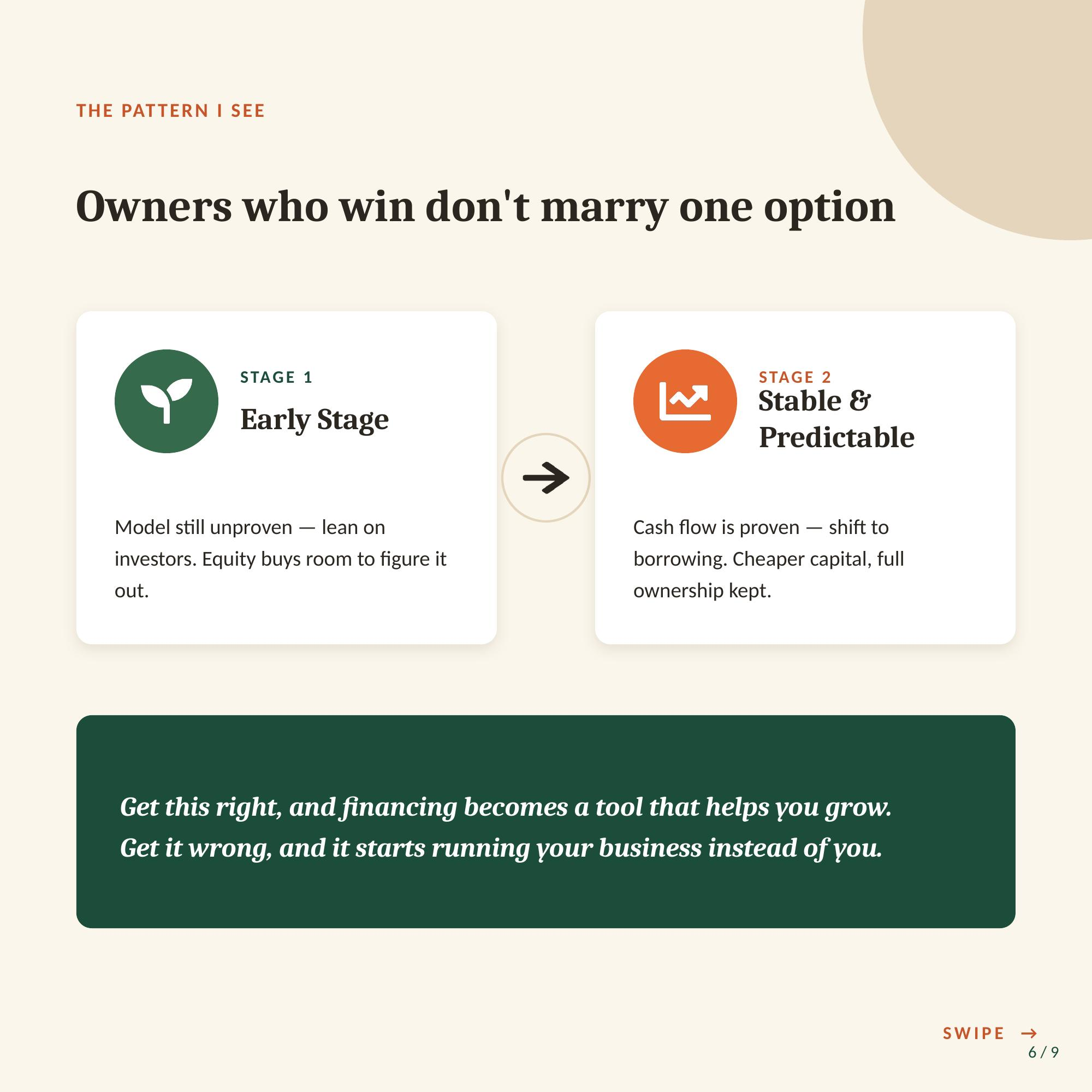
Here’s the pattern I see again and again with owners who handle financing well: they don’t marry one option for the life of their business. They match the type of capital to the stage their business is actually in.
Early on, when the model is still unproven — when you’re still figuring out if this thing actually works at scale — they lean on investors. It makes sense: equity doesn’t demand a fixed payment while you’re still finding your footing, and if things take longer than expected to click, you’re not compounding that uncertainty with a loan payment you might not be able to make.
Once the business is stable and predictable — once the revenue is consistent and the model has proven itself — they shift toward borrowing. Why? Because debt is cheaper than equity in the long run. A loan costs you interest. Equity costs you a permanent slice of everything you build from that point forward. Once you’ve de-risked the business, debt lets you grow without giving away any more of the company than you already have.
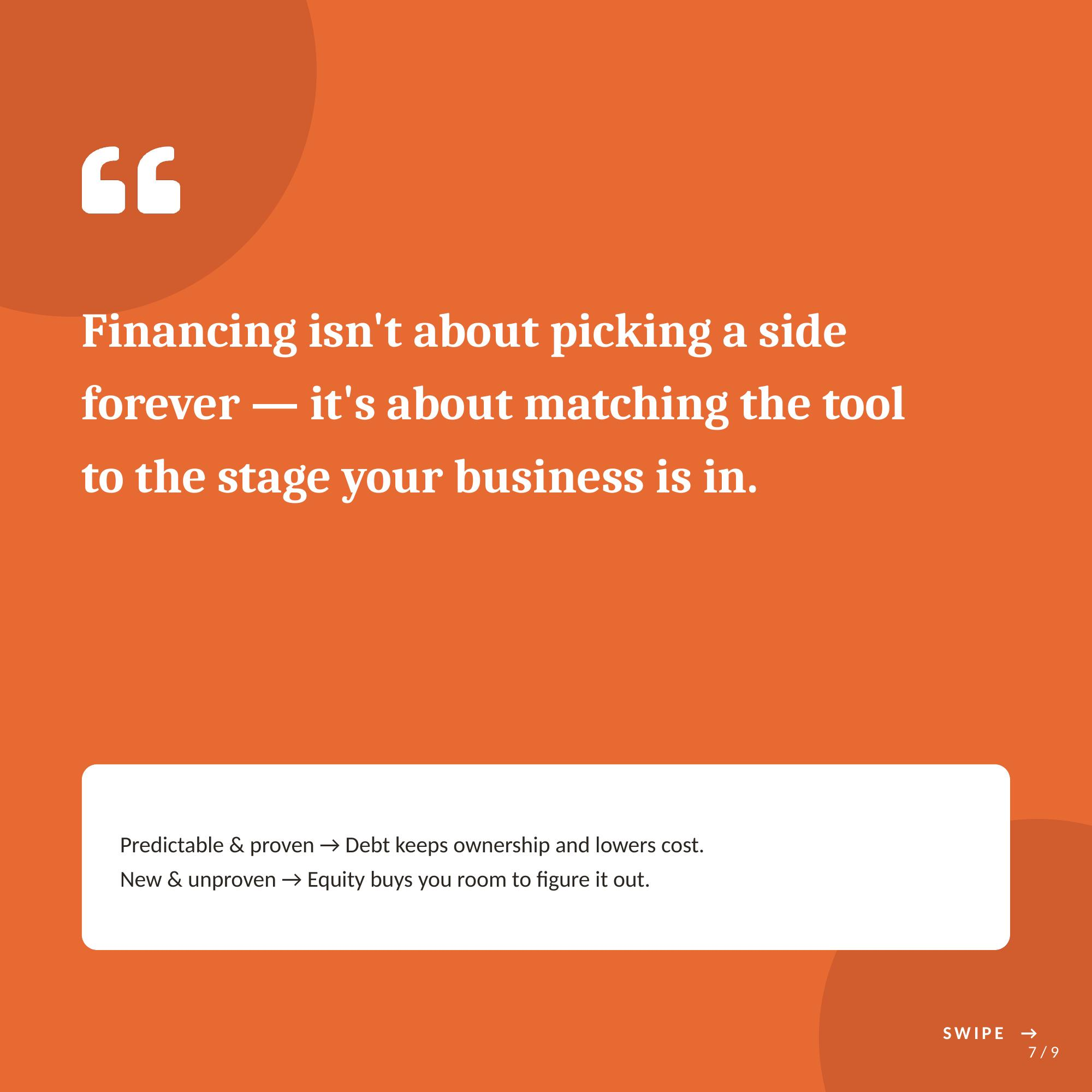
In short: equity to prove it, debt to scale it. It’s not a rule set in stone, but it’s a pattern worth understanding before you make your own call.
Financing Is a Tool — Not a Master
Get this right, and financing becomes exactly what it should be: a tool that helps you grow faster and smarter than you could on your own.
Get it wrong, and it flips. A loan payment you can’t comfortably make starts dictating decisions out of fear instead of strategy. An equity stake given away too early — before the business was even worth what you thought it was — means someone else profits from growth you built. Either way, the money that was supposed to serve your business ends up running it instead.
The goal isn’t to avoid debt or avoid investors. The goal is to be intentional — to know exactly why you’re choosing the capital you’re choosing, and to make sure it fits the stage your business is actually in, not just the stage you wish it were in.
So, How Are You Funding Your Next Stage of Growth?
Before your next funding decision, take a step back and really answer the three questions above. The right financing choice isn’t about what’s trendy or what worked for someone else’s business — it’s about what your business, right now, can actually handle.
A Final Word from SDF Consulting
Financing decisions rarely feel urgent until suddenly they are — a growth opportunity shows up, a slow month hits harder than expected, or an investor offer lands on your desk and you have thirty days to decide. The owners who navigate these moments well aren’t the ones who guessed right. They’re the ones who understood their numbers well enough, and early enough, to know exactly what their business could handle.
That’s the work we do at SDF Consulting. We sit down with business owners and go beyond the surface-level question of “debt or equity” — we look at your cash flow, your margins, your growth stage, and your risk tolerance, and help you build a financing strategy that actually fits your business instead of a generic playbook. Whether you’re weighing your first outside capital or deciding it’s finally time to shift from investors to lenders, we’re here to help you think it through clearly, before the decision is made — not after.
If your business is approaching a financing decision, we invite you to connect with us. The right conversation today can prevent a costly correction tomorrow.