
Clean Books Are the Baseline. Decision‑Ready Numbers Are the Advantage.
For many business owners, “clean books” feel like the finish line.
Transactions are categorized. Accounts are reconciled. Reports tie out. There are no red flags from the accountant.
And yet—despite technically accurate financials—decisions still feel unclear, reactive, or overly conservative.
That’s because clean books are not the goal.
They are the starting point.
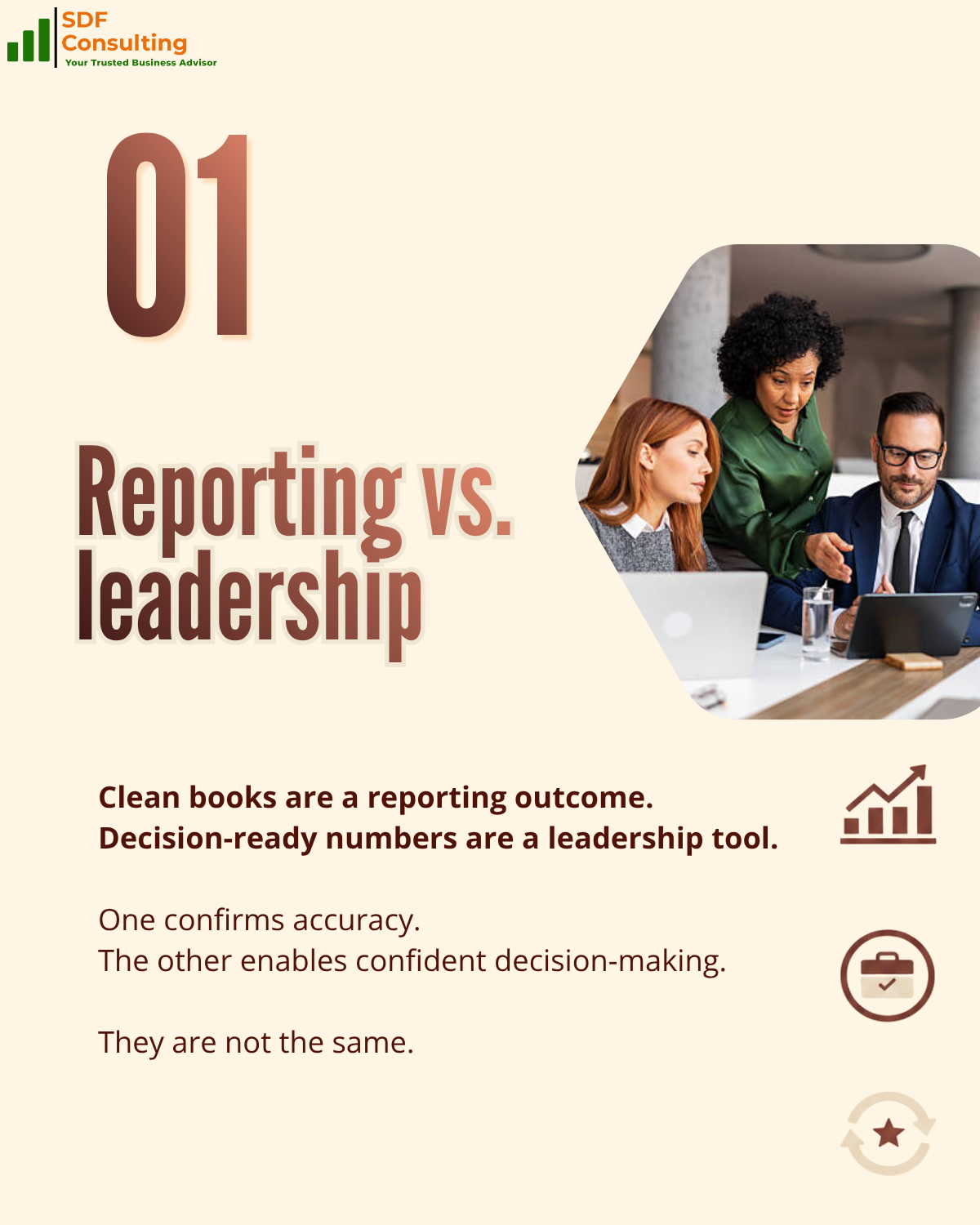
Clean books are a reporting outcome.
Decision‑ready numbers are a leadership tool.
Most financial systems are designed to answer one question: Was everything recorded correctly?
High‑performing businesses need their numbers to answer a very different set of questions.
What Clean Books Actually Tell You
Clean books are essential—but limited.
At their best, they tell you:
- What was recorded
- What reconciled
- What balances exist at month‑end
They confirm that the financial picture is internally consistent and compliant. That matters. You cannot build anything meaningful on inaccurate data.
But clean books are largely historical and passive. They describe what happened, not what it means.
They don’t tell you:
- Where profit is really coming from
- Which activities look productive but quietly drain resources
- When cash risk is beginning to build—months before it becomes urgent
- Which operational or strategic levers management can safely pull
In other words, they don’t inform leadership decisions. They simply document outcomes.
What Decision‑Ready Numbers Do Differently
Decision‑ready numbers are intentionally designed for use, not storage.
They translate financial activity into insights that directly support leadership.
They help you:
- Identify true profit drivers versus volume or effort traps
- Understand margin at the customer, product, or service level
- Separate fixed strain from variable inefficiency
- Anticipate cash pressure long before it shows up in the bank balance
- Make confident decisions around pricing, hiring, budgeting, and growth
These numbers are structured, analyzed, and contextualized. They don’t just balance—they explain.
This is where accounting stops being transactional and starts becoming strategic.
Accuracy Is Not Enough
Accounting is often framed as a technical discipline focused on correctness.
But accuracy without interpretation creates false confidence.
You can have perfectly clean books and still:
- Underprice your services
- Scale unprofitable segments
- Hire ahead of sustainable cash flow
- Cut the wrong costs during challenging periods
- Chase revenue that weakens the business
If your financials don’t clearly influence key decisions—pricing, headcount, capital allocation, or growth strategy—the problem isn’t cleanliness.
It’s usefulness.
The Shift High‑Performing Businesses Make
The most successful businesses don’t “review” their numbers once a month.
They use them continuously.
They expect their financials to:
- Highlight risk before it becomes damage
- Create clarity instead of reassurance
- Support confident trade‑offs, not hindsight explanations
This requires a shift in how bookkeeping and accounting are approached.
Not as a compliance task.
Not as a monthly chore.
But as an analytical system designed to support leadership.
When bookkeeping stops being purely transactional and starts becoming analytical, the numbers stop being historical records and start becoming operational tools.
That’s the difference between knowing what happened—and knowing what to do next.
Clean Books Are the Baseline. Not the Finish Line.
Every serious business needs clean books.
But clean books alone do not create clarity. They do not reduce risk. They do not drive better decisions.
Decision‑ready numbers do.
They are what allow leaders to move from reacting to results to actively shaping them.
Clean books are the baseline.
Decision‑ready numbers are the advantage.
And the businesses that understand this don’t just track performance—they lead with it.