
For many business owners, getting the books up to date brings a real sense of relief—and rightly so. Clean, accurate financials are critical. They keep you compliant, organised, and aware of what’s happening behind the scenes.
Bookkeeping is the foundation of a well‑run business.
But it’s important to recognise what bookkeeping does—and what it doesn’t do.
What Your Books Really Tell You
At its core, bookkeeping is historical.
It tells you what already happened:
- How much revenue you generated
- What you spent
- Where cash came from and where it went
- Whether things went up or down last month
That clarity is essential. Without it, you’re flying blind.
But once the numbers are clean and accurate, many owners still find themselves asking:
- Can I afford to hire right now?
- Are my margins actually healthy?
- Why does cash feel tight despite strong sales?
- What should I prioritise over the next 6–12 months?
Those questions don’t get answered by bookkeeping alone.
Where CFO‑Level Thinking Comes In
This is where CFO‑level thinking makes the difference.
CFO‑level thinking doesn’t mean more reports or more complicated spreadsheets. It means taking the financial data you already have and using it to drive better decisions.
Instead of just reviewing what happened, the focus shifts to:
- What the numbers are really telling you
- What trade‑offs you’re making (often without realizing it)
- How today’s decisions affect cash, risk, and growth tomorrow
With a CFO lens, financials become a decision‑making tool—not just a compliance requirement.
Case Example: Clean Books, But Unclear Decisions
To make this real, here’s a simplified example we see often.
A growing services business had clean, up‑to‑date books.
Revenue was increasing steadily. Profit looked reasonable on paper.
Yet the owner felt stuck.
“Sales are up, but I don’t feel confident hiring.
Cash always feels tight.
I don’t know whether to push growth or slow things down.”
From a bookkeeping perspective:
Everything was fine. The numbers were accurate and timely.
From a CFO perspective:
A few issues quickly surfaced:
- Jobs were priced without a clear margin target
- A small number of clients consumed a disproportionate amount of time
- Growth was being funded by short‑term cash rather than sustainable operating cash flow
With CFO‑level thinking applied, the focus shifted to:
- Repricing select services based on true delivery costs
- Adjusting client mix instead of adding headcount immediately
- Building a rolling 6‑month cash forecast to remove uncertainty
No overhaul. No complexity. Just better interpretation and prioritization.
Within months, the owner felt confident making decisions again—not because the books changed, but because the lens changed.
From Clarity to Direction
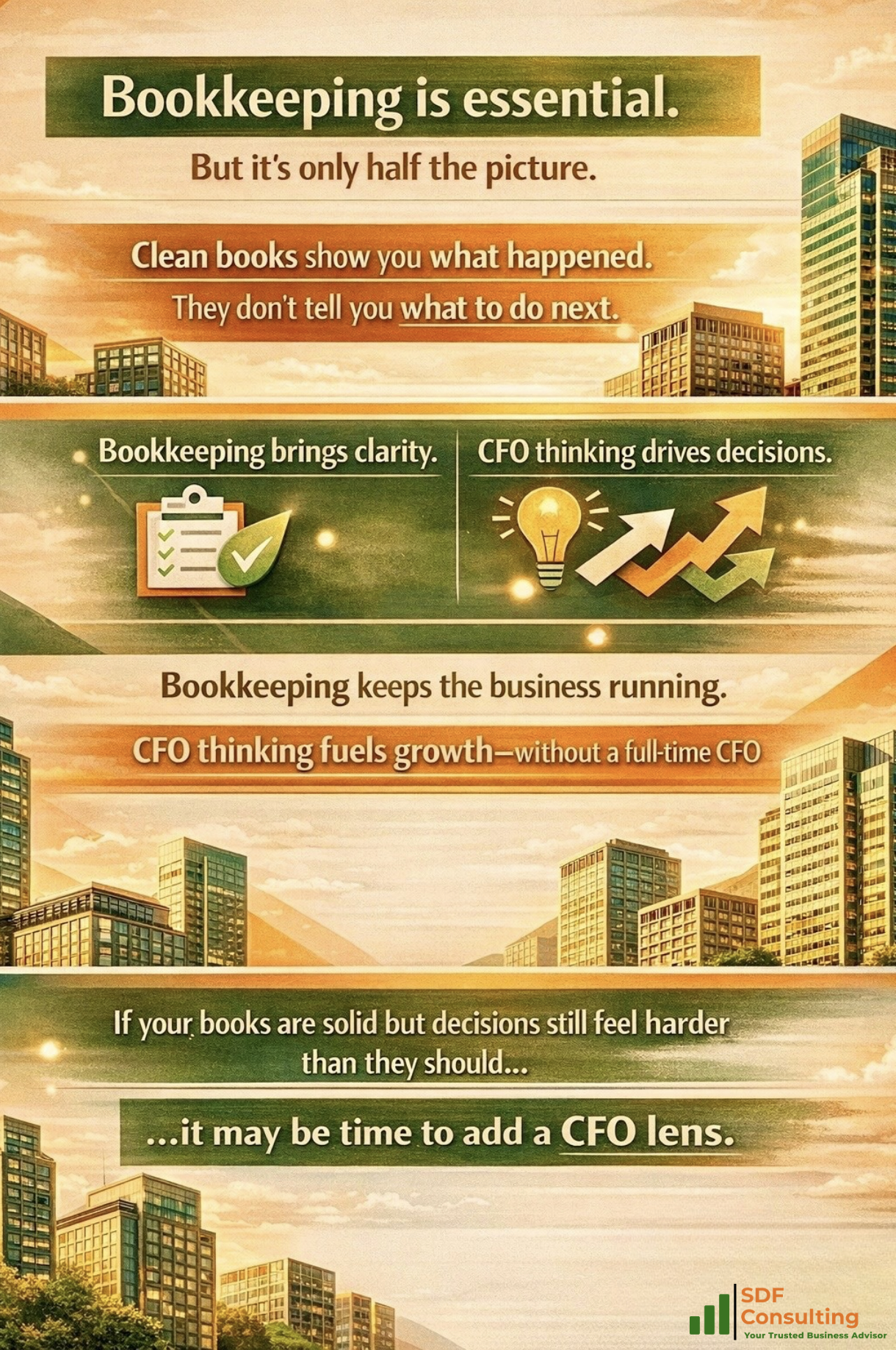
Bookkeeping gives you clarity.
CFO‑level thinking gives you direction.
It connects the dots between:
- Revenue and capacity
- Profitability and pricing
- Cash flow and growth plans
- Risk today and consequences later
This is how businesses move from reacting to the past to planning intentionally for the future.
Hiring decisions become proactive instead of rushed.
Pricing decisions are grounded in margins, not gut feel.
Cash is managed with confidence, not anxiety.
Why the Combination Matters
When bookkeeping and CFO‑level thinking work together, the impact is powerful.
You stop asking, “What just happened?”
And start asking, “What should we do next?”
That shift is often the difference between:
- Growing revenue but feeling stretched
- Versus growing intentionally and sustainably
It’s not about having more numbers.
It’s about having the right perspective on the numbers you already have.
The Bottom Line
Bookkeeping keeps the business running.
CFO‑level thinking helps it grow—without the need for a full‑time CFO.
For many business owners, the challenge isn’t data. It’s interpretation, prioritization, and confident decision‑making.
If your books are solid but decisions still feel harder than they should, adding a CFO lens may be the missing piece.