
How to Review Your Bookkeeper’s Work
You don’t need to be an accountant to know your books are in good hands. You need five minutes a month and four simple checks.
Most business owners trust their bookkeeper completely. That trust is usually well placed. But very few owners ever look at the work itself. They see a tax return once a year, or a number when the bank asks for one, and assume everything in between is fine.
This guide walks you through a short monthly routine. No accounting terms, no spreadsheets to build. Just what to look at, what it means, and what to ask.
Why this matters
Your books are the map you use to run your business. If the map is wrong, every decision built on it is wrong too.
Inaccurate books can lead you to:
- Think you have more cash than you do, and overspend
- Underprice your work because you can’t see your true costs
- Miss errors until tax time, when they are harder and more expensive to fix
- Get surprised by HST or payroll remittances you didn’t plan for
Most bookkeeping problems are small when they start. A missed transaction or a wrong category is a five-minute fix in the month it happens. Left for a year, it becomes a clean-up project that you pay for.
Check 1: Does the bank balance match?
The balance in your bookkeeping software should match your actual bank statement at month-end. This is the single most important check.
How to do it: Open your bank statement for the last day of the month. Then open your bookkeeping software (QuickBooks, Xero or similar) and find the balance for the same account on the same date. Do the same for any credit cards and loans.
What it means: If your books say $42,000 and your bank says $38,000, something is missing or counted twice. It might be a deposit recorded twice, a cheque that was never entered, or a fee nobody picked up.
What good looks like: The numbers match to the dollar. Your bookkeeper calls this a “bank reconciliation,” and it should be done every month for every account. Ask to see it.
Check 2: Is anything sitting in “uncategorized”?
Every dollar in and out of your business should be sorted into a category, like rent, supplies, sales or wages. Anything not yet sorted lands in an account called “uncategorized” or “ask my accountant.”
How to do it: In your software, look for accounts named “Uncategorized Income,” “Uncategorized Expense” or “Suspense.” Check the balance in each.
What it means: Think of it as the junk drawer of your books. A few recent items is normal. A large or growing pile means transactions aren’t being sorted, so your profit number is really a guess. It can also mean you’re missing deductions you’re entitled to at tax time.
What good looks like: Close to zero at month-end, and anything left over has a reason your bookkeeper can explain.
Check 3: Did the month close on time?
“Closing the month” means your bookkeeper has finished recording, sorting and checking everything for that month. After that, the numbers are final and ready to use.
How to do it: Ask your bookkeeper when last month was closed. Better still, agree on a standard date, such as the 15th of the following month.
What it means: If last month is still “in progress” weeks later, you’re making decisions on old information. Ongoing delays can also be an early sign your bookkeeper is overloaded, or that something is being avoided.
What good looks like: The month is closed within two to three weeks of month-end, on a predictable schedule, with a short summary sent to you.
Check 4: Ask “What looked unusual this month?”
This one question tells you more about your bookkeeper than any report. Ask it, then listen.
What a good answer sounds like:
- “Your supplier raised prices about 8%, so cost of goods is up.”
- “Two customers are over 60 days late on invoices.”
- “There’s a $340 charge on the credit card I couldn’t match to a receipt.”
- “Revenue dipped, but that’s normal for this time of year.”
What it means: A good bookkeeper doesn’t just enter numbers. They notice patterns and flag what doesn’t fit. If they have an answer ready, they’re paying attention to your business, not just processing it.
What to watch for: If the answer is “nothing” every single month, that’s worth a second conversation. Every business has something unusual most months.
Red flags and what to do
One miss is usually a simple fix. A pattern is worth acting on.
| What you notice | What it might mean | What to do |
|---|---|---|
| Bank balance doesn’t match, month after month | Reconciliations aren’t being done | Ask to see the reconciliation report each month |
| “Uncategorized” keeps growing | Work is falling behind | Ask for a catch-up date, then check it |
| Month close keeps slipping | Bookkeeper is overloaded | Agree on a fixed close date in writing |
| Vague or defensive answers | Unclear grasp of your books | Get a second opinion on a sample month |
| HST or payroll remittance surprises | Filings aren’t being planned | Ask for a calendar of upcoming deadlines |
If something feels off and you can’t get a clear answer, an independent review of a few months of books can confirm whether there’s a real problem. It’s far cheaper than a year-end clean-up.
This isn’t about mistrust
Checking your books isn’t a sign you doubt your bookkeeper. The best bookkeepers welcome these questions. It shows you value their work, and it gives them a regular chance to raise concerns before they grow.
It’s simply how you stay close to your own business.
Your monthly routine:
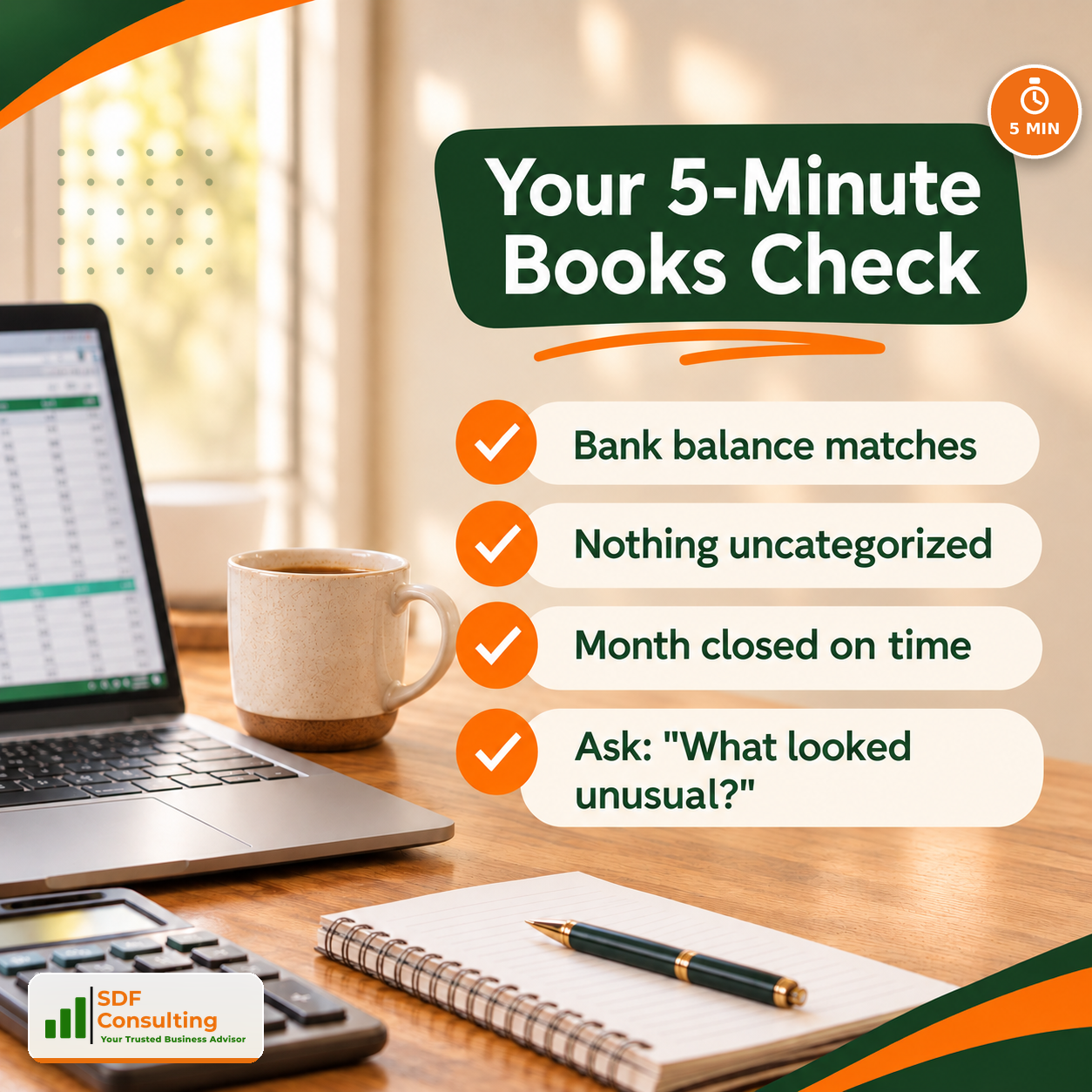
- Bank balance matches
- Nothing uncategorized
- Month closed on time
- Ask: “What looked unusual?”
Put 15 minutes in your calendar for the third week of each month. Five minutes for the checks, ten for the conversation.
When did you last look over your numbers with fresh eyes?
SDF Consulting helps owner-operators understand their numbers and make confident decisions. If you’d like a second set of eyes on your books, visit sdfconsulting.ca to get in touch.