
Most cash problems aren’t profit problems. They’re timing problems.
I hear the same story from owner-operators every month. Sales are up. The accountant says the business made money last year. And yet, every second Thursday, there’s a knot in your stomach about whether payroll will clear.
If that sounds familiar, you’re not doing anything wrong. You’re running into one of the most common and least understood numbers in business: the cash conversion cycle. Once you understand it, a lot of cash-flow stress starts to make sense, and you can do something about it.
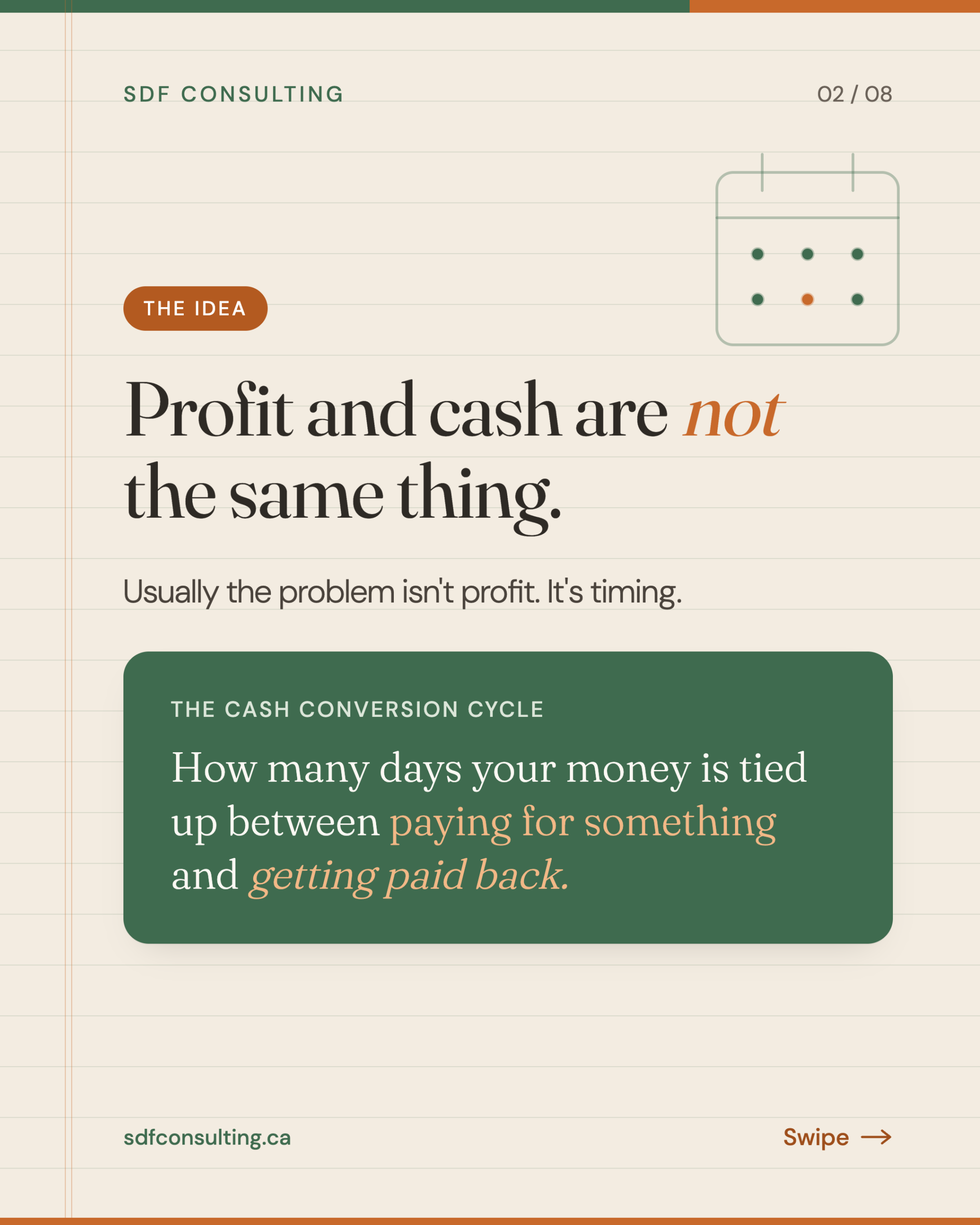
Profit and cash are not the same thing
The cash conversion cycle is how many days your money is tied up between paying for something and getting paid back.
Profit tells you whether you earn more than you spend over a period. Cash tells you whether the money is actually in your account today. A business can be profitable on paper and still run short, because the money it earned is sitting on shelves or in customers’ unpaid invoices.
The longer your cycle, the more of your own cash is out working for other people: funding your inventory, and funding your customers while they decide when to pay you.
Follow one dollar through your business
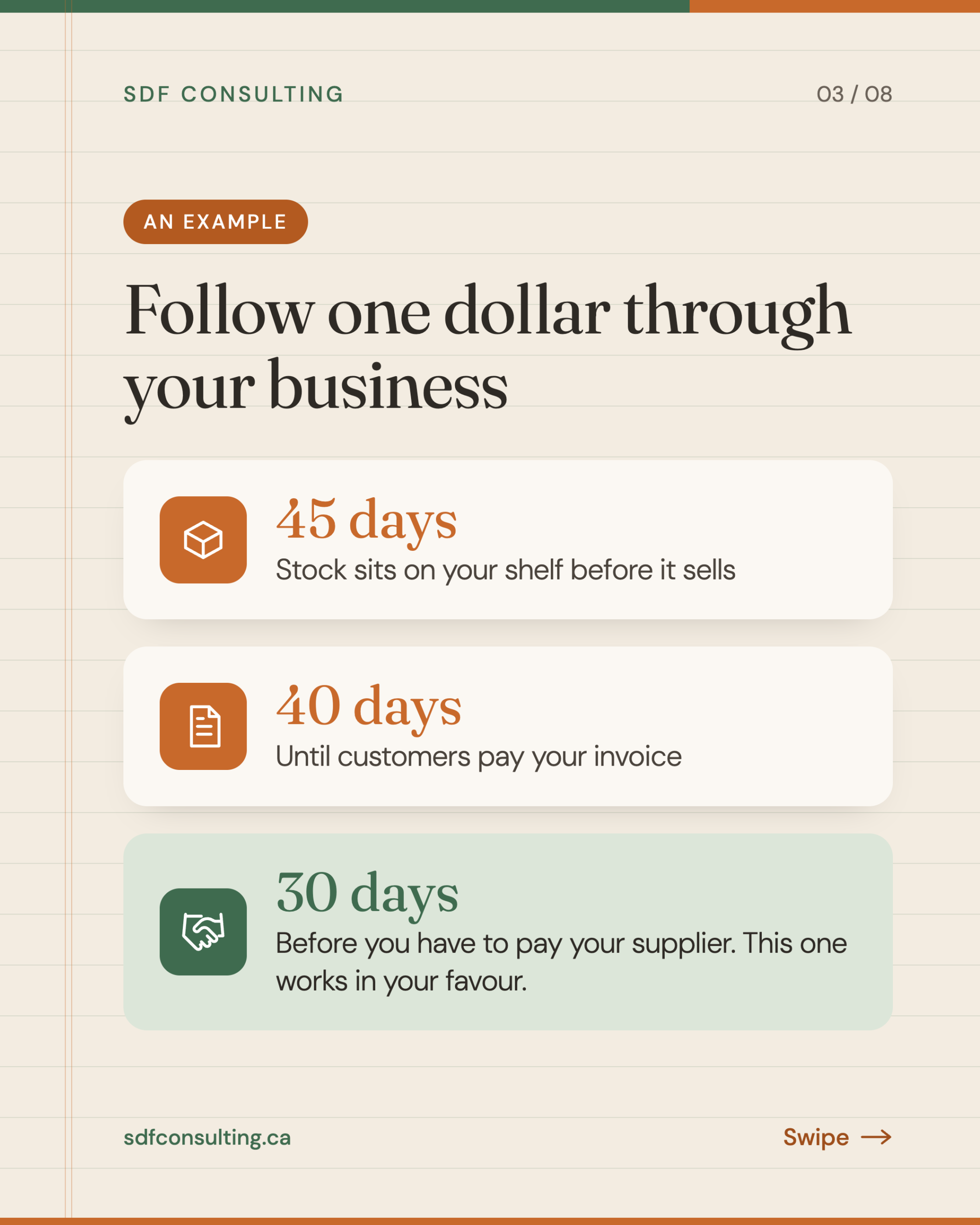
The cycle has three parts. Here they are for a typical product business:
45 days on the shelf. You buy stock, and it sits for 45 days before it sells.
40 days waiting to be paid. You invoice the customer, and they take 40 days to pay.
30 days of supplier terms. Your supplier gives you 30 days to pay them. This one works in your favour.
The first two parts keep your cash locked up. The third one helps, because for those 30 days you’re using the supplier’s money instead of your own.
The math, and what it costs you
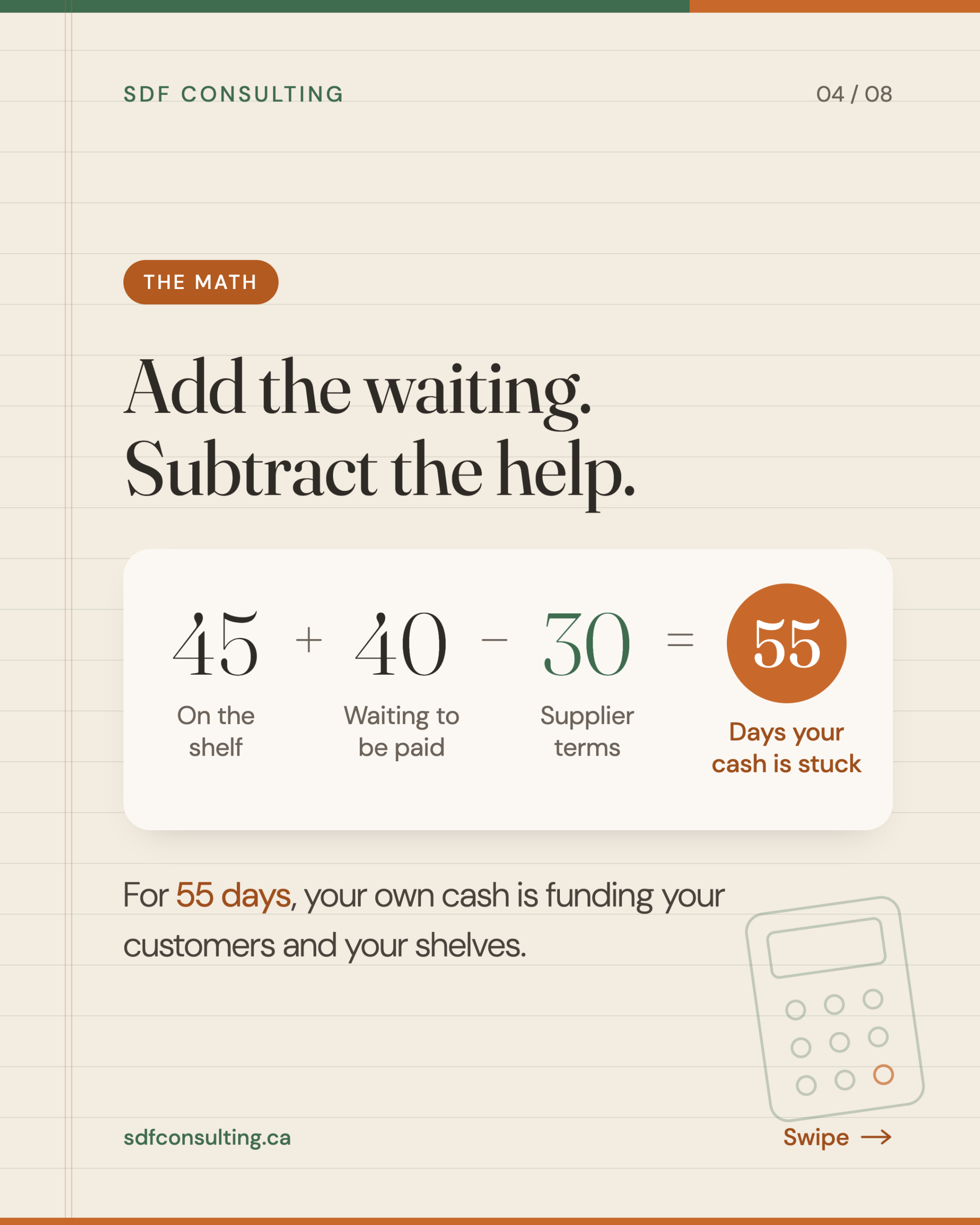
Add the waiting, then subtract the help:
45 days on the shelf, plus 40 days waiting to be paid, minus 30 days of supplier terms, equals 55 days.
For 55 days, your own cash is funding your customers and your shelves.
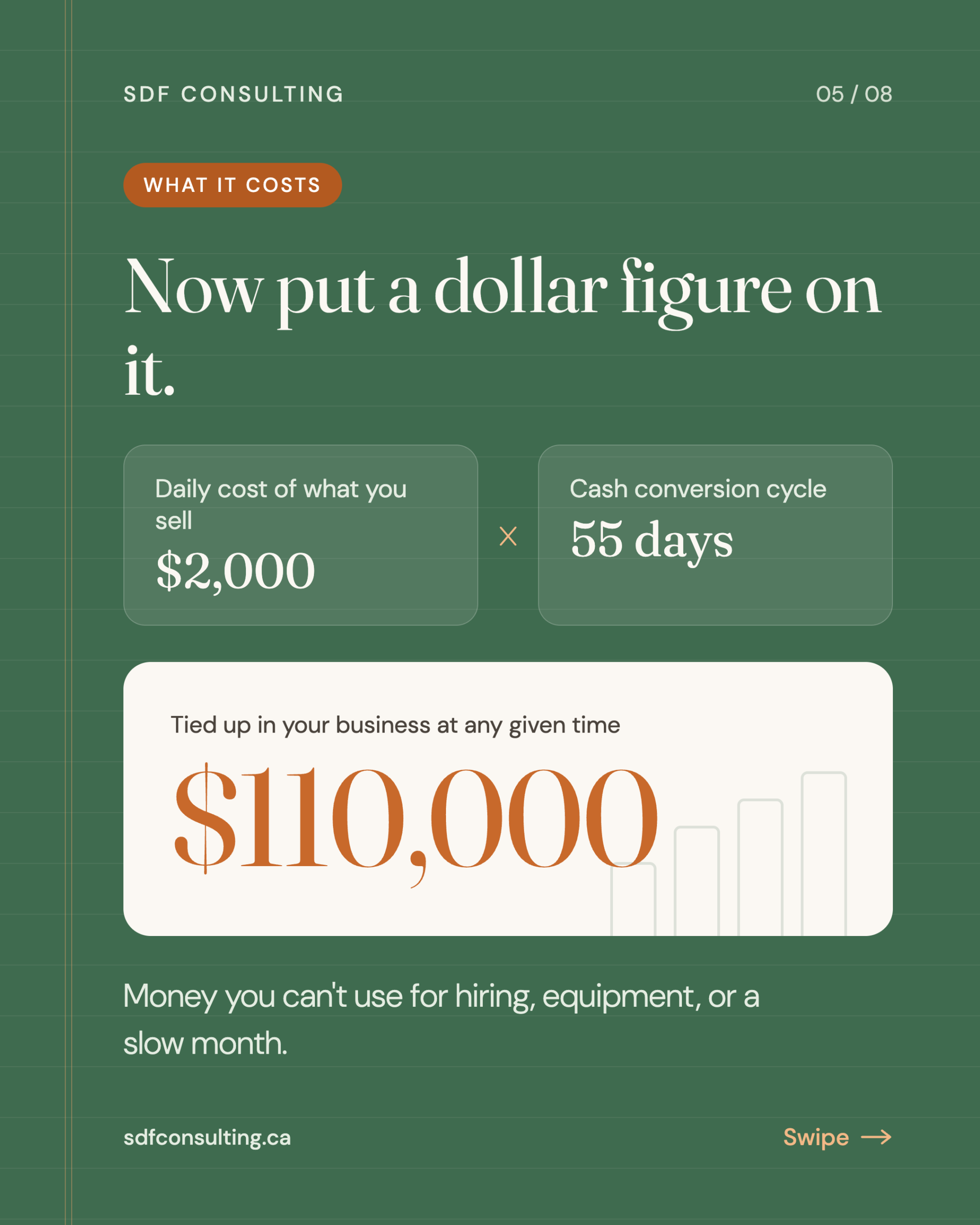
Days are hard to feel, so put a dollar figure on it. If the cost of what you sell runs about $2,000 a day, then 55 days × $2,000 means roughly $110,000 is tied up in the business at any given time.
That’s money you can’t use to hire, buy equipment, take on a bigger order, or get through a slow month. It isn’t lost. It’s just stuck, and stuck cash can feel exactly like no cash.
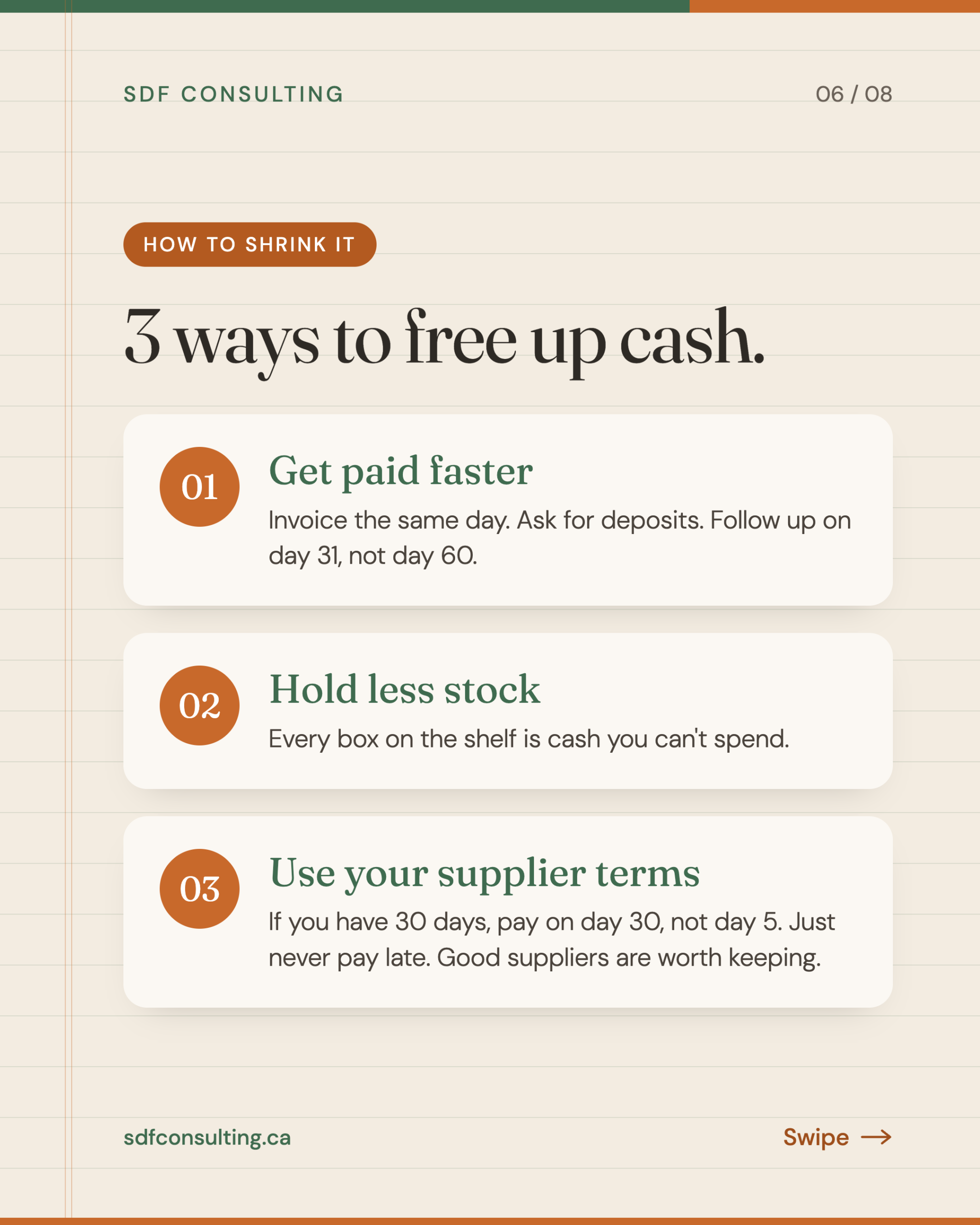
3 ways to free up cash
The good news: there are only three levers, and each one maps to a part of the cycle.
1. Get paid faster
Every day a customer takes to pay is a day your cash is working for them.
- Invoice the same day the work is done or the goods ship, not at month end.
- Ask for deposits or progress payments on larger jobs.
- Follow up on day 31, not day 60. A friendly reminder the day after the due date works better than a tense call weeks later.
- Make paying easy: e-transfer, card or online payment links.
2. Hold less stock
Every box on the shelf is cash you can’t spend.
- Know which products sell quickly and which sit. Reorder the fast movers and cut back on the slow ones.
- Order smaller amounts more often where your suppliers allow it.
- Clear out old stock, even at a discount. Cash in hand beats inventory gathering dust.
3. Use your supplier terms
If a supplier gives you 30 days, that’s 30 days of free financing.
- Pay on day 30, not day 5. Schedule payments for the due date instead of paying bills as they arrive.
- Ask for longer terms once you’ve built a good track record.
- Just never pay late. Good suppliers are worth keeping, and a damaged relationship costs far more than a few days of cash.
The payoff: cut 15 days, free up about $30,000
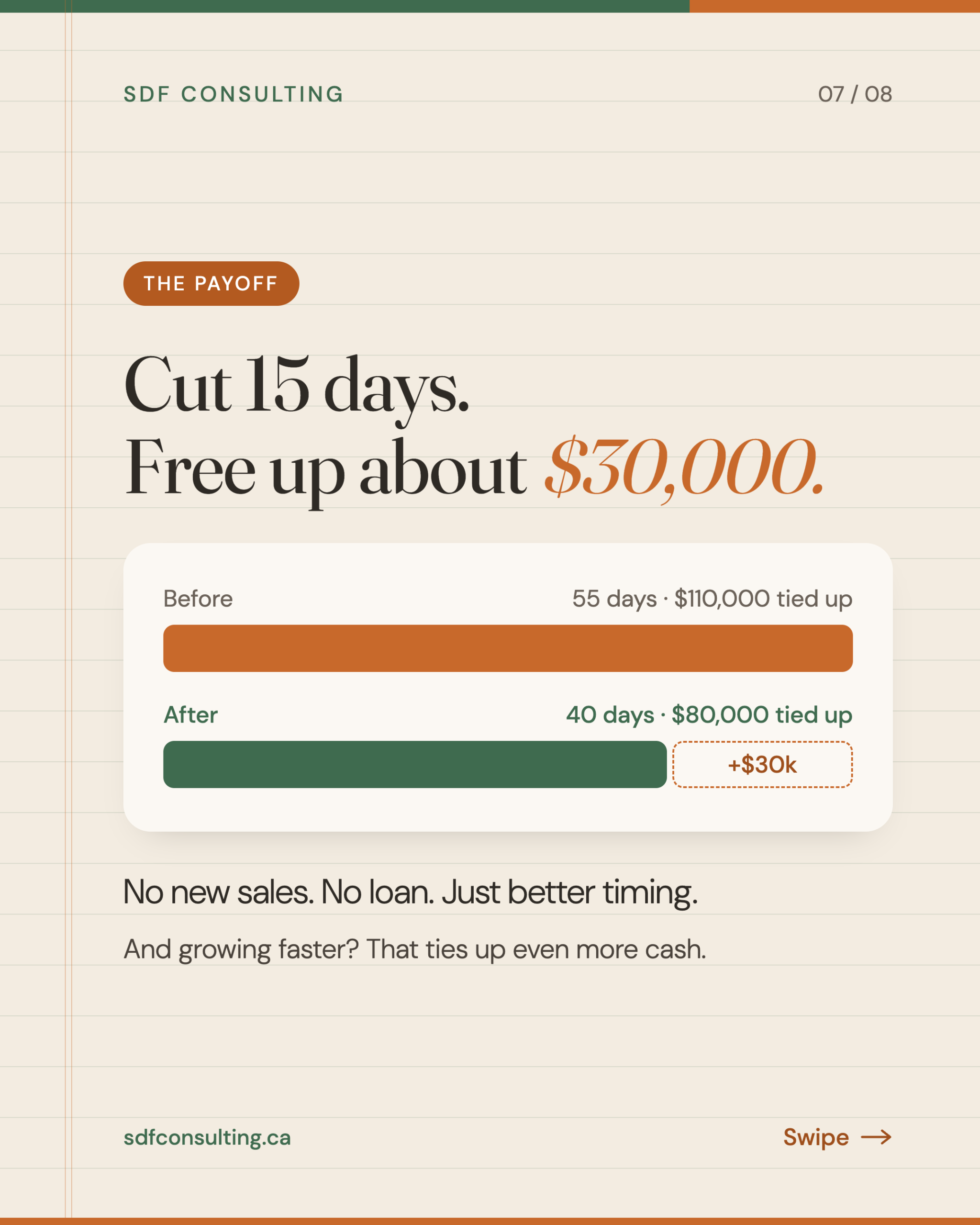
Small changes add up quickly. In the example above, cutting the cycle from 55 days to 40 days frees up about $30,000 (15 days × $2,000 a day). The cash tied up drops from roughly $110,000 to $80,000.
No new sales. No loan. Just better timing.
One warning: growth doesn’t fix a cash problem. Often it makes it worse. When sales grow, you buy more stock and send out more invoices, so even more cash gets tied up in the cycle. That’s why fast-growing businesses are often the ones that feel the tightest squeeze, and why it pays to fix the cycle before you push for growth.
How to work out your own number
You only need three figures from your balance sheet and two from your income statement for the past year. Your bookkeeper or accountant can pull them in minutes.
- Days on the shelf. Divide your inventory by your cost of goods sold for the year, then multiply by 365.
- Days to get paid. Divide your accounts receivable (what customers owe you) by your sales for the year, then multiply by 365.
- Days to pay suppliers. Divide your accounts payable (what you owe suppliers) by your cost of goods sold for the year, then multiply by 365.
- Put it together. Add the first two and subtract the third:
Your cash conversion cycle = days on the shelf + days to get paid − days to pay suppliers.
Run a service business with no inventory? Skip step 1. Your cycle is simply the gap between paying for the work (wages, materials) and getting paid by the client.
The exact number matters less than the trend. Work it out every quarter. If it’s creeping up, cash is getting tighter, even if profit looks fine.
Do you know your number?
Most owners don’t, and that’s exactly why cash surprises happen. The cash conversion cycle turns a vague worry (“where did the money go?”) into a number you can track and improve.
If you’d like help working out your cycle and finding the quickest ways to shorten it, get in touch with SDF Consulting at sdfconsulting.ca. Let’s work yours out together.