
Why profitable businesses run out of cash
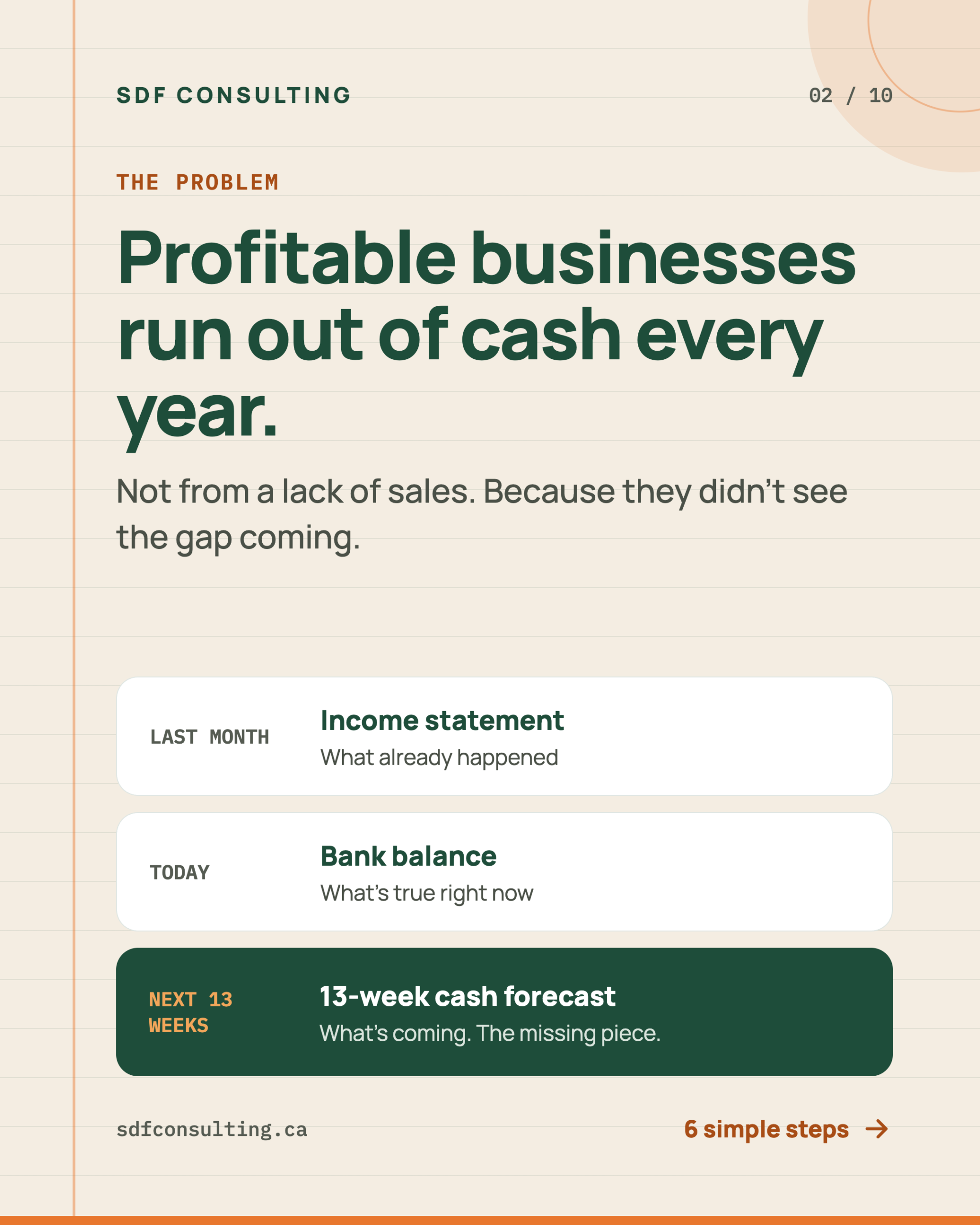
Profitable businesses run out of cash every year. Not because they lack sales, but because they didn’t see the gap coming.
Most owners watch two numbers: the profit on their income statement and the balance in their bank account. Both are useful, and both look backward. Your income statement tells you what happened last month. Your bank balance tells you what’s true today.
Neither one tells you what’s coming. A business can be profitable on paper and still miss payroll, because profit counts sales when you invoice them, while your bank only counts cash when it actually arrives.
That gap between earning money and having money is where good businesses get into trouble. The 13-week cash flow forecast is the simplest tool for seeing it before it arrives.
What a 13-week cash forecast is
A 13-week cash forecast is a week-by-week view of the cash coming into and going out of your business over the next quarter. It answers one question: how much cash will I have in the bank at the end of each week?
It is not a budget and it is not your accountant’s financial statements. It deals only in real cash: money that actually lands in your account and money that actually leaves it.
Why 13 weeks? Thirteen weeks is one quarter. It is close enough that your estimates stay accurate, and far enough out that you have time to act when you spot a problem. Look only a week or two ahead and you see trouble too late to fix it. Look a year ahead and the numbers turn into guesswork.
You don’t need special software. A simple spreadsheet with one column per week works well.
How to build one in 6 steps
Set up a spreadsheet with 13 columns, one for each week. Then work through these six steps.
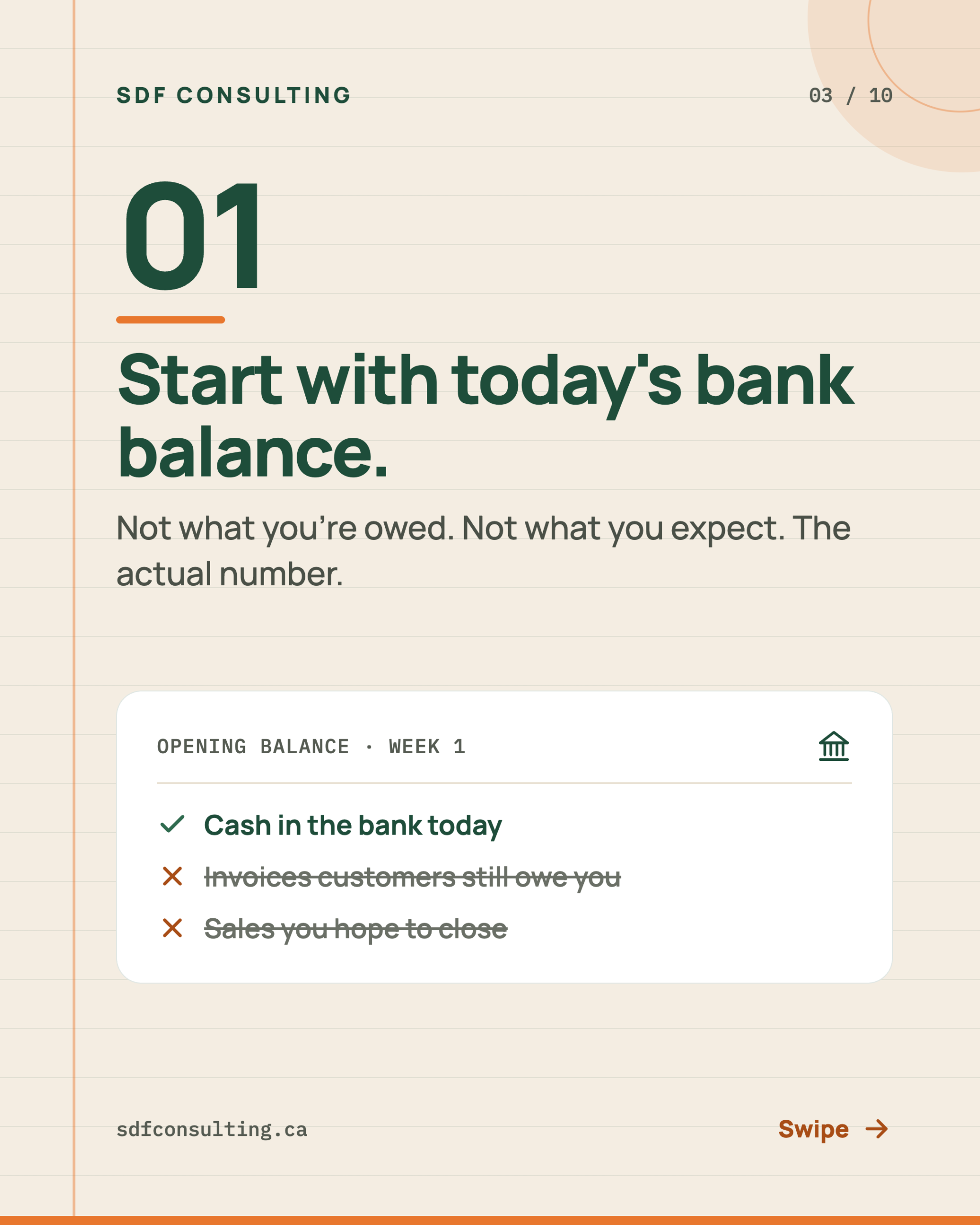
Step 1: Start with today’s bank balance
Your starting point is the cash in your bank account today. Not what customers owe you, and not the sales you expect to close. Just the actual number.
If you have more than one business account, add them together. Leave out credit available on a line of credit for now; that is a safety net, not cash.
Step 2: List the money coming in
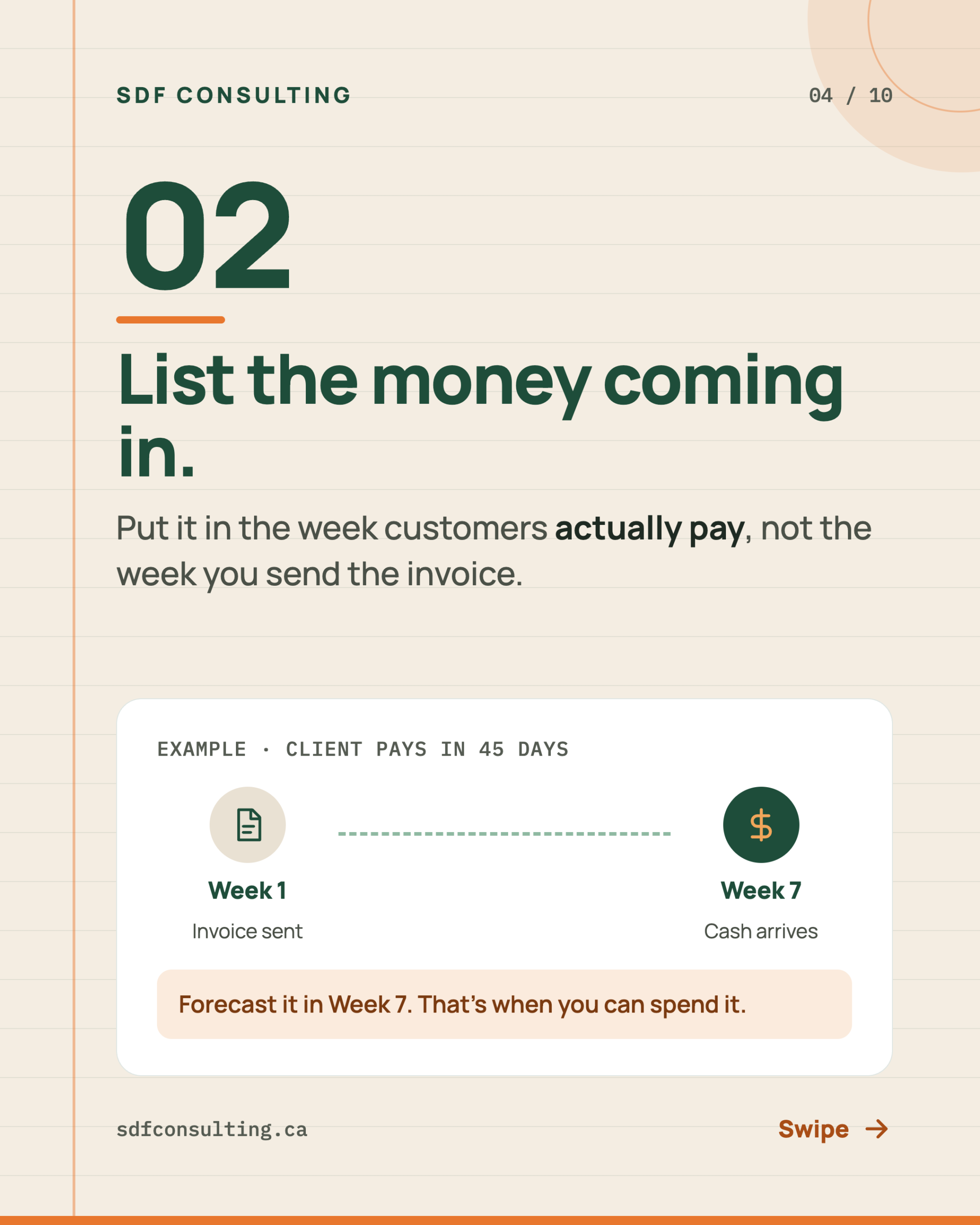
Write down the cash you expect to receive each week. The key is to put each amount in the week customers will actually pay, not the week you send the invoice.
For example, if you invoice a client in week 1 and they usually pay in 45 days, that cash belongs in week 7. Use how your customers really pay, not your payment terms. If a client always pays late, plan for late.
Step 3: List the money going out
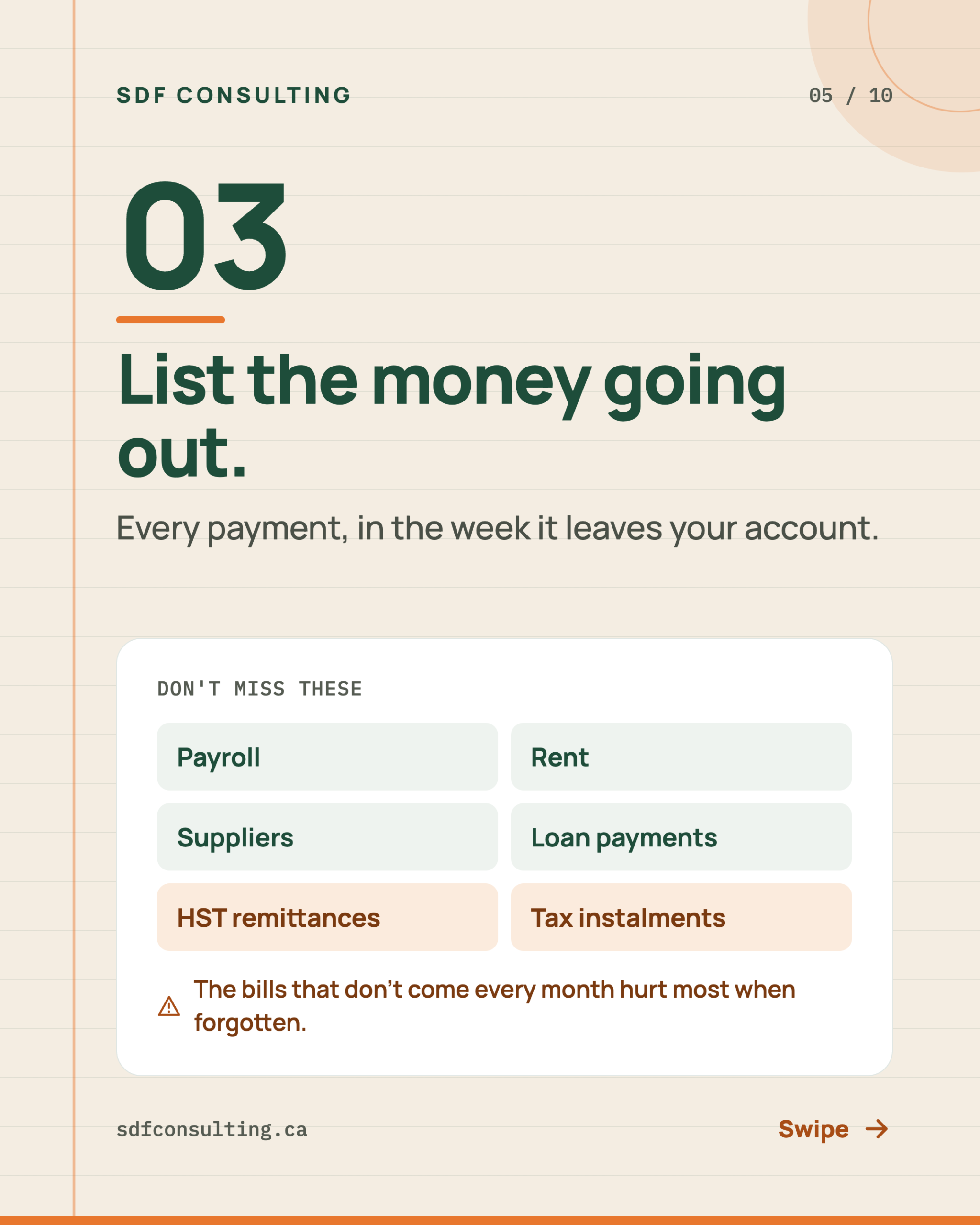
Now list every payment that will leave your account, in the week it will leave. Common ones include:
- Payroll
- Rent
- Suppliers
- Loan payments
- HST remittances
- Tax instalments
The bills that don’t come every month hurt most when forgotten. Check last year’s bank statements for anything annual or quarterly, like insurance, software renewals or tax payments.
Step 4: Do the simple math
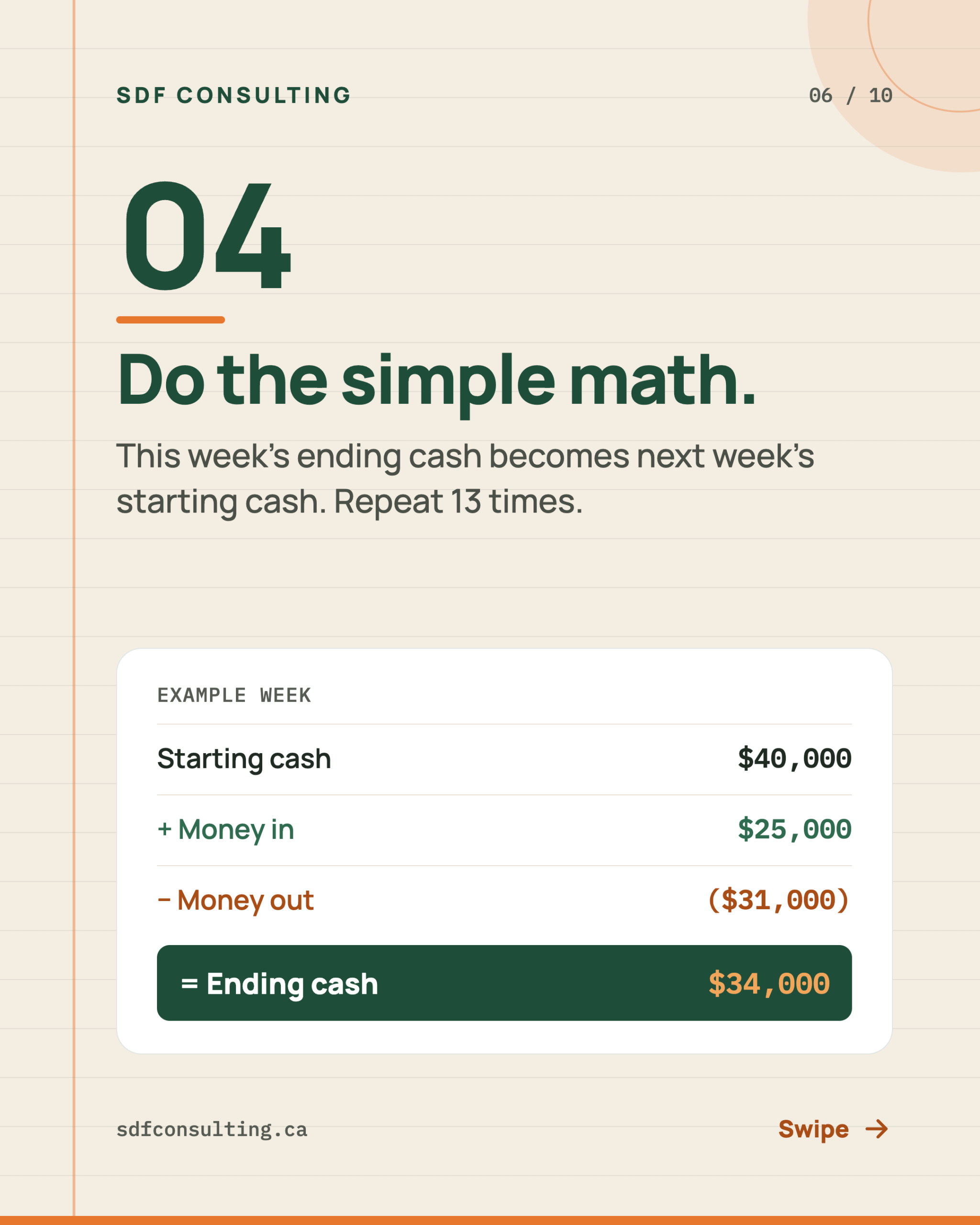
For each week: starting cash, plus money in, minus money out, equals ending cash. That ending cash becomes next week’s starting cash. Repeat for all 13 weeks.
| Example week | Amount |
|---|---|
| Starting cash | $40,000 |
| Plus money in | $25,000 |
| Minus money out | ($31,000) |
| Ending cash | $34,000 |
In this example, week 2 starts with $34,000.
Step 5: Draw your line in the sand
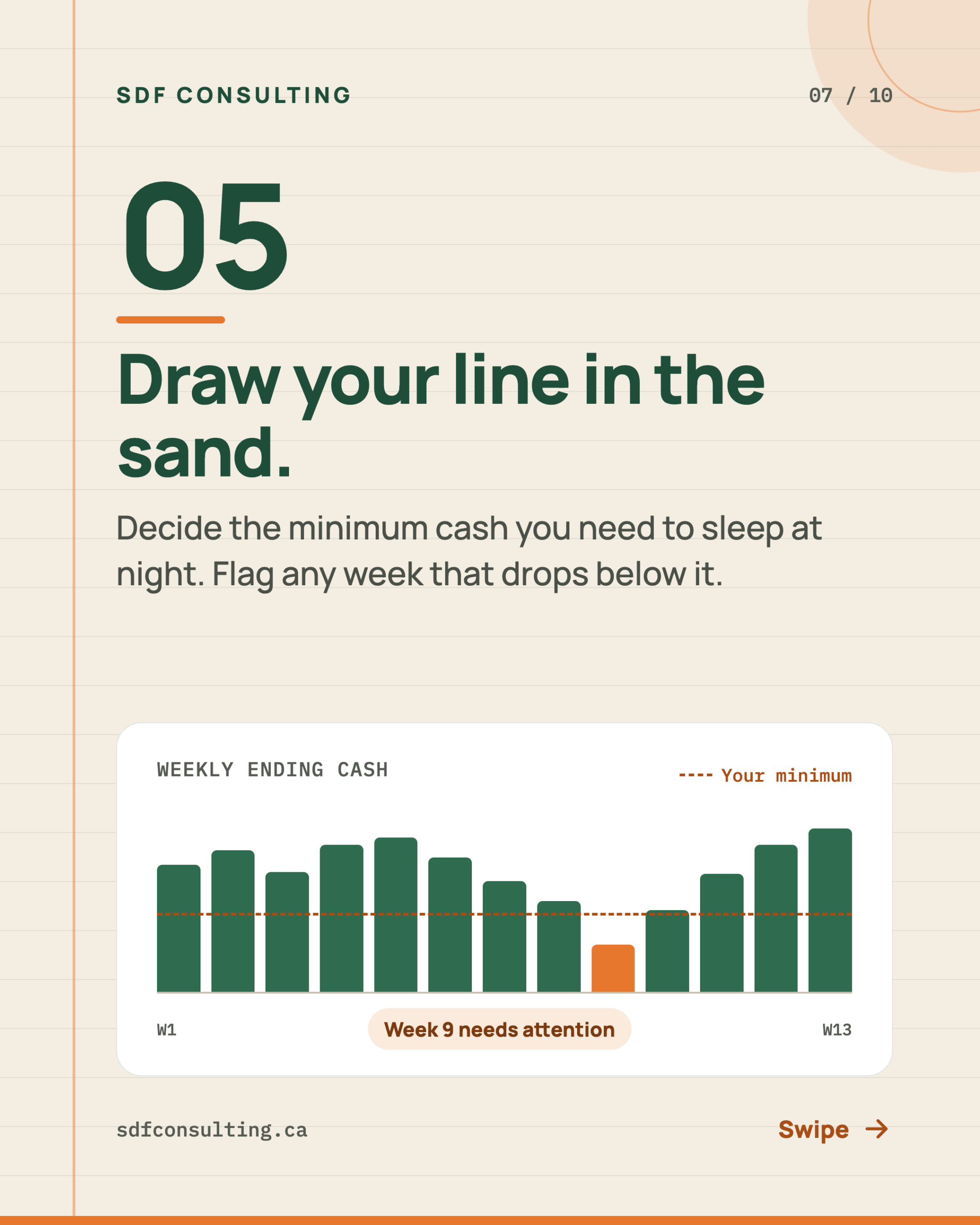
Decide the minimum cash you need in the bank to feel safe. For many owners that is enough to cover at least one payroll plus rent, but the right number depends on your business.
Highlight any week where your ending cash falls below that line. Those weeks are your early warnings.
Step 6: Update it every week
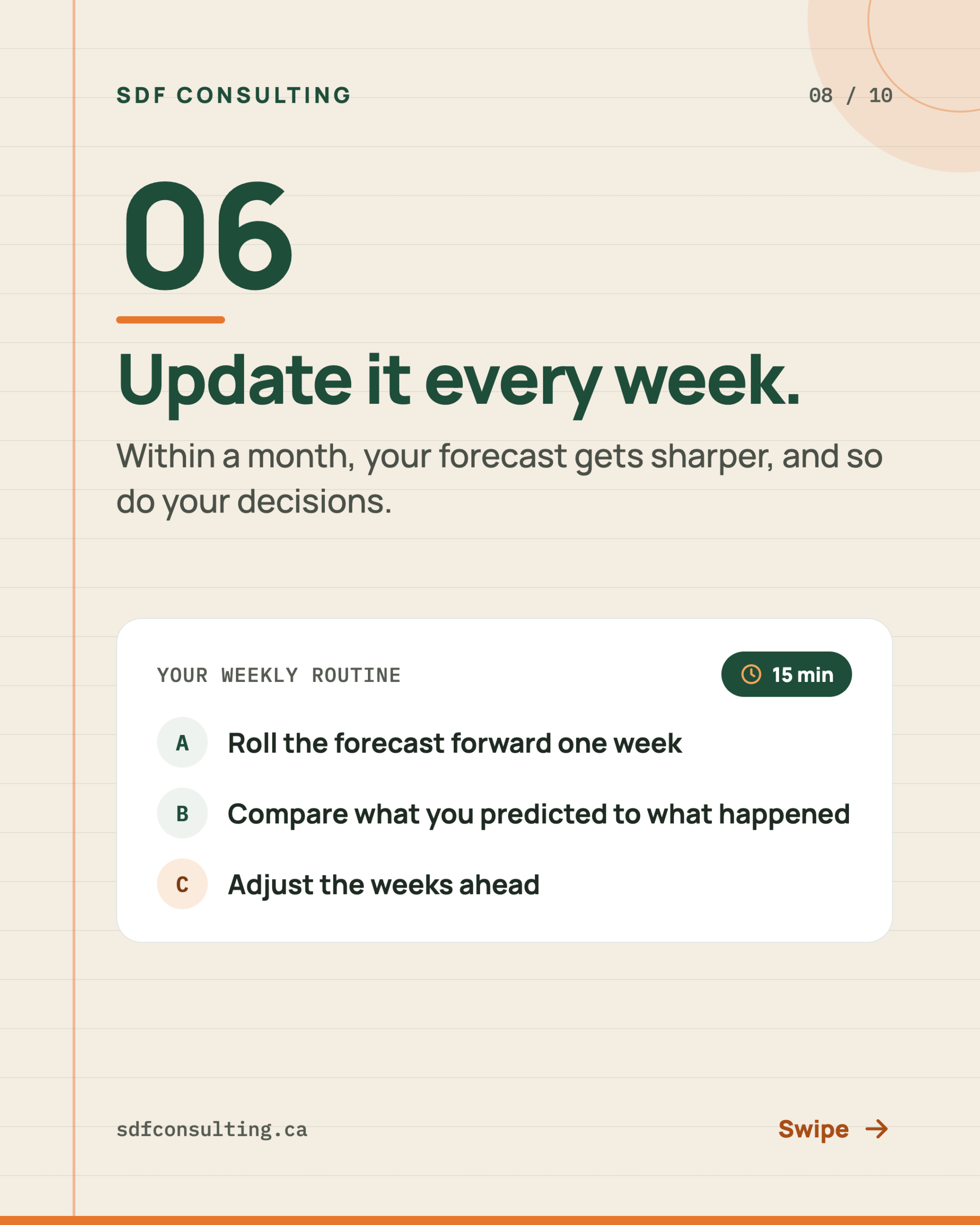
Once a week, roll the forecast forward: drop the week that just ended and add a new week at the end, so you always see 13 weeks ahead.
Then compare what you predicted with what actually happened. Within a month, your forecast gets sharper, and so do your decisions. Once it is set up, the weekly update takes about 15 minutes.
Why it matters: timing is everything
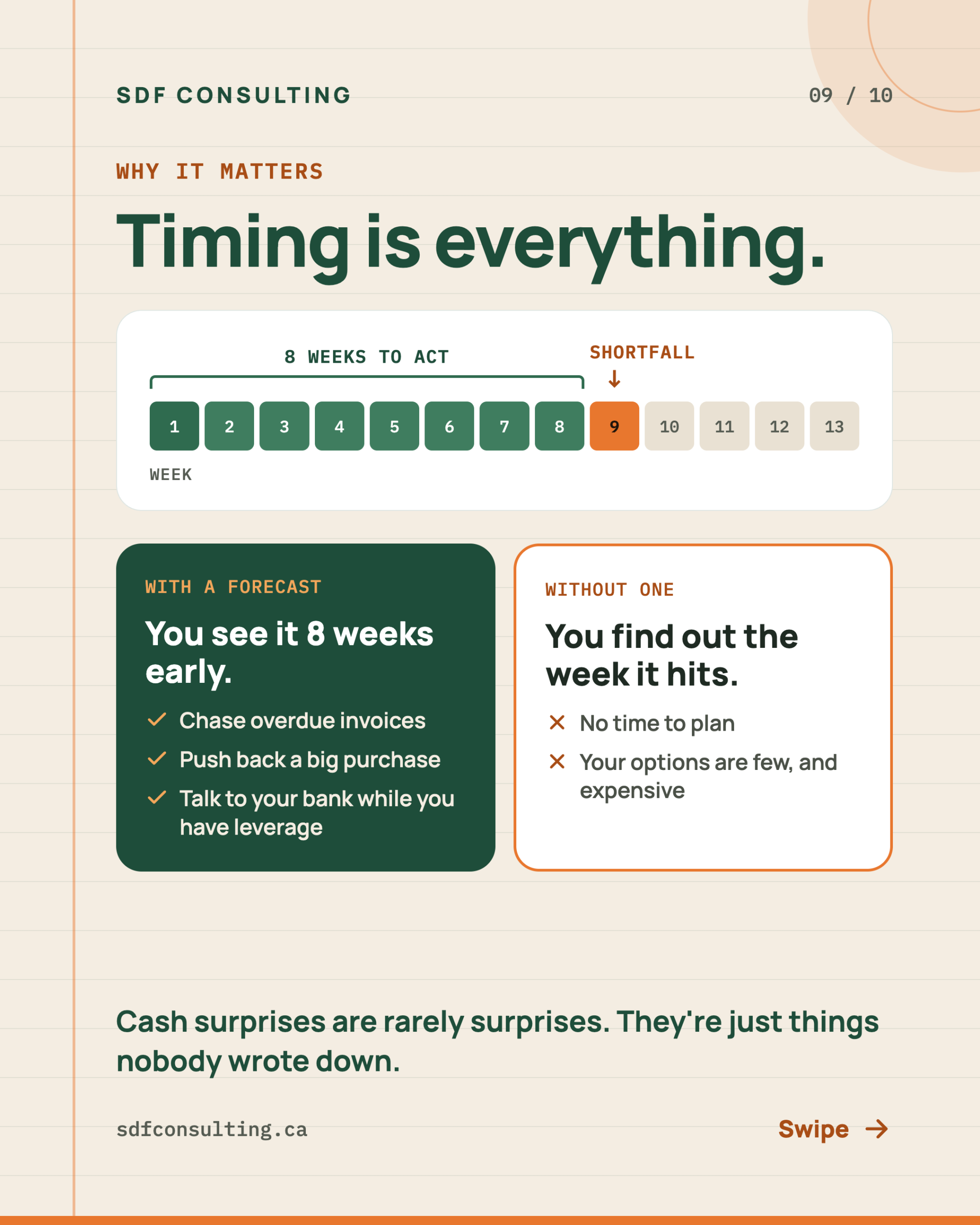
The value of a forecast is time. When you can see a cash shortfall weeks before it happens, you can fix it calmly instead of scrambling.
Say your forecast shows your cash dipping below your minimum in week 9. You now have 8 weeks to act. You can:
- Chase overdue invoices before they become a problem
- Push back a big purchase until cash recovers
- Talk to your bank while you still have leverage
Banks prefer lending to businesses that see problems coming. Walking in with a forecast and a plan puts you in a much stronger position than asking for help the week payroll is due.
With a forecast, you find out about a shortfall weeks early. You have time to plan, and your options are many and affordable. Without one, you find out the week it hits. You have days to react, or none at all, and the options left are few and expensive.
Cash surprises are rarely surprises. They are usually just things nobody wrote down.
Common mistakes to avoid
- Using invoice dates instead of payment dates. Cash arrives when customers pay, not when you bill them. This is the most common mistake, and it makes forecasts look rosier than reality.
- Forgetting irregular bills. Annual insurance, quarterly or annual tax payments and software renewals are easy to miss because they don’t show up every month.
- Being too optimistic. If a big deal might close, leave it out until it does. It is better to be pleasantly surprised than caught short.
- Building it once and never updating it. A forecast is only useful if it is current. A forecast that is a month old is already out of date.
- Mixing personal and business cash. Keep the forecast to your business accounts only, so the numbers show what the business can actually afford.
Start this week
You don’t need to be a finance expert to build a 13-week cash forecast. You need your bank balance, a list of who owes you and when they usually pay, and a list of what you owe and when it is due.
Block out an hour this week to build the first version. After that, 15 minutes every week keeps it current. It is one of the cheapest forms of insurance a business owner can have.
So ask yourself: do you know what your cash balance will be 13 weeks from today?
If you would like help setting up a cash forecast for your business, SDF Consulting can walk you through it. Visit sdfconsulting.ca or email arshad@sdfconsulting.ca.