
Why profitable businesses run short of cash, and how to stay ahead of it.
Every business owner knows that week.
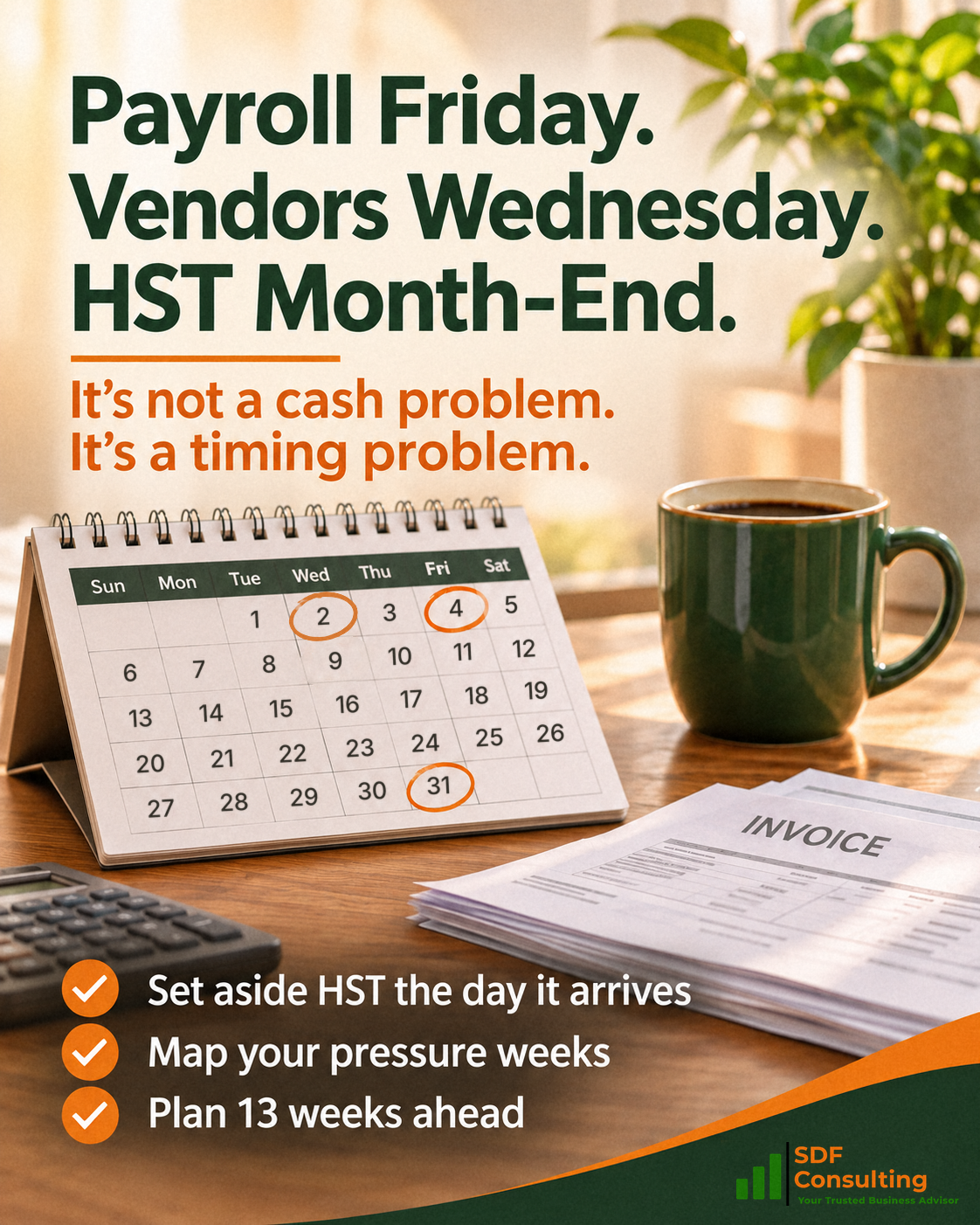
Payroll goes out Friday. Two vendor invoices are due Wednesday. HST is due at month-end. On Monday, the bank balance looked fine. By Thursday, you’re moving money between accounts, deciding which supplier can wait, and doing math at 2 a.m.
If that sounds familiar, here is the most important thing to know: your business is probably not in trouble. Your timing is. And timing is something you can plan for.
It’s not a profit problem. It’s a timing problem.
Profit and cash are not the same thing, and mixing them up is behind most of the stress owners feel.
Profit answers one question: over a month or a year, did you bring in more than you spent? Cash answers a different one: is there enough money in the bank today to pay what’s due today?
A business can be profitable and still run short of cash for a week. Here is a simple example:
- You finish a $40,000 job for a client in early March. On paper, that month looks great.
- Your client pays on 45-day terms, so the money arrives in mid-April.
- Meanwhile, your staff, your suppliers and the CRA all expect to be paid in March.
Nothing is wrong with the business. The money is real, it’s just not in the account yet. That gap between when you earn money and when you actually receive it is where most cash crunches live.
Why these three bills pile up
Payroll, vendors and HST each run on their own schedule, and none of those schedules care about when your customers pay you.
- Payroll is fixed and frequent. Every two weeks, like clockwork, and your team is counting on it.
- Vendors have their own terms, often 30 days. A big order placed early in the month can come due right alongside everything else.
- HST depends on how often you file. Monthly and quarterly filers generally owe their return and payment one month after the reporting period ends.
- Payroll remittances add a fourth layer. The income tax, CPP and EI you hold back from employees is generally due to the CRA by the 15th of the following month for regular remitters.
Most months, these land at different times and you barely notice. A few times a year, they line up in the same week. That’s when a healthy business suddenly feels broke.
A calmer way to plan
You can’t stop these bills from coming. You can stop them from surprising you. These six habits don’t require a finance background, just a little discipline.
1. Treat HST as money you’re holding, not money you earned
In Ontario, when a customer pays you $1,130, only $1,000 is yours. The other $130 is HST you’ve collected on the government’s behalf.
The simplest fix is a separate bank account. Each time a payment comes in, move the HST portion over that same day. When your return is due, the money is already waiting, and it never gets spent by accident.
2. Do the same with payroll deductions
The income tax, CPP and EI you withhold from your team’s pay isn’t yours either. You’re holding it in trust until it’s sent to the CRA.
Set it aside every pay run, in the same separate account. That way the remittance never competes with rent, inventory or your next payroll.
3. Mark your pressure weeks in advance
Take 20 minutes and put every payroll date, major vendor due date and tax deadline for the next three months on one calendar.
You’ll spot the crunch weeks right away. Seeing them three weeks out gives you options. Discovering them on a Thursday doesn’t.
4. Look 13 weeks ahead, not 13 days
A 13-week cash forecast sounds technical, but it’s simply a week-by-week list of money you expect to come in and money you expect to go out. It’s the single most useful tool I give clients, and the next section shows what one looks like.
5. Talk to vendors before you need to
Ask for better payment terms in a calm month, not a panicked one. A long-standing customer asking for 45 days instead of 30 gets a yes far more often than one asking for an extension the day before a payment is due.
It also helps to know which vendors are flexible and which aren’t, before you need to make that call.
6. Arrange your line of credit while you don’t need it
Banks prefer lending to businesses that look like they don’t need the money. Set up a line of credit while your numbers are strong, and treat it as a safety net for a tight week, not a way to cover ongoing losses.
What a 13-week cash view looks like
It’s a simple list, one line per week: what you expect to come in, what you expect to go out, and what will be left in the bank at the end of the week.
Picture a small business that starts with $30,000 in the bank and runs payroll every two weeks. For the first three weeks, everything looks fine. Then week 4 brings a large vendor payment and the HST bill, and week 5 brings payroll before most customer payments arrive. The balance dips to about $13,000 before bouncing back above $30,000 in week 6.
The business is healthy. But with a 13-week view, the owner sees those two tight weeks a month in advance, instead of on a Thursday afternoon.
That changes everything. Instead of scrambling in week 5, the owner can follow up on a slow-paying customer in week 2, move a vendor payment by a few days, or line up a short draw on a credit line, calmly and on their own terms.
You don’t need special software to start. A simple spreadsheet, updated once a week, does the job. Keep extending it so you’re always looking 13 weeks out.
When timing is a sign of something bigger
A tight week now and then is normal. These signs suggest the problem may be more than timing:
- You’re short every month, not just a few times a year.
- You’ve dipped into HST or payroll deductions to cover other bills.
- Your line of credit keeps climbing and rarely comes back down.
- You’re delaying the same vendors again and again.
- You can’t say with confidence whether the business made money last quarter.
If any of these sound familiar, it’s worth a closer look at pricing, margins and how quickly customers pay. Using HST or payroll deductions for other expenses deserves special attention, because falling behind on those can bring penalties and interest from the CRA.
Stop being surprised by your own bills
Owners who plan this way don’t have fewer bills. They just stop being surprised by them.
Setting aside HST and payroll deductions, marking your pressure weeks and keeping a 13-week view takes an hour or two to set up and a few minutes a week to maintain. In return, you get something most owners would pay a lot more for: fewer 2 a.m. calculations.
If that week shows up often in your business, let’s talk. At SDF Consulting, we help owner-operators build simple, practical cash plans so they can spend less time worrying about timing and more time running the business.