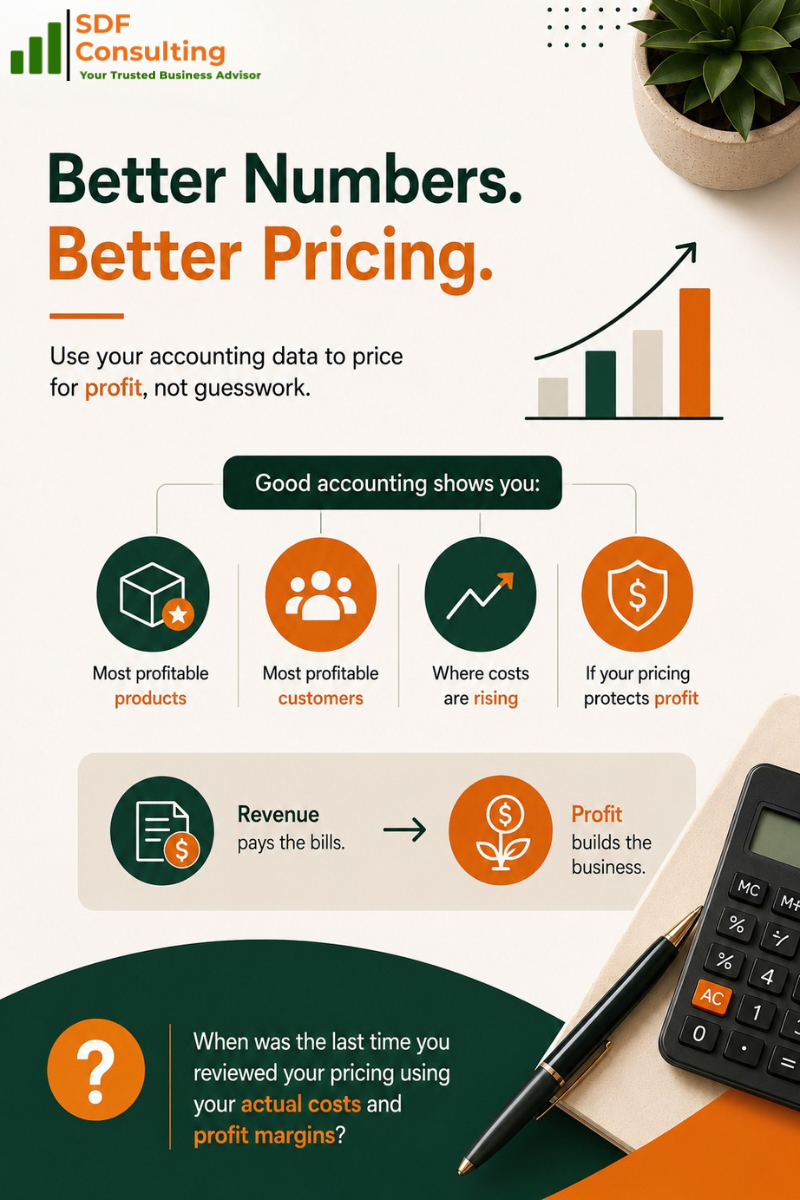

Why Pricing Decisions Should Start with Your Financial Data
One of the most common pricing mistakes business owners make is setting prices based primarily on what competitors are charging. While market awareness is important, competitor pricing alone rarely provides the information needed to build a sustainable and profitable business.
The reality is simple: your competitors do not operate with your cost structure, overhead expenses, labor requirements, customer mix, or profit objectives. Their pricing decisions are based on factors unique to their business.
Your accounting data, however, tells the story of your business.
It provides objective insight into whether your pricing strategy is generating healthy margins, supporting growth, and creating long-term financial stability. Without that visibility, pricing decisions become educated guesses rather than strategic business decisions.
The strongest companies do not rely on assumptions when it comes to pricing. They rely on data.
Understanding the Relationship Between Revenue and Profit
Many business owners focus heavily on increasing sales volume. Growth is important, but revenue alone is not a reliable measure of business success.
A company can achieve record sales while still experiencing declining profitability.
This often happens when rising costs, underpriced services, inefficient operations, or low-margin customers erode profitability behind the scenes.
The more important question is not:
“How much revenue are we generating?”
It is:
“How much profit are we retaining from every sale?”
Revenue keeps the business operating. It pays employees, suppliers, and ongoing expenses.
Profit, however, creates business value. Profit funds expansion, strengthens cash flow, increases resilience during economic uncertainty, and provides the resources needed for future investment.
Businesses that consistently outperform their competitors understand this distinction and regularly evaluate pricing through the lens of profitability rather than sales volume alone.
What Your Accounting Data Can Reveal About Pricing Performance
Accurate financial reporting provides critical insights that directly influence pricing decisions.
Which Products and Services Generate the Highest Profit
Not all revenue is created equal.
Many organizations assume that their best-selling products or services are also their most profitable. In reality, some offerings generate strong sales but deliver minimal margins once labor, materials, delivery costs, and overhead are considered.
Accounting data helps identify:
- High-margin products and services that deserve greater focus
- Low-margin offerings that may require price adjustments
- Products that consume excessive resources relative to their profitability
- Opportunities to shift sales efforts toward more profitable areas of the business
Understanding the true profitability of each offering allows leadership teams to allocate resources more effectively and maximize overall returns.
Which Customers Contribute the Most Profit
Customer profitability is often overlooked.
Some customers purchase frequently, pay on time, require minimal support, and generate consistent margins. Others may create significant administrative burden, request constant concessions, or require extensive service that reduces profitability.
Financial analysis can help answer important questions:
- Which customers generate the highest lifetime value?
- Which customer segments produce the strongest margins?
- Are certain accounts requiring disproportionate time and resources?
- Are discounts or customized pricing structures impacting profitability?
By understanding customer profitability, businesses can make more informed decisions about client acquisition, retention strategies, and pricing models.
Where Costs Are Increasing
Inflation, wage pressures, supply chain disruptions, technology investments, and operational expenses can gradually increase the cost of doing business.
Many business owners hesitate to review pricing because increases can feel uncomfortable. However, failing to adjust pricing when costs rise can quietly erode profitability over time.
Your accounting data serves as an early warning system by highlighting:
- Rising material costs
- Labor cost increases
- Higher operational expenses
- Declining gross margins
- Reduced profitability despite stable revenue
When business leaders have visibility into cost trends, they can take proactive action rather than reacting after margins have already deteriorated.
Protecting Profit Margins Through Strategic Pricing
Pricing should not be viewed as a one-time decision. It is an ongoing strategic process that requires regular review and adjustment.
A price that generated healthy margins two years ago may no longer be adequate today.
As costs evolve, market conditions change, and customer expectations shift, businesses must ensure their pricing continues to support financial objectives.
Regular margin analysis helps answer several critical questions:
- Are current prices covering all direct and indirect costs?
- Are margins improving, holding steady, or declining?
- Are discounts impacting overall profitability?
- Is the business earning an appropriate return for the value it delivers?
Organizations that consistently monitor these metrics are better positioned to maintain profitability while continuing to invest in growth.
Data-Driven Pricing Creates Competitive Advantage
Many business owners fear raising prices because they believe customers will automatically seek lower-cost alternatives.
Yet the most successful companies understand that pricing is not simply about being the cheapest option in the market. It is about delivering value while earning a sustainable return.
Businesses that use financial data to guide pricing decisions gain several advantages:
- Greater confidence in pricing conversations
- Improved profit margins
- Stronger cash flow
- Better resource allocation
- Increased ability to invest in growth initiatives
- Enhanced long-term business stability
Data-driven pricing enables leaders to make decisions backed by facts rather than assumptions.
The Hidden Profit Opportunity Most Businesses Miss
In many organizations, significant profit opportunities remain hidden within existing operations.
A modest pricing adjustment, improved understanding of customer profitability, or refinement of product and service offerings can often generate greater bottom-line impact than a substantial increase in sales volume.
The challenge is that these opportunities are rarely visible without accurate financial reporting and ongoing analysis.
That is why successful business owners view accounting not merely as a compliance requirement, but as a strategic management tool.
When used effectively, accounting data becomes one of the most powerful resources for improving profitability and guiding smarter business decisions.
A Question Every Business Owner Should Ask
Before focusing on acquiring more customers or increasing sales volume, consider a more fundamental question:
When was the last time you reviewed your pricing strategy based on your actual costs, margins, and profitability—not simply what your competitors were charging?
The answer may reveal that one of your largest profit opportunities is already sitting inside your business, hiding in plain sight.