
The Slow Leak: Why Gross Margin Decides Whether Your Business Actually Wins
Picture two business owners.
The first has a fantastic year. Sales are up, the phone won’t stop ringing, the team is flat out. On paper, he’s winning. But when the year ends, there’s less money in the bank than when it started, and he can’t explain why.
The second has a quieter year. Sales grew modestly. No fireworks. Yet she paid herself well, put money aside, and slept fine.
The difference between them isn’t luck, and it isn’t sales. It’s gross margin — and it’s the number most owners never learn to watch.
Start with the bucket
Imagine your business as a bucket you carry to the well and back. Every sale pours water in. Sales is how much water you pour.
But most buckets have a hole — the cost of actually delivering the work. Gross margin is simply how much water is still in the bucket after that hole has done its job.
Here’s the plain version. Gross margin is what’s left from a sale after you subtract the direct costs of delivering it: materials, the products you buy to resell, and the labour tied directly to the work. Accountants call those costs “cost of goods sold.” You can just call them the hole in the bucket.
Say you run a small landscaping business and complete a job for $1,000. Plants, materials, and crew hours cost $600. You keep $400 — a 40% margin. That $400 is the water that made it home. It’s what pays for your office, your admin staff, your software, your own wages, and whatever profit you get to keep.
Pour in more water all you like. If the hole is getting bigger, you can run yourself ragged and still arrive home with an empty bucket.
Why sales fool people
Sales feel like the scoreboard, so that’s where everyone looks. It’s the number we quote at dinner parties. It’s the one that makes us feel like the business is going somewhere.
But sales only measure how much you poured in. They tell you nothing about how much you kept. And that gap is exactly where businesses quietly get into trouble.
I’ve sat with owners who grew their sales handsomely and ended the year with less cash. Every time, the story was the same. The hole in the bucket had grown a little wider, month by month, and no one was watching the water level. More work. More stress. Less to show for it.
This is why a steady business at 45% margin is usually stronger than a busy one chasing bigger sales at 20%. One keeps nearly half of every dollar to build with. The other keeps a fifth and hopes volume makes up the difference. It rarely does.
The four quiet leaks
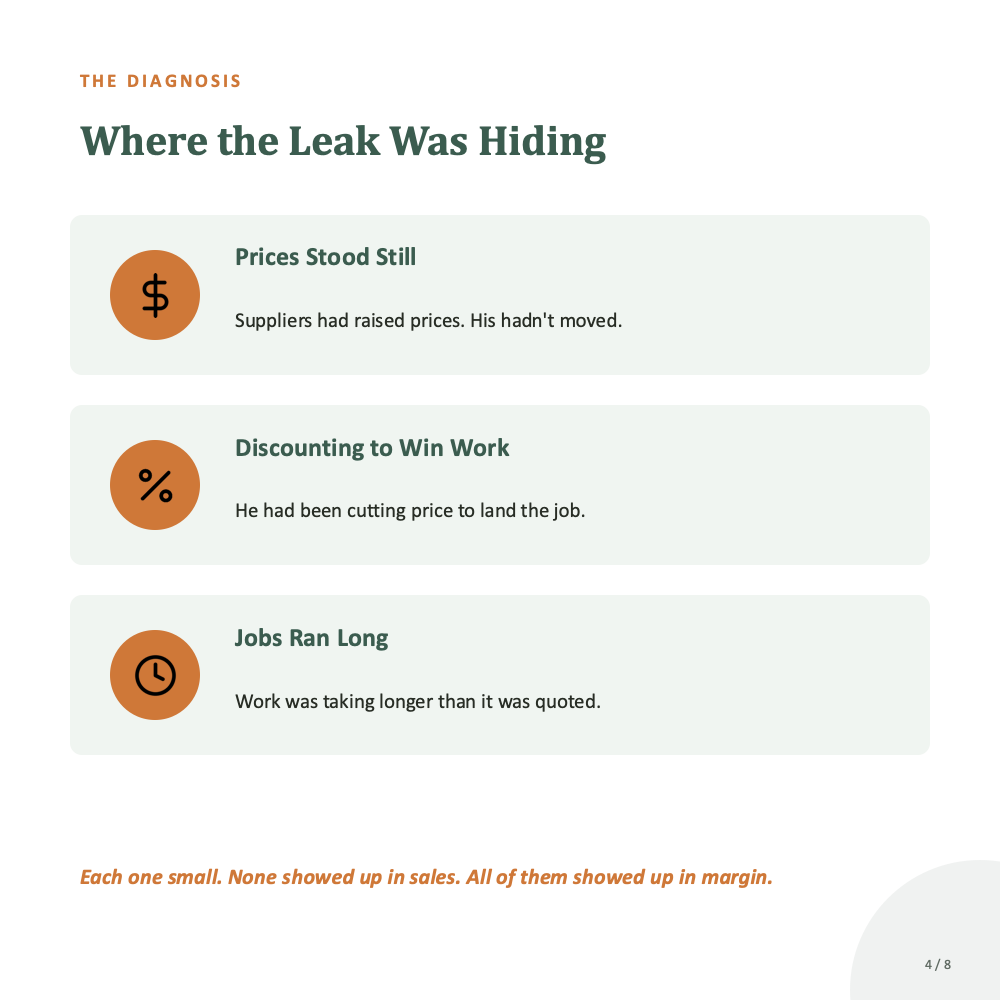
Margin almost never drops in one dramatic moment. It seeps, slowly, which is exactly what makes it so easy to miss. Four leaks show up again and again:
- The supplier crept up and you didn’t. Your costs rose, your prices stayed put, and every sale now earns you a little less than it used to.
- The discount that felt like a win. Cutting your price to land a job feels great in the moment. But that discount comes straight out of your margin, not your overheads. Shave 10% off the price and you can wipe out a big slice of the profit on that job.
- The job that ran long. Quote a job at four hours and deliver it in six, and those extra hours don’t come out of thin air. They come out of your margin.
- The mix that shifted. If more of your sales drift toward your lower-margin products or services, your overall margin sinks — even when nothing else has changed.
Notice what these have in common: not one of them shows up in your sales figure. They only reveal themselves in your margin. That’s why the margin is the number worth guarding.
How to guard it (without becoming an accountant)
The good news is that protecting your margin doesn’t take special software or a finance degree. It takes a few steady habits:
Check it every month, not just at year-end. A monthly glance catches a leak while it’s a drip, not a flood.
Ask why it moved. The number alone isn’t the point — the reason behind it is. A supplier increase, a discounted job, a change in your mix. Once you can name the cause, you can act on it.
Revisit your pricing on purpose. Costs drift upward on their own; prices don’t. Reviewing them regularly is how you keep the hole from widening.
Look at margin job by job, or product by product. Very often a small handful of items are dragging down your whole average. Once you can see them, you get to choose: reprice them, improve them, or walk away from them.
The bottom line
Gross margin isn’t a complicated idea, and you don’t have to be a numbers person to use it. It answers one very practical question: after covering the cost of doing the work, how much is actually left to run and grow your business?
Sales will always be the number that gets the applause. But margin is the one that quietly decides whether the applause was worth it.
Watch it. Understand what moves it. Patch the leaks while they’re small. Do that, and you’ll see your business far more clearly than the sales figure alone will ever let you.
And if you’d like a hand finding where your margin sits, or why it’s drifting, that’s exactly the kind of thing we help owners with. No pressure — just an honest, clear look at your own numbers.
At SDF Consulting, we help business owners gain the financial clarity needed to make better decisions, improve profitability, and build sustainable growth. Because when you understand the numbers behind your business, you can lead with confidence.