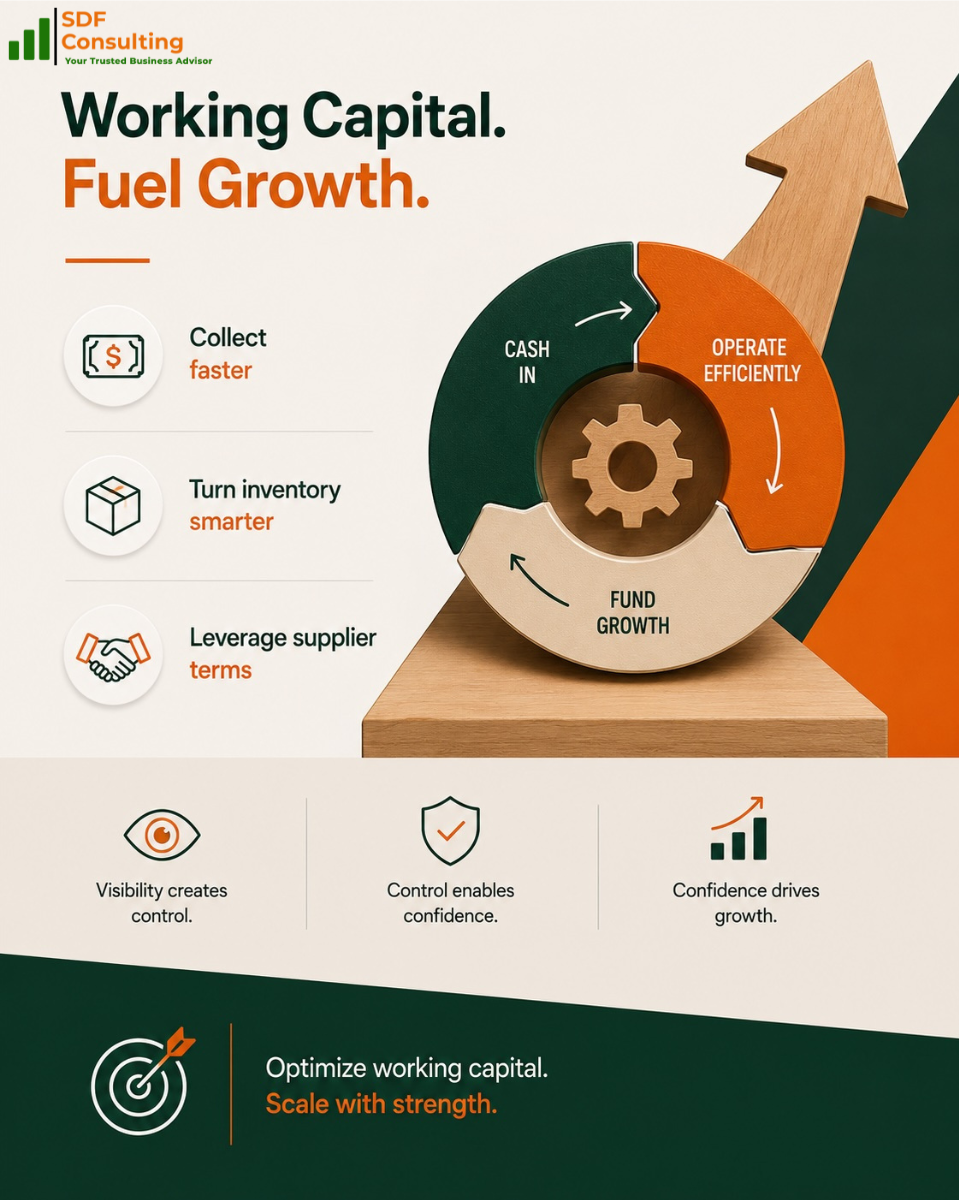

How Operators Turn Working Capital into a Growth Lever
For many organizations, working capital is treated as a constraint—something to manage tightly, report on monthly, and optimize incrementally.
But in high-performing companies, working capital is not just managed. It is actively engineered as a lever for growth.
The distinction lies not in accounting mechanics, but in operational intent.
Reframing Working Capital: From Constraint to Capability
Working capital sits at the intersection of operations and finance. It reflects how effectively a business converts its commercial activity into cash.
Yet too often, it is viewed passively—as a byproduct of revenue and cost decisions.
Leading operators take a different approach. They recognize that:
- Every dollar tied up in receivables or inventory is deferred growth capacity
- Every improvement in cycle times creates immediate liquidity
- Every inefficiency introduces hidden financing costs
In this context, working capital becomes a capability—one that can be intentionally shaped to support scale.
Cash Conversion as an Operating Discipline
Best-in-class organizations elevate the cash conversion cycle (CCC) from a finance KPI to a core operating discipline.
They align cross-functional teams around a single objective: cash velocity.
This requires deliberate coordination across the business:
- Sales prioritizes not just revenue, but quality of revenue—terms, collectability, and customer discipline
- Procurement negotiates for flexibility, resiliency, and alignment with cash flow objectives—not just price
- Operations manages inventory dynamically, optimizing for turnover, service levels, and demand accuracy
The result is a system where cash flow is not reconciled after the fact—it is designed into the operating model.
Self-Funded Growth: The Strategic Advantage
One of the most powerful implications of working capital excellence is the ability to fund growth internally.
Small improvements compound quickly:
- Reducing days sales outstanding (DSO) accelerates cash inflows
- Increasing inventory turns releases trapped capital
- Extending payables in a thoughtful way improves liquidity without sacrificing supplier trust
Together, these actions create incremental cash capacity—often at a scale significant enough to:
- Fund expansion initiatives
- Support new product investments
- Reduce reliance on external financing
In an environment where capital costs and access can fluctuate, this capability becomes a meaningful strategic advantage.
The Role of Accounting: Enabling Precision
Operational excellence in working capital is only possible with strong accounting foundations.
Without timely, accurate, and transparent financial data, decision-making degrades quickly.
High-performing organizations prioritize:
- Clean receivables aging with clear visibility into risk and collection timelines
- Accurate inventory valuation and segmentation, enabling differentiated strategies across SKUs
- Disciplined payables management that balances liquidity with supplier relationships
Accounting, in this context, is not just compliance—it is decision infrastructure.
It enables leaders to act with confidence, speed, and precision.
Balancing Efficiency with Resilience
It is tempting to view working capital optimization as a linear exercise—minimize it as much as possible.
But experienced operators understand the trade-offs.
Excessive tightening can:
- Strain supplier relationships
- Introduce operational fragility
- Compromise customer experience
The objective is not minimization—it is optimization.
That means consciously balancing:
- Liquidity vs. supplier stability
- Inventory efficiency vs. service levels
- Faster collections vs. long-term customer relationships
Resilience, not just efficiency, defines sustainable performance.
From Finance Metric to Competitive Advantage
Ultimately, working capital reflects how well a business operates beneath the surface.
Companies that outperform do not treat it as a static balance sheet metric.
>They treat it as a dynamic lever embedded in daily decision-making.
They design for cash.
>They operate for velocity.
>They scale with discipline.
The Takeaway
Working capital is one of the most under-utilized levers in business.
When approached with operational rigor and accounting clarity, it becomes more than a measure of efficiency—it becomes a driver of growth, resilience, and strategic flexibility.
The best operators don’t just manage it.
They build their advantage through it.