
Paying suppliers on time without draining your cash.
Most businesses don’t run out of money. They run out of timing.
I have sat across the table from owners whose companies were profitable on paper and still struggling to make payroll. Sales were fine. Margins were fine. The problem was when cash left the business compared with when it came in.
One of the biggest levers on that timing is how you pay your suppliers. It is not about how much you pay. It is about when.
What accounts payable really means
Accounts payable is simply the bills you owe your suppliers. Inventory, materials, rent, software, contractors: anything you have received but not yet paid for.
Most suppliers give you payment terms. “Net 30” means the full amount is due 30 days after the invoice date. Those 30 days are not a favour to rush past. They are part of the deal you agreed to.
How you use those terms decides how much cash sits in your account on any given day. That cash is what pays your staff, covers surprises, and lets you say yes to opportunities.
Two businesses, one bill
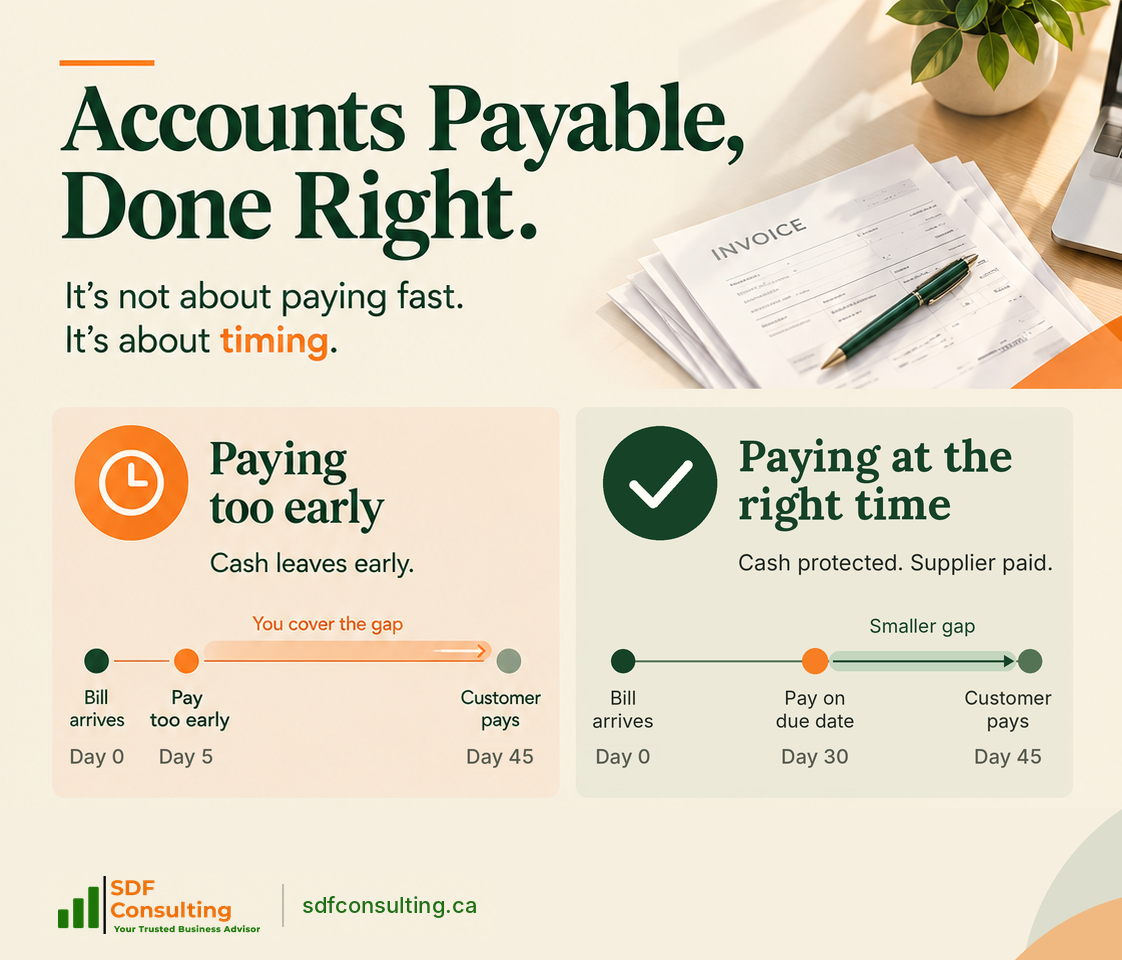
Picture two businesses. Both receive the same supplier bill on Day 0, with Net 30 terms. Both wait 45 days for their own customers to pay them.
Business A pays on Day 5. It feels responsible. The bill is off the desk. But that cash is now gone for 40 days before any customer money comes back in. The owner is covering that gap out of pocket.
Business B pays on Day 30, the due date. The supplier is paid in full and on time. The gap until customer money arrives shrinks to 15 days.
Put the two side by side. Both bills arrive on Day 0, and both businesses get paid by their customers on Day 45. Business A covers 40 days with its own cash. Business B covers just 15. And in both cases, the supplier is paid on time.
Same bill. Same supplier. Both paid on time. Business B simply has 25 more days of breathing room, on every bill, every month. Across dozens of suppliers, that adds up to a real cushion.
Why paying late is not the fix
If paying early hurts, it is tempting to think paying late helps even more. It does not.
- Fees and interest. Many suppliers charge late fees or interest on overdue balances. That is money spent for nothing.
- Lost trust. Suppliers talk to each other and remember who pays on time. Slow payers get served last when stock is tight.
- Tighter terms. Pay late often enough and a supplier may cut your terms or ask for payment before they ship. That pulls cash out even earlier and makes the original problem worse.
- Lost goodwill when you need it. A supplier who trusts you is far more likely to flex when you hit a rough month.
The goal is not to delay. It is to pay on time, at the right time.
Five habits that get it right
You do not need a finance department to manage payables well. You need a few consistent habits.
- Know your terms. List your main suppliers and their payment terms. Net 15, Net 30 and Net 60 each give you a different window. If you don’t know a supplier’s terms, ask.
- Pay on the due date, not the day the bill arrives. Enter each bill when it comes in, note its due date, and schedule payment for that date. Most accounting software and online banking can do this for you.
- Set one or two payment days a week. Paying bills in batches, say every Tuesday and Friday, gives you control and a clear picture of what is leaving. It also saves time.
- Line up money out with money in. Keep a simple calendar of expected customer deposits and upcoming bills for the next few weeks. A spreadsheet is enough. You will see a tight week coming well before it arrives.
- Call suppliers before you are late, not after. If cash will be short, a heads-up and a realistic payment date keep the relationship intact. Silence is what damages it.
The one time paying early pays off
Some suppliers offer a discount for paying early. You may see it written as “2/10 Net 30”: take 2% off if you pay within 10 days, otherwise the full amount is due in 30.
On a $10,000 bill, paying by Day 10 saves $200. That may sound small. But you are only giving up 20 days of cash to earn it. Repeated across a full year, that works out to a return of roughly 37%. Very few investments pay that well.
So the rule is simple:
- If you have the cash to spare, take the discount. It is one of the best returns available to a small business.
- If paying early would leave you short, skip it. Pay on the due date instead. A discount is never worth missing payroll.
The bottom line
Paying suppliers reliably and protecting your cash are not competing goals. They are the same discipline.
Pay too early and you fund the gap yourself. Pay too late and you pay in fees and trust. Pay on time, at the right time, and your suppliers stay happy while your cash stays where it can do the most good.
The goal isn’t to pay fast. It’s to pay at the right time.
If you’re not sure how your bills line up with the money coming in, SDF Consulting can help you map it out and build a payment routine that fits your business. Get in touch at sdfconsulting.ca.