
What lenders watch, and how to avoid a nasty surprise.
Most business owners think about their bank twice a year: when they need money, and when the annual review comes around.
Your bank thinks about you every month.
When you signed for your operating line or term loan, you agreed to a short list of financial tests. Most owners forget about them until something goes wrong. A credit line gets frozen, new fees appear, or the renewal conversation turns tense.
The good news is that staying in good standing with your bank comes down to watching three numbers. This guide explains each one in plain English, shows where the surprises usually come from, and gives you a simple routine to stay ahead of them. No accounting background needed.
First, what is a covenant?
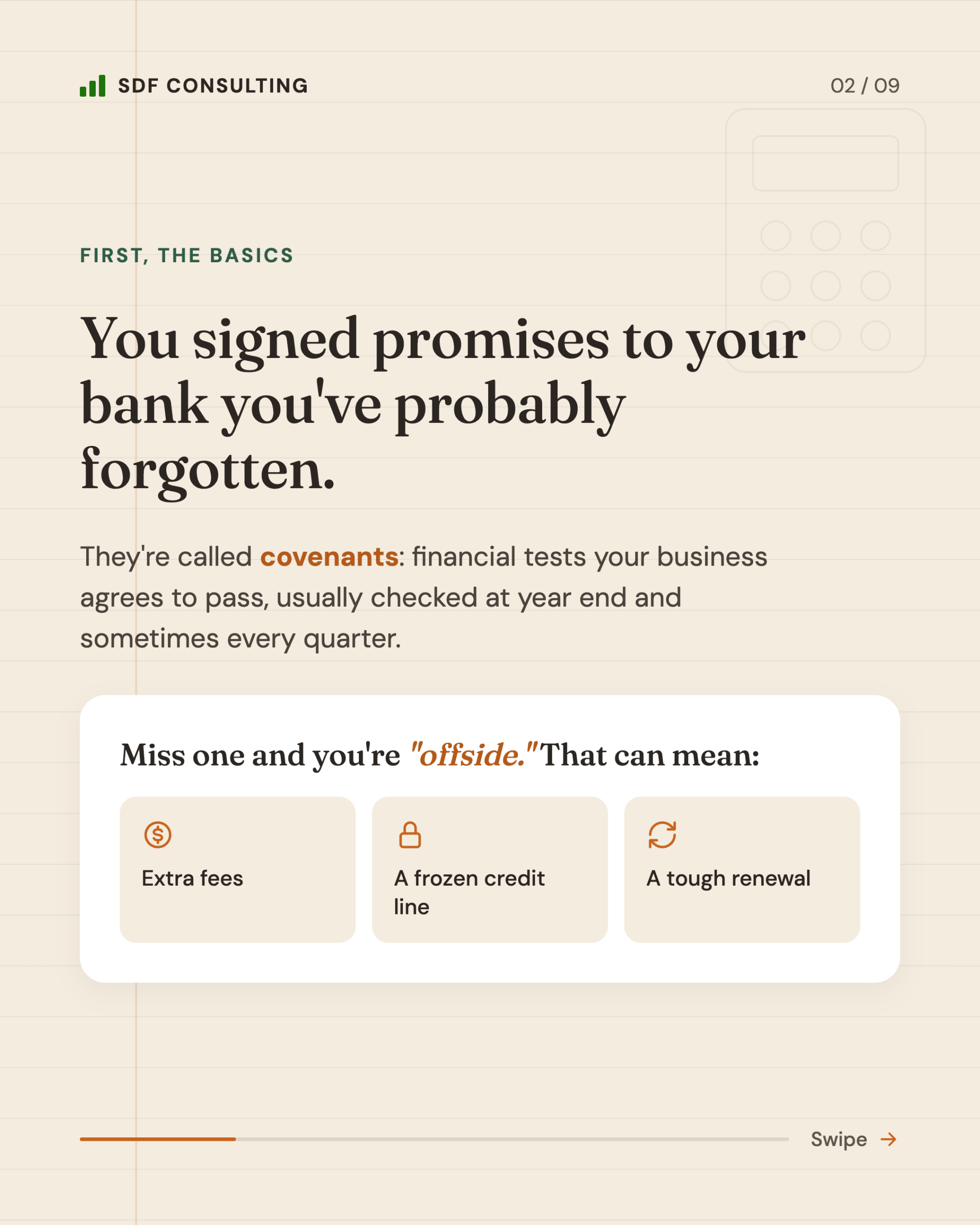
A covenant is a promise in your loan agreement. Some are about behaviour, such as sending your bank annual financial statements or keeping your business insured. Others are financial tests your business has to pass, and those are the ones this guide is about.
Most Canadian banks test small and mid-sized businesses once a year, using the financial statements your accountant prepares at year end. Larger lines of credit are often tested quarterly, and many come with a monthly report on your receivables and inventory.
If your business fails a test, you are offside. That doesn’t automatically mean the bank calls your loan, but it gives the bank options. Common outcomes include:
- A waiver fee, or a higher interest rate
- A reduced or frozen line of credit
- Tighter terms or extra conditions at renewal
- In serious or repeated cases, the bank asking you to move your banking elsewhere
Every loan agreement is different. Some smaller loans have few or no financial covenants at all. Your own agreement, usually in a section called “financial covenants,” lists exactly what your bank measures and the targets you have to hit.
Number 1: Working capital
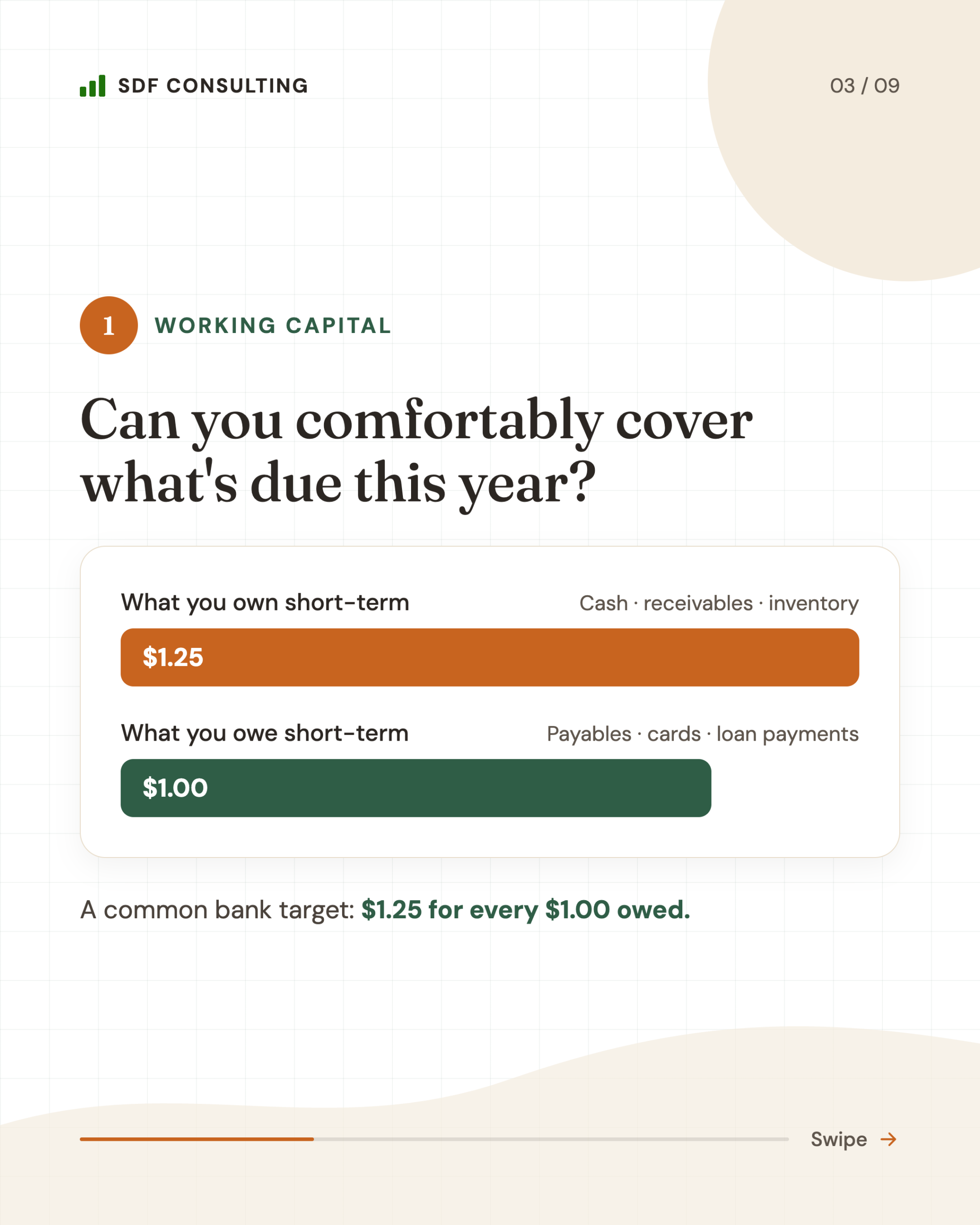
The question your bank is asking: can you comfortably cover what’s due in the next year?
Your bank compares two groups of numbers on your balance sheet:
- What you own short-term, meaning things that turn into cash within a year: cash in the bank, money customers owe you (receivables), and inventory.
- What you owe short-term, meaning bills due within a year: supplier invoices (payables), credit card balances, taxes owing, and the next 12 months of payments on your loans.
Divide the first by the second and you get your current ratio, sometimes called the working capital ratio. A common bank target is 1.25, meaning $1.25 of short-term assets for every $1.00 of short-term debt. Some banks use 1.20 or 1.10, so check your agreement.
A quick example. Say your business has $250,000 in cash, receivables and inventory, and $200,000 in short-term bills and loan payments. Your current ratio is 1.25, right at a typical minimum. Pay $60,000 cash for a new truck and your short-term assets drop to $190,000. Your ratio falls to 0.95 and you’re offside, even though the business didn’t lose a dollar.
Number 2: Debt service coverage
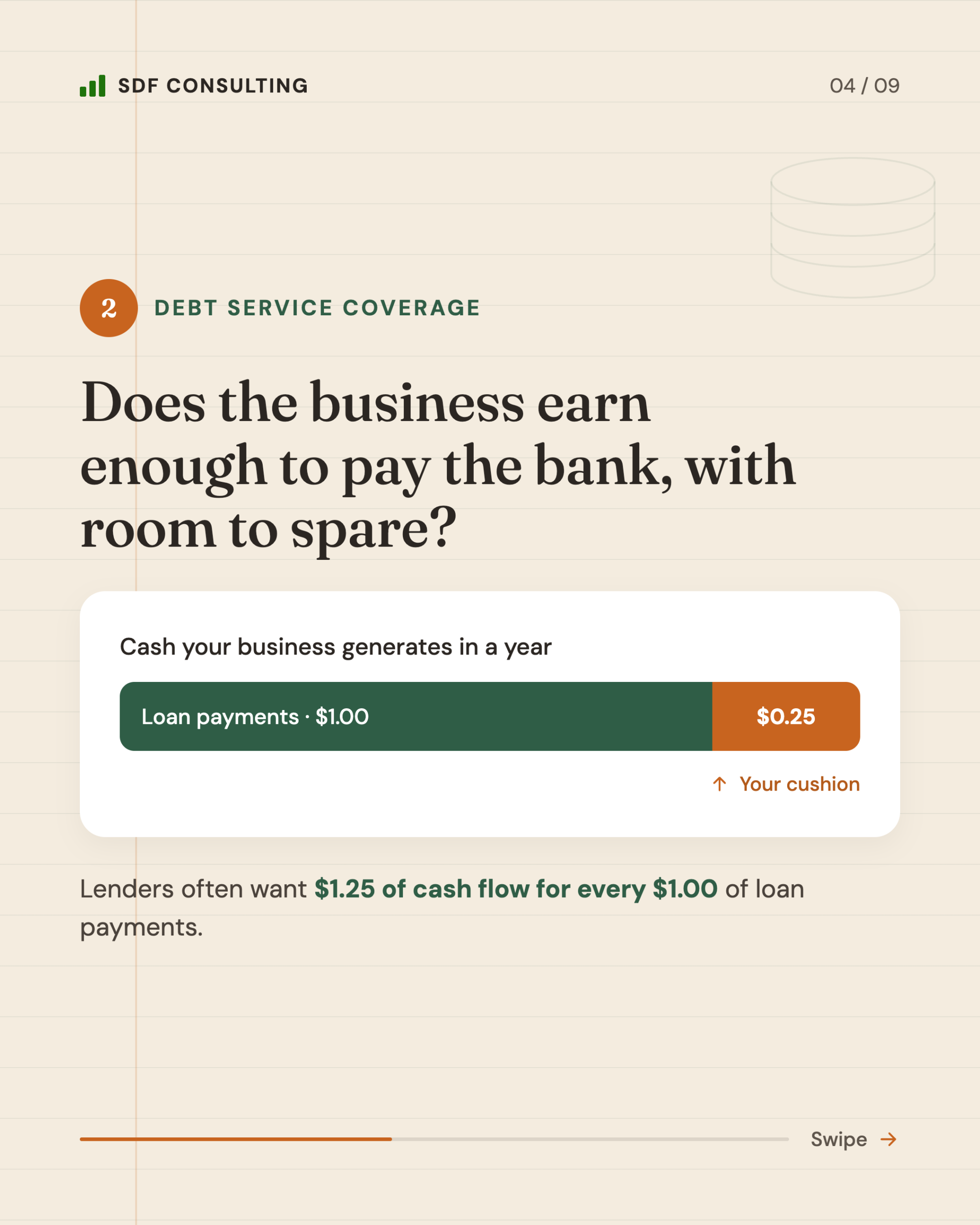
The question your bank is asking: does the business earn enough to make its loan payments, with room to spare?
Your bank looks at the cash your business generates from operations over the year. It’s usually based on profit before interest, taxes, depreciation and amortization, sometimes called EBITDA. It then compares that to the principal and interest you have to pay on your loans in the same year.
The result is your debt service coverage ratio. Some banks use a close cousin called the fixed charge coverage ratio, which can also count items like equipment lease payments, rent, or money taken out by the owners. The exact formula is in your loan agreement, and it matters.
A common target is 1.25: $1.25 of cash flow for every $1.00 of loan payments. That extra 25 cents is the cushion your bank wants to see.
A quick example. Your business generates $150,000 of cash flow and owes $100,000 a year in principal and interest. Your ratio is 1.50, comfortably above a 1.25 target. Add a new $40,000-a-year equipment loan without growing profit, and your ratio drops to about 1.07. That would fail a 1.25 test.
Number 3: Your borrowing base
The question your bank is asking: how much can you safely draw on your line right now?
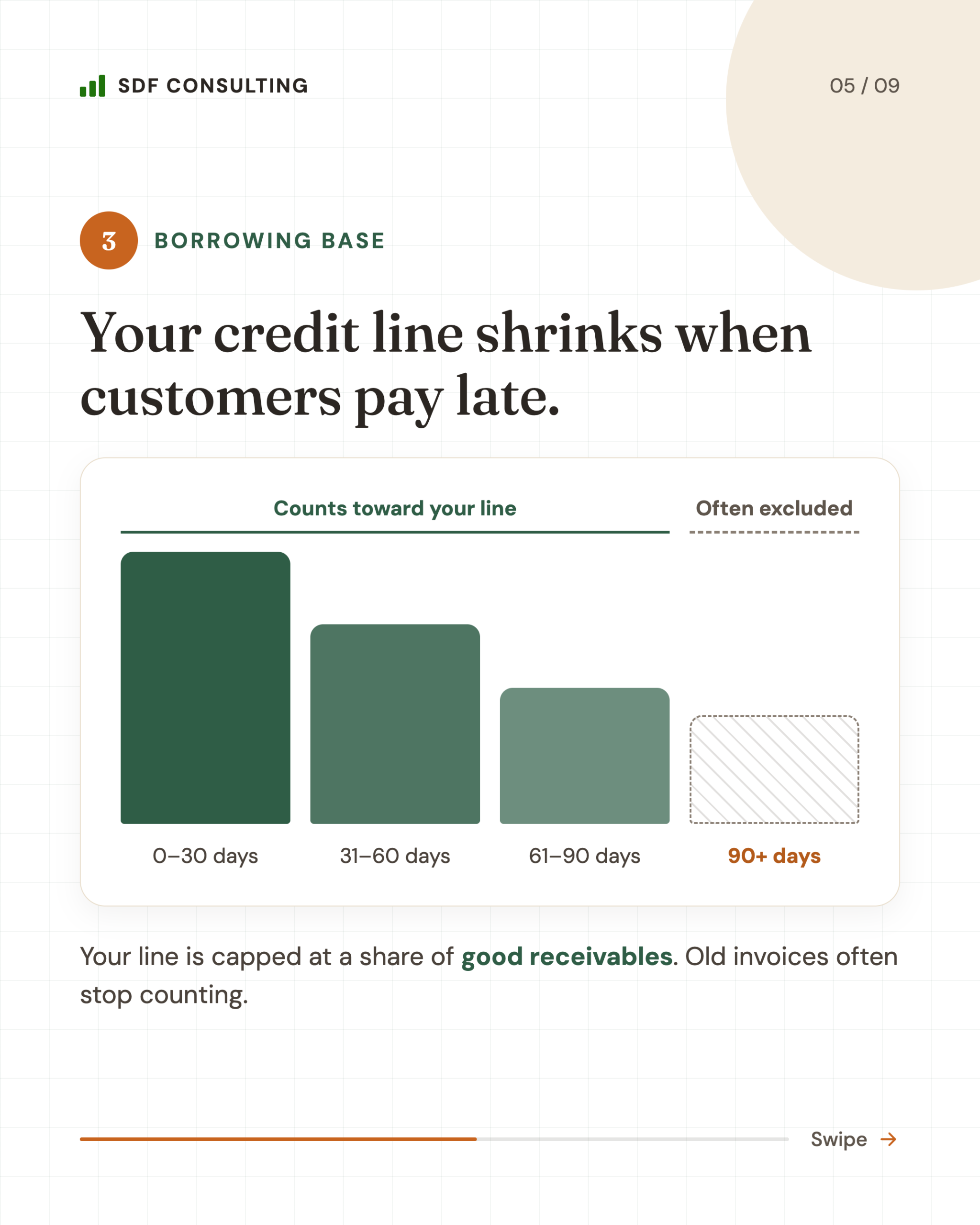
If you have an operating line of credit, the limit on paper isn’t always what you can actually use. Many lines are margined, which means the amount available each month depends on your receivables and inventory. This calculation is your borrowing base, and it’s often reported to the bank monthly.
Terms vary, but a common structure looks like this:
- Up to 75% of good receivables. Invoices more than 90 days old usually don’t count, and neither do amounts owed by related companies.
- Up to 50% of inventory, often with a dollar cap.
- Minus amounts owed to the government that could rank ahead of the bank, such as unpaid HST or payroll deductions.
A quick example. You have a $200,000 line. Customers owe you $200,000, but $40,000 of that is over 90 days. Only $160,000 counts, so your receivables support $120,000. Add $50,000 from inventory and you can draw $170,000. Owe $10,000 in unpaid HST and the bank may hold that back too, leaving $160,000.
The trap is timing. Slow-paying customers shrink your available credit exactly when cash is already tight.
Where the nasty surprises come from
Most covenant breaches don’t come from a bad year. They come from ordinary decisions made without checking the numbers first.
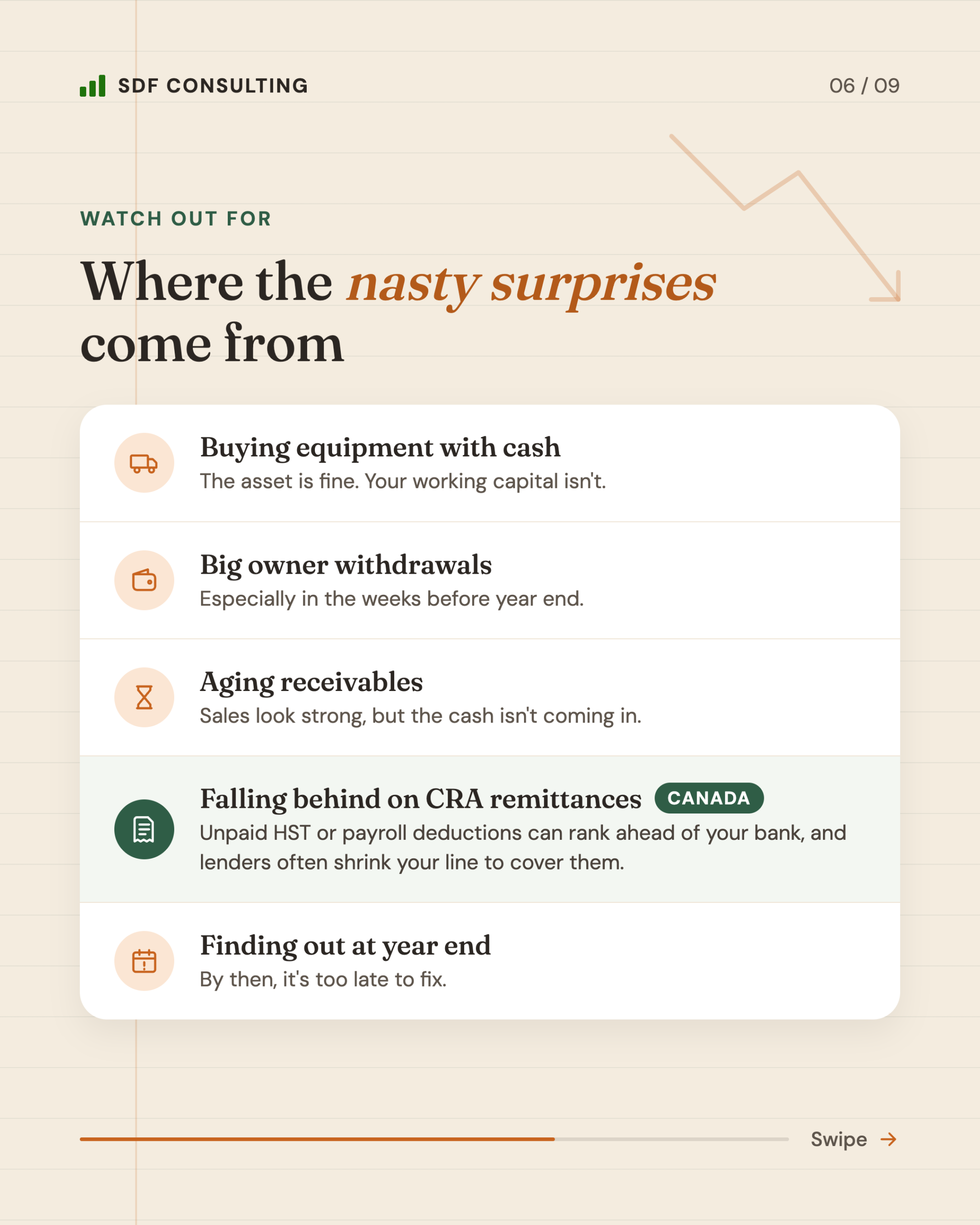
Buying equipment with cash. The truck or machine is a good asset, but it’s a long-term one. Paying cash for it moves money out of working capital, as the example above shows. Financing the purchase over its useful life usually protects your ratios.
Big owner withdrawals. Large dividends, bonuses or shareholder loan repayments reduce cash and can hurt both working capital and debt service coverage. Timing them just before year end is especially risky, because that’s often when the bank measures you.
Aging receivables. Strong sales don’t help if customers pay slowly. Invoices that cross 90 days can drop out of your borrowing base, and they tie up cash you need for bills.
Falling behind on CRA remittances. This one is specific to Canada. HST you collect and payroll deductions you withhold are held in trust for the government. Under the CRA’s deemed trust rules, those amounts can rank ahead of your bank’s security. Banks know this, so many loan agreements reduce your borrowing base by any amounts owing, and arrears can be a default in their own right.
Finding out at year end. Your accountant usually finishes your statements a few months after year end. If that’s the first time anyone calculates your covenants, a breach has already happened and it’s too late to fix.
How to stay onside
Staying onside isn’t complicated. It’s a habit. These five steps cover most of it.
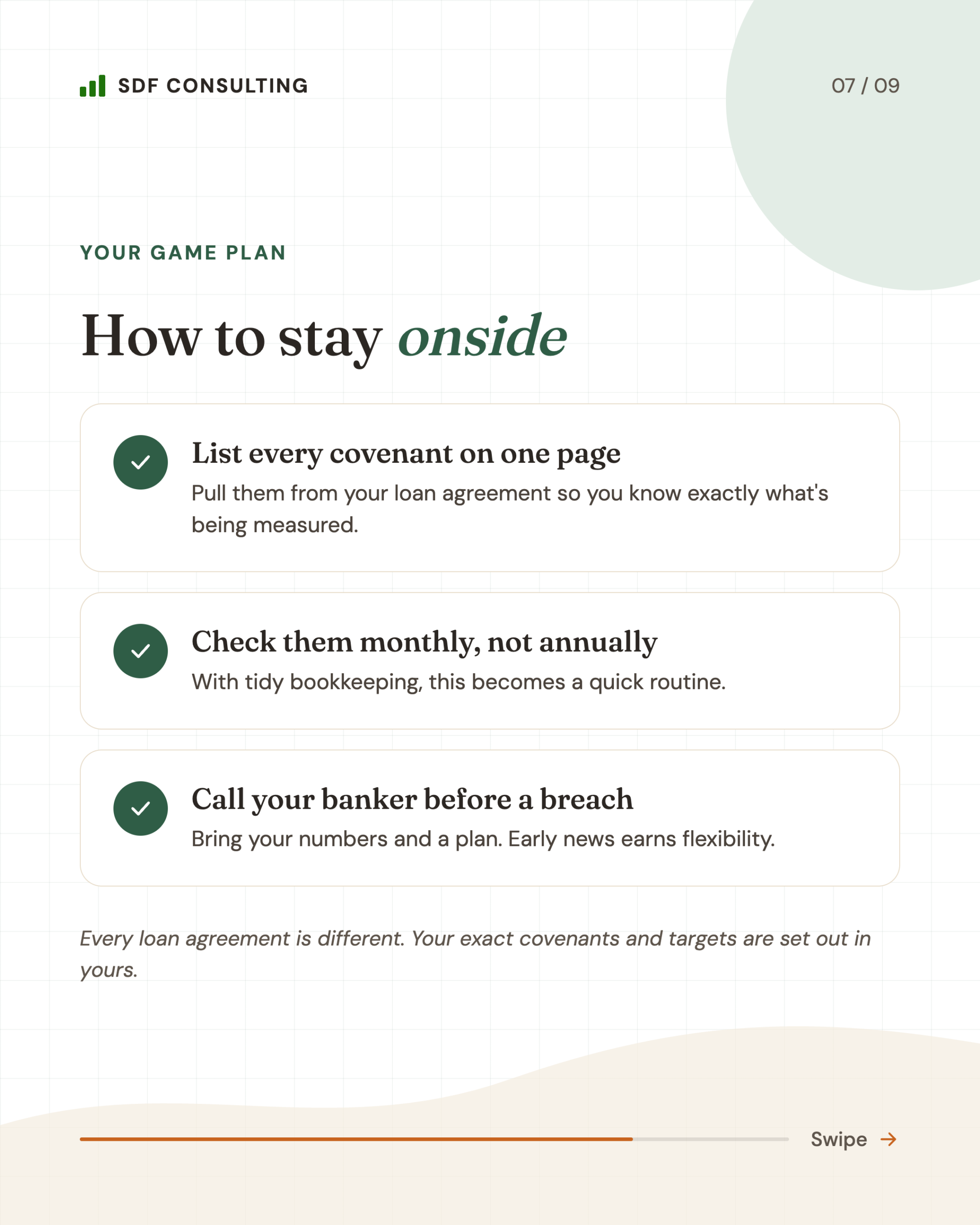
- Put your covenants on one page. Pull every financial covenant from your loan agreement: what’s measured, the target, and how often it’s tested. Keep it where you and your bookkeeper can see it.
- Check them monthly, not annually. With up-to-date bookkeeping, calculating three ratios takes minutes. Monthly checks show a problem months before your bank does.
- Run the numbers before big decisions. Before buying equipment, taking a large draw or adding new debt, ask what it does to your ratios. If the answer is “pushes us close to the line,” consider financing or timing it differently.
- Stay current with CRA and your receivables. File and pay HST and payroll remittances on time, and follow up on invoices well before they reach 90 days.
- Call your banker before a breach, not after. If you can see a problem coming, ask for a waiver early. Bring your numbers and a plan to fix them.
The bottom line
A waiver requested early is a conversation. A breach discovered late is a problem.
Banks don’t like surprises. The owners who get flexibility when times are tight are the ones who show up with their numbers and a plan. Knowing your three numbers, and checking them every month, puts you in that group.
Not sure where you stand? SDF Consulting helps owner-operators understand their loan agreements, track their covenants, and prepare for conversations with their bank.