
The Most Valuable Numbers in Your Business Aren’t Always the Ones on the Income Statement
Ask most business owners which number they watch most closely, and the answer is almost always revenue.
Revenue is important. It tells you how much business you generated and whether your company is growing. But revenue is a lagging indicator. It tells you what has already happened.
The most successful business leaders understand that sustainable growth comes from paying attention to the metrics that signal what is likely to happen next.
Throughout my career as a CFO, I’ve learned that strong financial management isn’t about reviewing historical results alone. It’s about identifying the leading indicators that provide visibility into the future. The businesses that consistently outperform their competitors are not waiting for monthly financial statements to reveal a problem. They are monitoring key performance indicators that provide early warning signs—or early opportunities—months in advance.
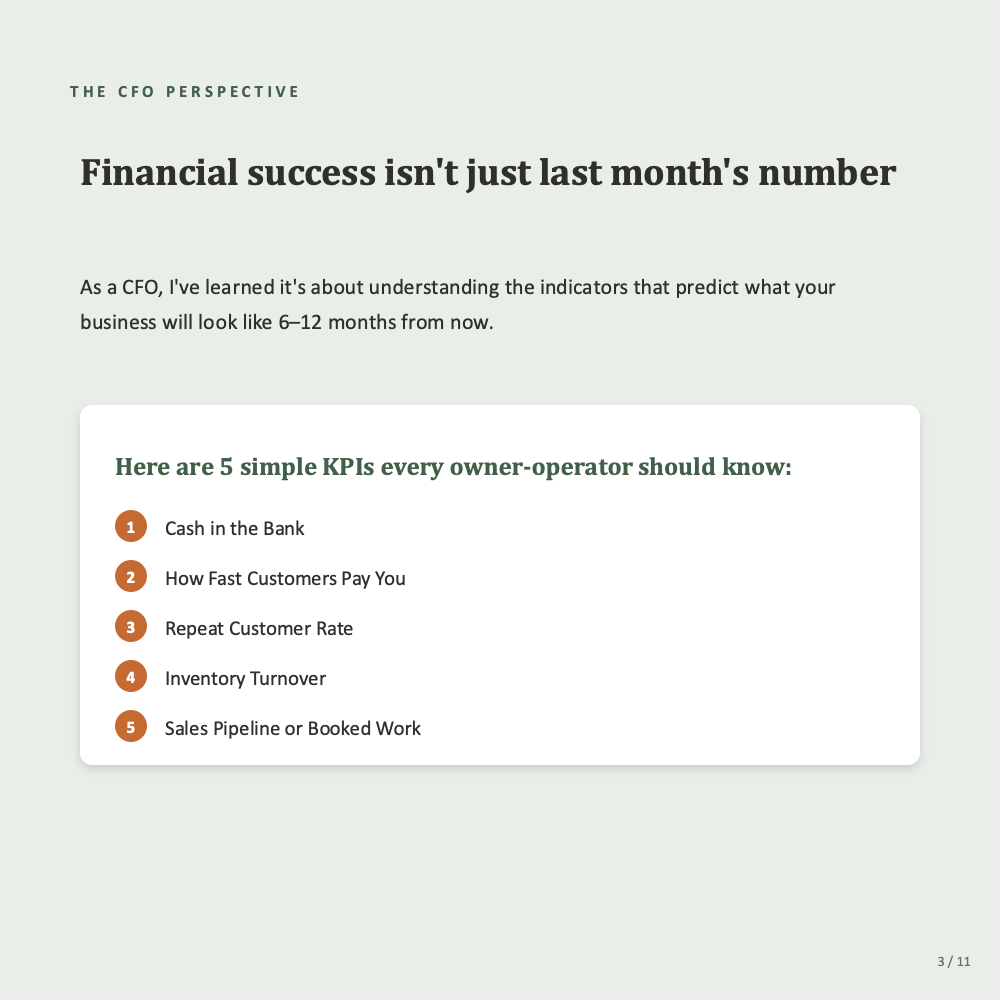
While every industry has its own unique metrics, there are five financial KPIs that I believe every owner-operator should understand and review regularly. These indicators provide valuable insight into cash flow, operational efficiency, customer loyalty, and future revenue generation.
1. Cash in the Bank: The Ultimate Reality Check
Many companies generate impressive revenues and even report healthy profits, yet still find themselves under financial stress. The reason is simple: profits do not pay bills—cash does.
Cash on hand is one of the clearest indicators of business stability and resilience. It determines your ability to meet payroll obligations, pay suppliers, invest in growth opportunities, respond to unexpected challenges, and navigate economic uncertainty.
A healthy cash position provides flexibility and confidence. A weak cash position creates pressure, limits strategic decision-making, and often forces leadership teams into reactive rather than proactive decisions.
Business owners should regularly monitor not only their current cash balance but also their projected cash position over the next 30, 60, and 90 days. Understanding where your cash is headed is often more important than understanding where it is today.
2. Customer Payment Speed: How Fast You Turn Sales Into Cash
Making a sale is only part of the equation. Getting paid is what ultimately sustains the business.
One of the most overlooked indicators of future financial health is the speed at which customers pay their invoices. Often measured through Accounts Receivable Days or Days Sales Outstanding (DSO), this KPI reveals how quickly your business converts revenue into usable cash.
When customer payment cycles begin to lengthen, it can signal several potential issues:
- Customers may be experiencing financial stress.
- Collection processes may be ineffective.
- Credit policies may be too lenient.
- Cash flow challenges may be approaching.
Conversely, businesses that collect payments efficiently typically enjoy stronger liquidity, lower borrowing requirements, and greater financial flexibility.
Monitoring this metric allows leadership teams to identify trends early and address collection challenges before they become significant cash flow issues.
3. Repeat Customer Rate: The KPI That Measures Customer Confidence
Acquiring new customers is expensive. Retaining existing customers is where sustainable profitability is often created.
Your repeat customer rate measures the percentage of customers who return to purchase again. More importantly, it provides insight into customer satisfaction, service quality, product value, and long-term market positioning.
A strong repeat customer rate often translates into:
- More predictable revenue streams
- Lower customer acquisition costs
- Higher customer lifetime value
- Greater business stability during economic fluctuations
In many cases, declining repeat customer activity becomes visible long before revenue begins to decline. That’s why this metric can serve as a powerful early warning indicator.
When customers consistently choose to do business with you again, they are effectively validating the strength of your business model.
4. Inventory Turnover: The Efficiency Indicator
For businesses that carry inventory, turnover rates provide a critical window into operational performance.
Inventory turnover measures how quickly products move through the business. It helps answer an important question: Are we effectively converting inventory investments into sales?
Slow-moving inventory can create several challenges:
- Capital becomes trapped in stock instead of being available for growth initiatives.
- Storage and carrying costs increase.
- Obsolescence risk grows.
- Cash flow becomes constrained.
On the other hand, healthy inventory turnover generally indicates strong demand, efficient purchasing practices, and sound operational management.
Business owners should carefully monitor turnover trends over time rather than relying solely on point-in-time inventory balances. A slowdown in inventory movement may be signaling changes in customer demand well before sales figures begin to reflect the shift.
5. Sales Pipeline and Booked Work: Your Forward-Looking Revenue Forecast
If revenue tells you where you’ve been, your sales pipeline tells you where you’re going.
One of the most important predictive KPIs is the value and quality of future work already identified, quoted, contracted, or scheduled.
Depending on your industry, this may include:
- Qualified sales opportunities
- Signed customer contracts
- Booked projects
- Backlog
- Recurring revenue commitments
A strong pipeline provides visibility into future revenue and helps leadership teams make informed decisions regarding hiring, investment, production planning, and capital allocation.
Equally important is monitoring pipeline quality. A large pipeline that consistently fails to convert offers little value. The most effective organizations track both pipeline volume and conversion rates to understand how much future revenue is realistically expected.
When monitored consistently, pipeline performance can provide leadership with a six-to-twelve-month view of business momentum.
Winning Businesses Focus on Leading Indicators
Too many businesses operate by looking in the rearview mirror. They analyze results after the fact and react when challenges have already materialized.
High-performing organizations take a different approach.
They focus on leading indicators. They monitor cash before cash becomes a problem. They identify changes in customer behavior before sales decline. They watch collection trends before liquidity tightens. They evaluate operational efficiency before margins deteriorate.
These businesses understand that financial success is rarely determined by what happened last month.
It is determined by the decisions made today based on what the data suggests will happen tomorrow.
Final Thought
Revenue matters. Profit matters.
But if I had to choose the metrics that provide the greatest visibility into future performance, I would focus on these five:
- Cash in the Bank
- Customer Payment Speed
- Repeat Customer Rate
- Inventory Turnover
- Sales Pipeline or Booked Work
Together, they provide a powerful view of your company’s financial trajectory and your ability to grow sustainably.
The question for every business owner is simple:
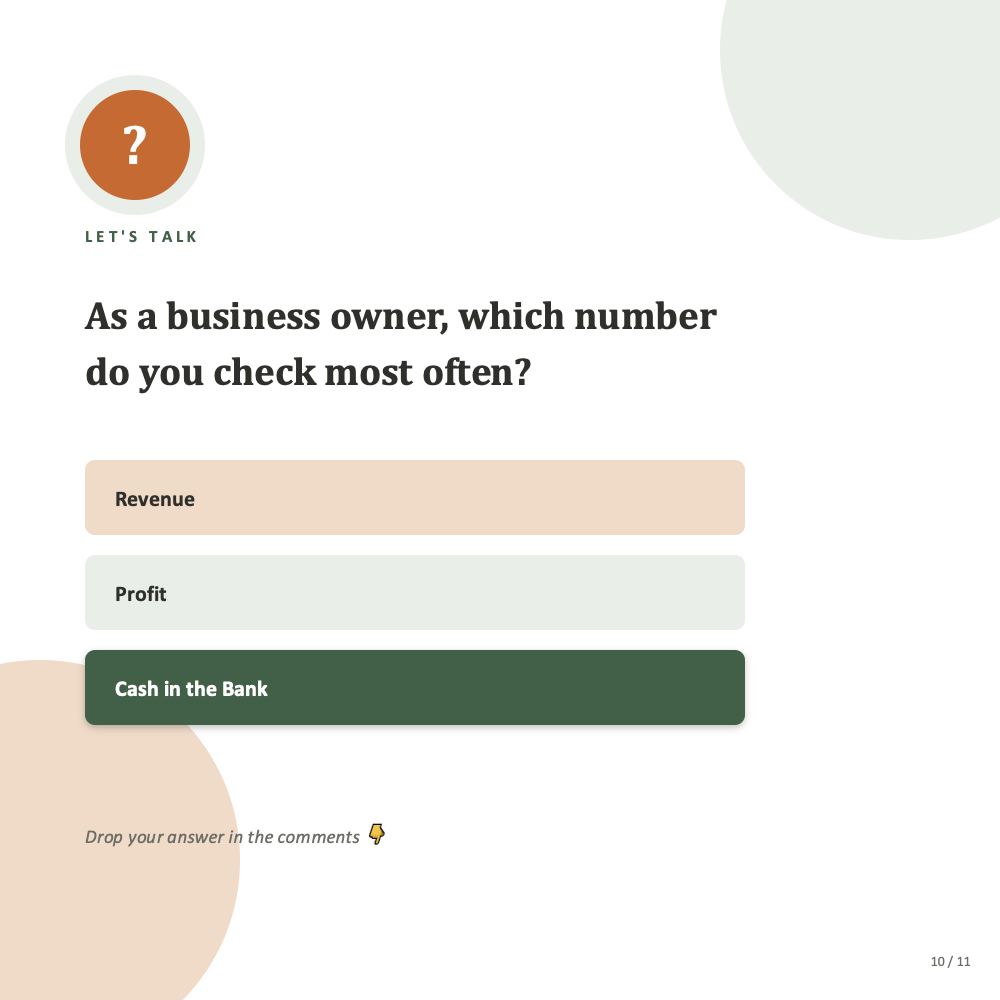
Which number do you check most often—revenue, profit, or cash in the bank? And more importantly, are you paying enough attention to the indicators that tell you what’s coming next?