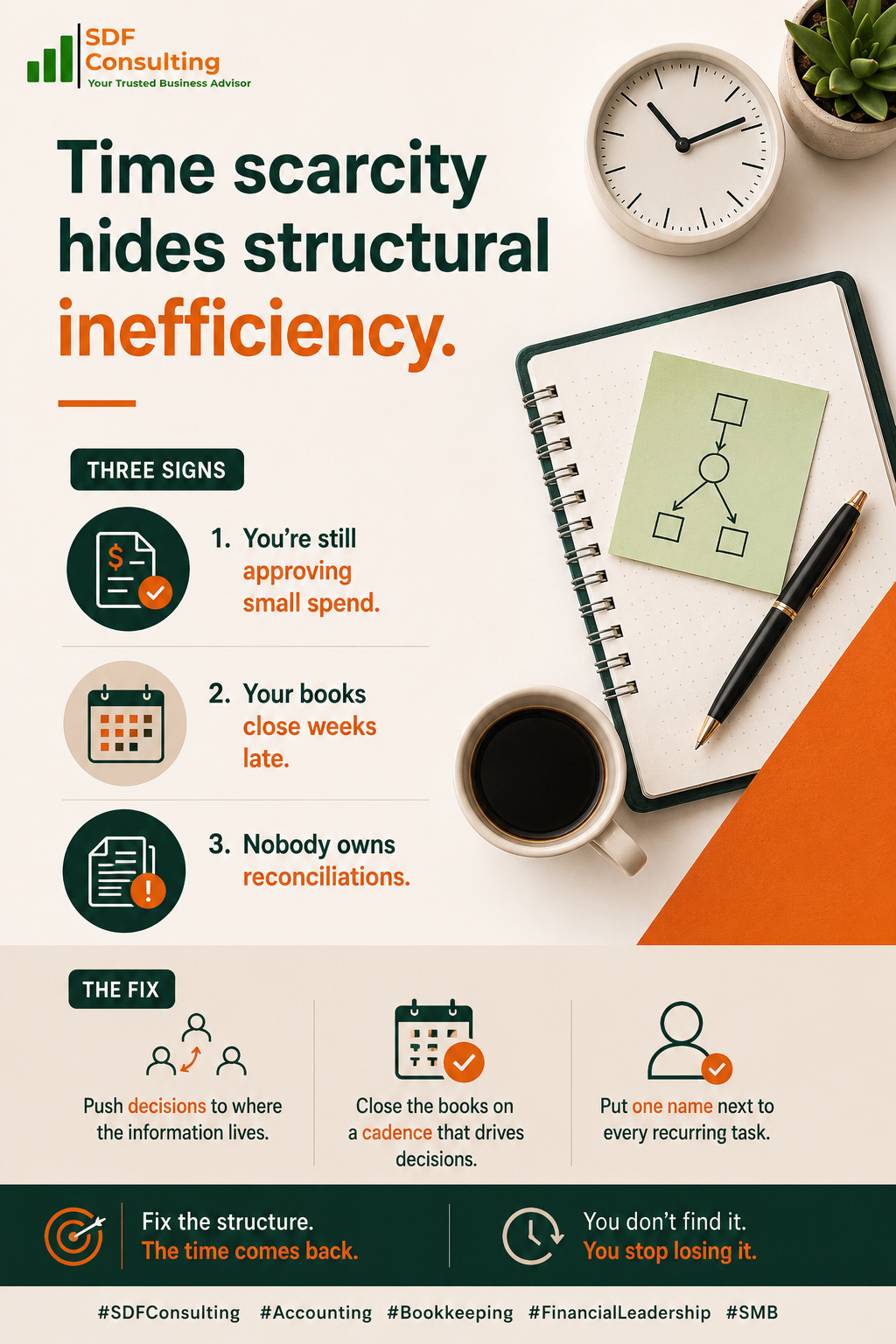

Time Scarcity Is Often a Structural Problem, Not a Time Problem
If you spend any amount of time with small and mid-sized business owners, you’ll hear a familiar refrain:
“I just need more hours in the day.”
The assumption is understandable. The owner is working nights, answering emails on weekends, approving expenses between meetings, and constantly feeling behind. From the outside, it looks like a capacity problem.
But in most growing businesses, the issue isn’t a shortage of time.
It’s structural inefficiency.
Time scarcity is often the visible symptom of deeper operating problems. The business has developed processes, decision-making patterns, and accountability gaps that force work upward toward leadership. As a result, the owner becomes the bottleneck for activities that should be happening without their involvement.
The reality is simple: people rarely run out of time because they’re working too little. They run out of time because the system around them is creating unnecessary work.
The Hidden Cost of Structural Inefficiency
Most inefficiencies don’t announce themselves dramatically.
They appear in small moments:
- An employee asks for approval on a routine purchase.
- Financial reports arrive weeks after month-end.
- Account reconciliations sit unfinished until they become urgent.
- Team members wait for direction before making straightforward decisions.
Individually, these issues seem minor.
Collectively, they create hundreds of hours of wasted effort each year.
The owner feels overwhelmed, employees feel dependent, and growth becomes increasingly difficult because every important activity eventually funnels back through the same person.
The result is a business that appears busy but operates far below its potential efficiency.
Sign #1: You’re Still Approving Small-Dollar Spending
One of the clearest indicators of a structural problem is when routine spending requires executive approval.
The justification is usually something like:
“It’s faster if I just approve it myself than explain the process.”
On the surface, that sounds reasonable.
In reality, it signals that no scalable process exists.
If every $500 invoice, software subscription, or vendor payment passes through the owner, the organization has effectively built a workflow that requires executive involvement for routine decisions.
The immediate cost is time.
The larger cost is organizational dependence.
Employees never develop judgment because they’re never expected to use it. Decision-making remains concentrated at the top, causing delays, frustration, and unnecessary interruptions throughout the business.
Strong organizations don’t scale by increasing approvals.
They scale by establishing clear spending thresholds, decision frameworks, and accountability structures that allow decisions to be made where the relevant information already exists.
When people closest to the work can make routine decisions confidently, leadership gains time for strategic activities that actually require executive attention.
Sign #2: Your Books Close Weeks Late
Many businesses accept delayed financial reporting as normal.
Month-end becomes month-and-a-half-end.
By the time reports arrive, leaders have already made dozens of decisions without reliable information.
The consequence isn’t simply slower reporting.
It’s slower decision-making.
When financial data arrives late, confidence in the numbers declines. Teams begin questioning whether information is current, complete, or accurate. Meetings become filled with debates about data instead of discussions about action.
Ironically, the time spent second-guessing stale numbers often exceeds the effort required to create a disciplined close process in the first place.
Timely financial information is not an accounting luxury.
It’s an operational requirement.
Businesses that close quickly gain the ability to identify problems earlier, allocate resources more effectively, and make decisions with greater confidence.
The faster a company needs to make decisions, the more important a consistent reporting cadence becomes.
Financial visibility is not about accounting efficiency.
It’s about management efficiency.
Sign #3: Nobody Owns Reconciliations
There is a simple rule in operations:
When everyone owns something, nobody owns it.
Reconciliations are a perfect example.
Bank accounts, credit cards, prepaid expenses, and balance sheet accounts often fall into a gray area where multiple people assume someone else is managing them.
As a result, they accumulate.
What should be a brief weekly task becomes a quarterly cleanup project. Small discrepancies turn into large investigations. Documentation becomes harder to locate. Errors become more expensive to resolve.
The issue is rarely technical.
It’s accountability.
When a recurring responsibility lacks a clearly assigned owner, work naturally drifts until it reaches a crisis point.
Organizations that operate efficiently eliminate this ambiguity. Every recurring process has a single accountable owner, a defined cadence, and a clear expectation of completion.
The result is less firefighting, fewer surprises, and significantly less wasted time.
Why the Problem Looks Like a Time Shortage
Structural inefficiency is deceptive because it disguises itself as workload.
The owner doesn’t see broken systems.
They see a calendar packed with meetings.
They don’t see unclear accountability.
They see long working hours.
They don’t see poor process design.
They see an endless to-do list.
This creates the illusion that working harder is the solution.
But adding more hours to an inefficient structure only increases the amount of inefficiency being supported.
A business cannot permanently solve operational problems through individual effort.
Eventually, the system determines the outcome.
The Real Fix: Redesign the Structure
The solution is not productivity hacks, longer hours, or better calendar management.
The solution is operational design.
Push Decisions to Where Information Already Exists
Decisions should be made by the people closest to the facts.
When every decision travels upward for approval, organizations become slower and leaders become overwhelmed.
Create clear guardrails, spending limits, and accountability standards so routine decisions can happen without executive intervention.
Close Financials at the Speed of Decision-Making
Financial reporting should support management, not simply satisfy accounting requirements.
If leadership needs weekly insight, build weekly visibility.
If monthly reporting drives decisions, make month-end close a disciplined process rather than a recurring scramble.
The goal is confidence in current information.
Assign One Owner to Every Recurring Task
Every recurring process should have a name beside it.
Not a department.
Not a team.
A person.
Ownership creates accountability, accountability creates consistency, and consistency prevents work from becoming a future crisis.
Fix the Structure, and Time Returns
Most business owners do not need more hours.
They need fewer unnecessary decisions.
Fewer bottlenecks.
Fewer recurring cleanups.
Fewer systems that depend on personal intervention to function.
Time is rarely recovered through better scheduling alone.
It’s recovered when the organization is designed to operate efficiently without constant oversight.
That’s why “I don’t have enough time” is often the wrong diagnosis.
The real issue is that the business is leaking time through ineffective structures, unclear ownership, and avoidable process friction.
Fix the structure, and the time comes back naturally.
You don’t find more time.
You simply stop losing it.