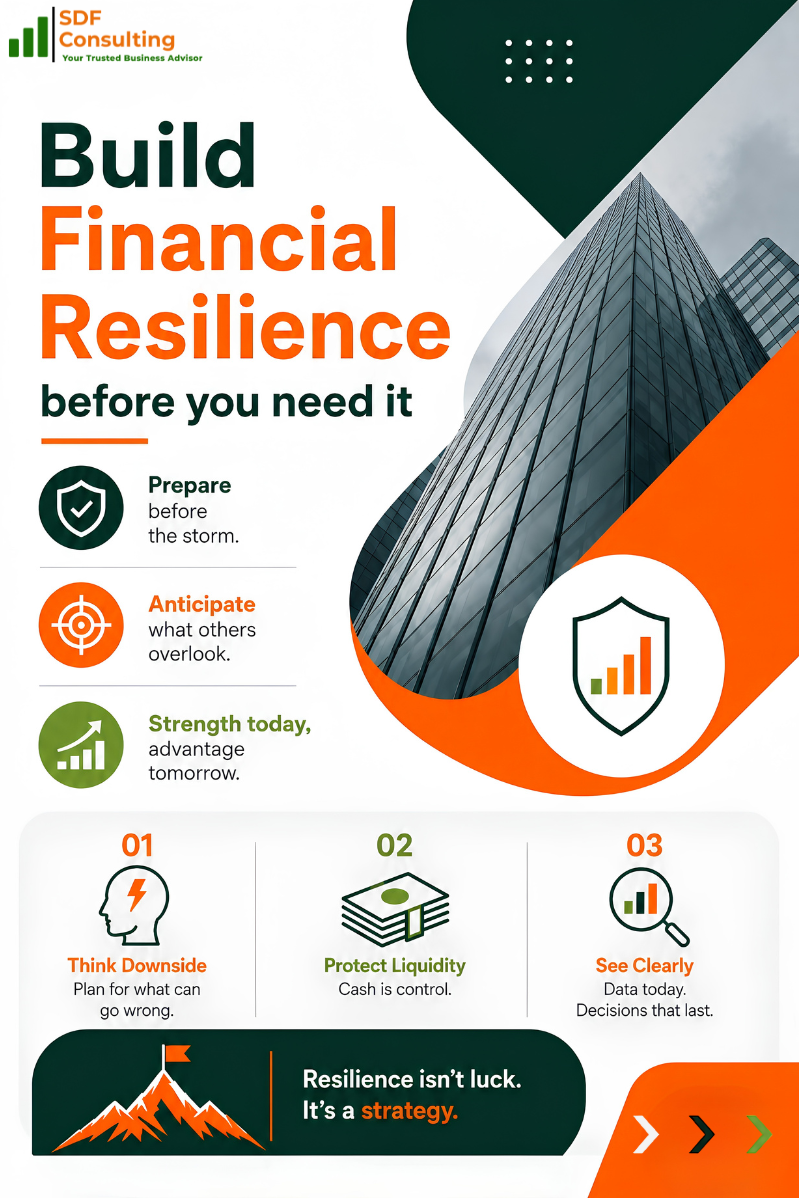

The Discipline of Preparedness Over Optimism
Markets do not reward optimism—they reward preparedness. While ambition and growth narratives often dominate executive agendas, history consistently demonstrates that resilience, not aspiration, determines long-term survival.
Most organizations do not fail because they fall short of aggressive growth targets. They fail because they inadequately prepare for adverse scenarios. Downside risk is frequently underestimated, insufficiently modeled, or entirely dismissed—until it materializes.
Financial resilience is not something that can be engineered in the midst of disruption. By the time stress appears, the outcome has already been determined by decisions made earlier. Resilience is a precondition, not a reaction.
Defining Financial Resilience
At its core, financial resilience is the ability of an organization to maintain operational continuity, strategic flexibility, and decision-making control under adverse conditions. It is not merely about survival—it is about preserving optionality when others are constrained.
Resilient companies do not depend on favorable conditions. They operate from a position of structural strength, allowing them to withstand volatility, absorb shocks, and capitalize on opportunities that disruption often creates.
The Three Defining Disciplines of Resilient Organizations
1. Downside Thinking as a Strategic Starting Point
High-performing organizations do not begin with best-case scenarios. They begin by rigorously stress-testing their vulnerabilities.
The fundamental question is not “What can go right?”—it is “What could break us?”
This shift in orientation is critical. It forces leadership teams to confront structural weaknesses, hidden dependencies, and flawed assumptions before they are exposed in real time. Scenario modeling, stress testing, and downside planning are not defensive exercises—they are strategic necessities.
If a business model cannot withstand pressure, it is not a strategy—it is a bet.
Resilient organizations embed downside thinking into capital allocation, operational planning, and strategic decision-making. They assume that volatility is inevitable and prepare accordingly.
2. Liquidity as a Source of Strategic Power
Liquidity is often misunderstood as a passive buffer—a reserve held for emergencies. In reality, liquidity is a source of control.
Cash is not simply a cushion; it is leverage.
It determines whether an organization can make proactive decisions or is forced into reactive ones when conditions tighten. In constrained environments, liquidity dictates negotiating power, access to opportunities, and the ability to maintain strategic direction without compromise.
Organizations with strong liquidity positions can:
-
-
- Continue investing while competitors retreat
- Negotiate from strength rather than necessity
- Absorb shocks without destabilizing operations
-
Conversely, those without sufficient liquidity are often forced into unfavorable decisions—costly financing, distressed asset sales, or unavoidable retrenchment.
In uncertain environments, liquidity is not optional—it is foundational.
3. Accounting as a Strategic Intelligence Function
In resilient organizations, accounting is not relegated to compliance or retrospective reporting. It is elevated to a forward-looking strategic capability.
Finance functions serve as an early warning system—providing real-time visibility into performance, forward projections, and emerging risks.
This requires three core capabilities:
-
-
- Real-time financial visibility: Accurate, timely data that reflects current conditions—not lagging indicators
- Disciplined forecasting: Continuous refinement of projections based on evolving inputs
- Scenario planning: Clear modeling of multiple potential outcomes, enabling rapid response
-
When executed effectively, finance becomes a source of strategic insight rather than administrative output. Leadership gains the clarity needed to act early, adjust course, and avoid being surprised by predictable risks.
From Stability to Strategic Advantage
Financial resilience is often framed as a defensive posture. In reality, it creates offensive advantage.
Organizations that are structurally prepared for disruption are positioned not only to endure downturns, but to move decisively within them. They acquire assets, capture market share, and strengthen their competitive positioning while others are constrained by fragility.
Preparedness enables speed. Stability enables boldness.
Bottom Line
Resilient companies do not rely on favorable conditions to succeed. They are deliberately constructed to endure unfavorable ones.
They think rigorously about downside risk before it materializes.
>They treat liquidity as a strategic asset, not a passive reserve.
>They elevate finance into a forward-looking intelligence function.
In doing so, they ensure that when disruption comes—as it inevitably will—they are not reacting to events. They are operating with control.