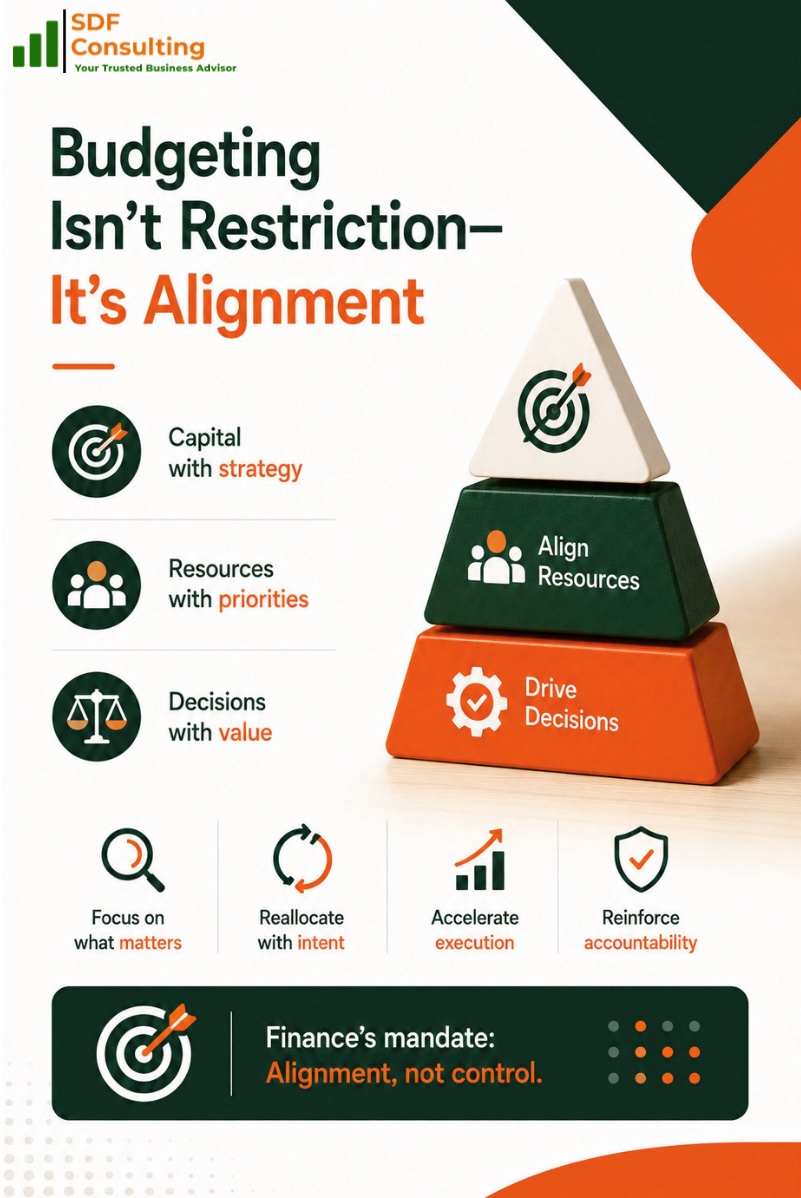

Budgeting Isn’t Restriction—It’s Strategic Alignment
At the executive level, budgeting is often misunderstood. It is not a constraint mechanism designed to limit ambition or stifle innovation. Rather, it is a strategic instrument—one that ensures every dollar deployed advances the organization’s most critical objectives.
When approached with discipline and intent, budgeting becomes less about control and more about alignment.
Reframing the Purpose of Budgeting
Traditional views position budgeting as a guardrail against overspending. While financial discipline remains essential, this lens is incomplete—and, in many cases, counterproductive.
High-performing organizations recognize that the true purpose of budgeting is to answer a far more important question:
Where will capital create the greatest strategic advantage?
This shift in perspective transforms budgeting from a reactive exercise into a proactive driver of enterprise value.
The Three Pillars of Strategic Budget Alignment
A well-constructed budget serves as a blueprint for execution, aligning three critical dimensions of the organization:
1. Capital with Strategy
Every allocation of capital should directly support strategic priorities. Whether investing in growth, innovation, talent, or infrastructure, spending decisions must trace back to clearly defined objectives.
When budgets and strategy diverge, resources are diluted—and so is impact.
2. Resources with Priorities
Time, talent, and capital are finite. Budgeting forces organizations to confront this reality and make deliberate choices about where to concentrate effort.
This clarity eliminates ambiguity and ensures that teams are focused on what matters most—rather than what is simply urgent or habitual.
3. Decisions with Long-Term Value
Short-term pressures can easily distort decision-making. A disciplined budgeting process introduces rigor, ensuring that investments are evaluated through a long-term value lens.
This is where strong financial leadership distinguishes itself—not by minimizing spend, but by maximizing return.
The Real Risk: Misallocation, Not Overspending
In many organizations, the greatest financial risk is not excessive spending—it is ineffective spending.
Misallocated capital manifests in several ways:
- Funding legacy initiatives that no longer drive value
- Underinvesting in emerging opportunities
- Spreading resources too thin across competing priorities
These inefficiencies erode competitiveness far more quietly—and often more dangerously—than overspending ever could.
Executives must therefore shift their focus from “How much are we spending?” to “How effectively are we allocating?”
From Static Budgets to Dynamic Capital Allocation
The pace of business today demands agility. Static, once-a-year budgeting processes are increasingly out of step with rapidly changing market conditions.
Modern finance leaders are redefining budgeting as a dynamic discipline characterized by:
- Continuous performance monitoring
- Agile reallocation of capital
- Real-time prioritization adjustments
This approach ensures that resources are consistently directed toward the highest-impact opportunities, even as conditions evolve.
Budgeting, in this context, becomes an ongoing strategic dialogue—not a fixed annual plan.
Enabling Speed, Not Slowing It Down
A common misconception is that budgeting introduces friction and slows decision-making. In reality, well-executed budgeting does the opposite.
By establishing clear priorities and guardrails, it:
- Sharpens organizational focus
- Accelerates execution by reducing decision ambiguity
- Reinforces accountability at every level
Teams move faster when they understand where to invest—and where not to.
The Evolving Mandate of Finance Leadership
Today’s finance leaders are no longer just stewards of cost control. They are architects of alignment.
Their mandate extends beyond safeguarding financial health to actively shaping how capital fuels strategy. This requires:
- Deep business partnership
- Forward-looking insight
- A willingness to challenge assumptions
In this role, finance becomes a catalyst for growth and transformation—not merely a function of oversight.
Conclusion: Alignment Is the Ultimate Objective
Budgeting, when done right, is not about saying “no.” It is about enabling the right “yes.”
It aligns capital with purpose, resources with priorities, and decisions with long-term value creation.
In a landscape defined by constant change and increasing complexity, organizations that master this alignment will not only operate more efficiently—they will execute more decisively and compete more effectively.
The mandate for finance is clear: not control, but alignment.