
The Misconception: Revenue as the Primary Driver
In many organizations, revenue is treated as the ultimate indicator of success. It becomes the metric that guides strategy, incentivizes teams, and frames performance narratives.
But this view is fundamentally flawed.
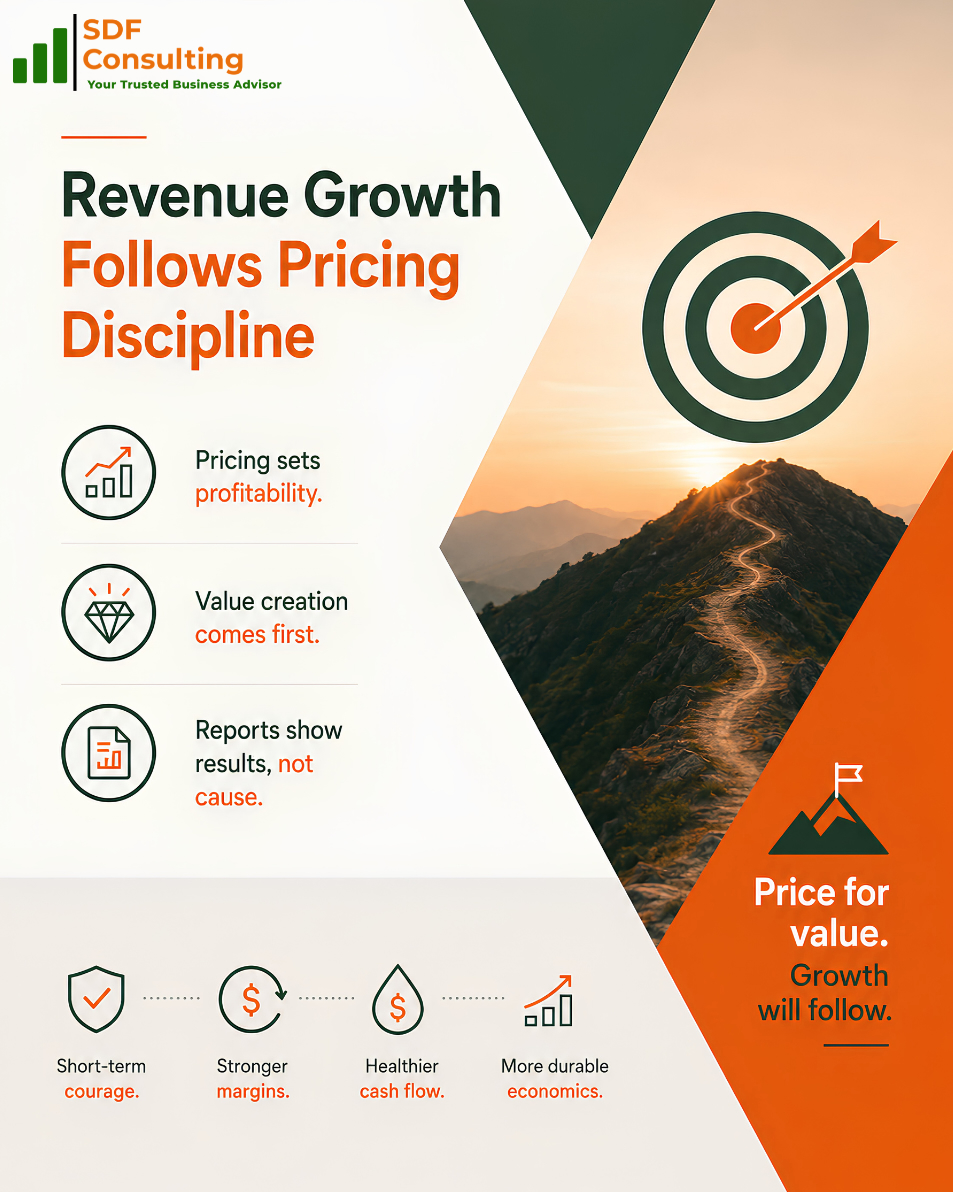
Revenue does not drive performance—pricing decisions do.
Revenue is an outcome. Pricing is a strategic choice. One is reactive; the other is foundational.
The Hidden Cost of Weak Pricing Discipline
Organizations that lack pricing discipline tend to fall into a predictable pattern:
- They prioritize volume over value
- They discount to win business
- They rationalize margin erosion in pursuit of growth
Over time, this approach masks weak unit economics and creates a fragile financial model. Growth may appear strong on the surface, but it is often subsidized by shrinking margins and unsustainable cost structures.
In contrast, high-performing operators take a different path.
The Operator’s Advantage: Anchoring Price to Value
Disciplined organizations understand that pricing is not just a financial exercise—it is a strategic signal of value.
They:
- Anchor price to the value delivered, not competitive pressure
- Protect margins even at the expense of short-term volume
- Allow demand to adjust naturally to a well-justified price point
This approach requires conviction. It demands clarity on the product’s value proposition and confidence in the market’s willingness to pay for it.
Three Truths Leaders Can’t Afford to Ignore
1. Profitability Is Set by Pricing, Not Volume
Volume amplifies outcomes—it does not create them. If the underlying pricing is flawed, scaling volume only accelerates margin dilution.
2. Value Creation Comes Before Revenue Recognition
Revenue is earned when value is delivered and correctly priced. Without genuine value creation, revenue becomes transactional rather than durable.
3. Accounting Reports Outcomes—It Doesn’t Create Them
Financial statements are a reflection of past decisions. Pricing strategy, on the other hand, actively shapes future performance.
The Leadership Challenge: Pricing Courage
Exercising pricing discipline often comes with short-term consequences:
- Slower top-line growth
- Increased scrutiny from stakeholders
- Potential volume contraction
This is where leadership matters most.
Pricing courage is the willingness to prioritize long-term economic strength over near-term optics. It is the discipline to hold price when the easier path is to discount.
The Long-Term Payoff
While disciplined pricing may initially constrain revenue growth, its long-term effects are profound:
- Stronger and more resilient margins
- Improved cash flow quality
- Healthier, more predictable unit economics
- Enhanced strategic flexibility
Over time, growth does not disappear—it improves in quality and durability.
Closing Perspective: Shift the Growth Mindset
The most effective organizations don’t chase growth at any cost. They engineer it.
They understand a simple but powerful principle:
When value is priced correctly, revenue growth follows.
Not immediately. Not always linearly. But reliably.
Don’t chase growth. Price for value—and let performance compound.