
Hard Decisions Are the Real Job of an SMB Founder
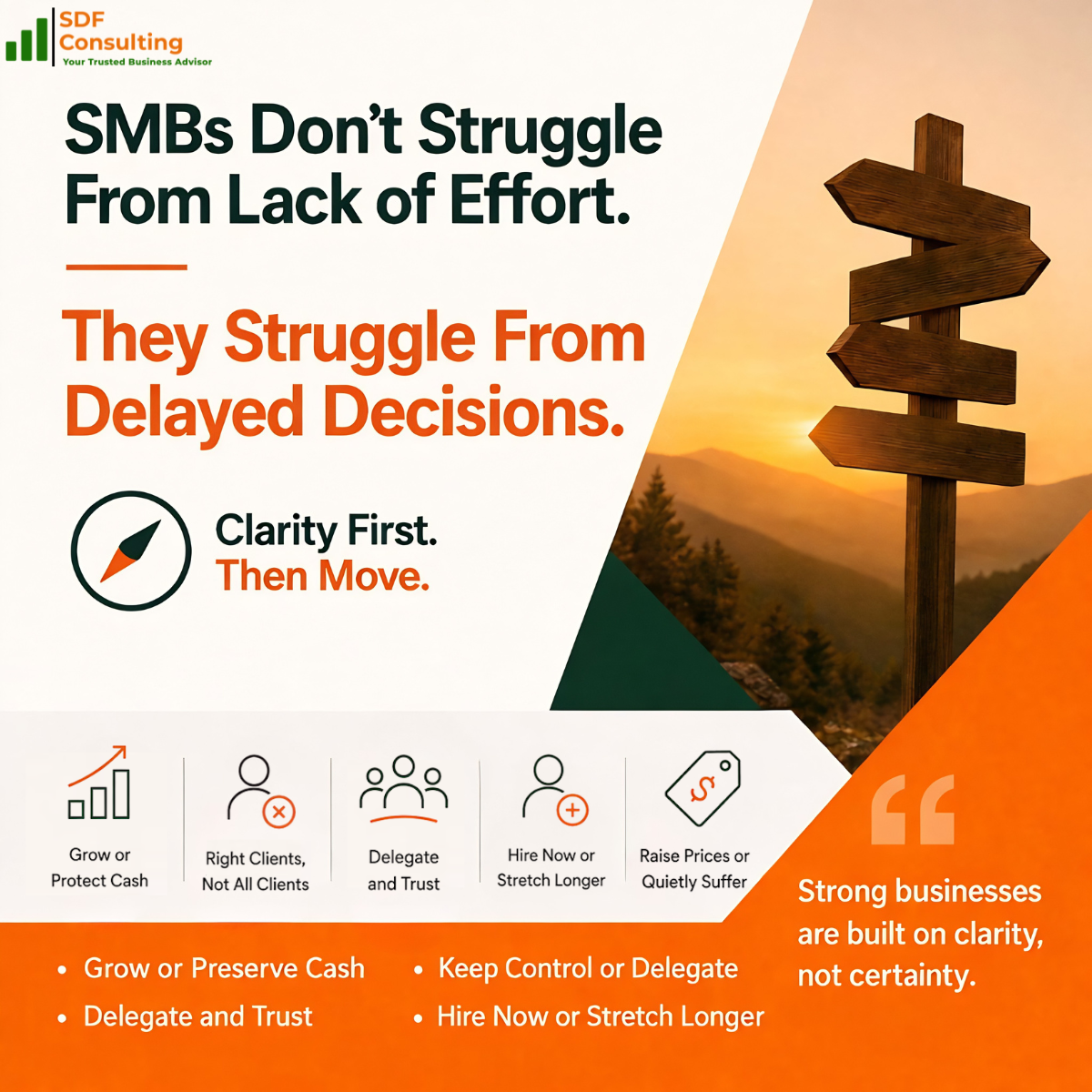
Most SMBs don’t struggle because founders are lazy.
They struggle because hard decisions get delayed.
I’ve seen this pattern up close—first as an operator, then as a CFO, and now working alongside founders week after week. Different industries, different personalities, same underlying issue.
The hardest part of running a business isn’t working harder.
It’s choosing what not to do.
The uncomfortable reality of trade‑offs
Every small and mid‑sized business eventually hits the same set of trade‑offs. They show up in different forms, but they’re always there:
- Grow faster or protect cash
- Take the revenue or say no to the wrong client
- Keep control or delegate and trust others
- Hire now or stretch the team a little longer
- Raise prices or quietly absorb the pain
None of these decisions feel good in the moment. That’s why so many founders try to postpone them. They hope more effort, longer hours, or another small tweak will make the choice unnecessary.
It rarely does.
The “more effort” trap
Earlier in my career, I believed effort was the answer to almost everything.
If something wasn’t working, the instinct was simple: push harder.
Work later.
Say yes more often.
Carry the load yourself.
What I learned—sometimes the hard way—is this:
If the model is off, more effort doesn’t fix the problem. It just hides it.
You can work around a broken pricing model for a while.
You can compensate for bad clients with personal heroics.
You can mask weak cash flow with optimism and hustle.
But eventually the business sends the invoice—in stress, burnout, or stalled growth.
Why founders get stuck
Most founders don’t delay decisions because they’re careless. They delay because they’re responsible.
They don’t want to:
- Let their team down
- Lose clients
- Make the “wrong” call
- Regret a decision they can’t undo
So they wait for certainty.
The problem is that certainty almost never shows up on time.
Strong businesses aren’t built on certainty.
They’re built on clarity.
How I help founders think through hard decisions
When I see founders stuck, spinning, or second‑guessing themselves, I don’t start with answers. I start with structure.
Here’s the framework I come back to again and again:
1. Name the real trade‑off
Most decisions sound vague on the surface.
“What should I do?”
“Is now the right time?”
Those questions don’t help.
Reframe it clearly:
-
-
- Cash vs growth
- Speed vs quality
- Control vs scale
-
Once the trade‑off is explicit, the fog starts to lift.
2. Decide which time horizon matters most
Every decision looks different depending on the horizon:
-
-
- Survival (next 90 days)
- Stability (next 6–12 months)
- Scale (12+ months)
-
Many founders mix these up—and then feel stuck because they’re trying to optimize all three at once.
You can’t.
3. Define the downside honestly
Instead of asking, “What if this fails?”
Ask, “If this fails, what actually breaks?”
Reputation?
Cash?
A relationship?
Ego?
Most fears sound far scarier than the real downside once you say them out loud.
4. Create reversibility
Whenever possible, avoid one‑way doors.
Pilot instead of committing.
Time‑box instead of locking in.
Test before scaling.
Reversibility lowers risk—and speeds decision‑making.
5. Decide, communicate, move on
This last part matters more than people realize.
Once you decide:
-
-
- Communicate clearly
- Align expectations
- Stop re‑litigating the choice
-
Second‑guessing costs more than most mistakes.
A truth most founders resist
Not all revenue is good revenue.
Not all growth is healthy growth.
Not all effort leads to progress.
Some clients slow you down.
Some growth destroys cash flow.
Some “busy” keeps you from fixing what actually matters.
The difference between struggling SMBs and steady ones usually isn’t intelligence, tools, or ambition.
It’s decisiveness.
Calm, clear, and intentional
The best SMB leaders I know aren’t fearless.
They’re not reckless.
They don’t always know the answer.
What they do have is clarity:
- About their constraints
- About their priorities
- About what matters now
They make the call, adjust when needed, and keep moving.
If you’re sitting on a tough decision right now, don’t wait for perfect information.
Solve for clarity.
Then move forward.
That’s the real job.