
The Founder’s Paradox: Building Between Order and Chaos
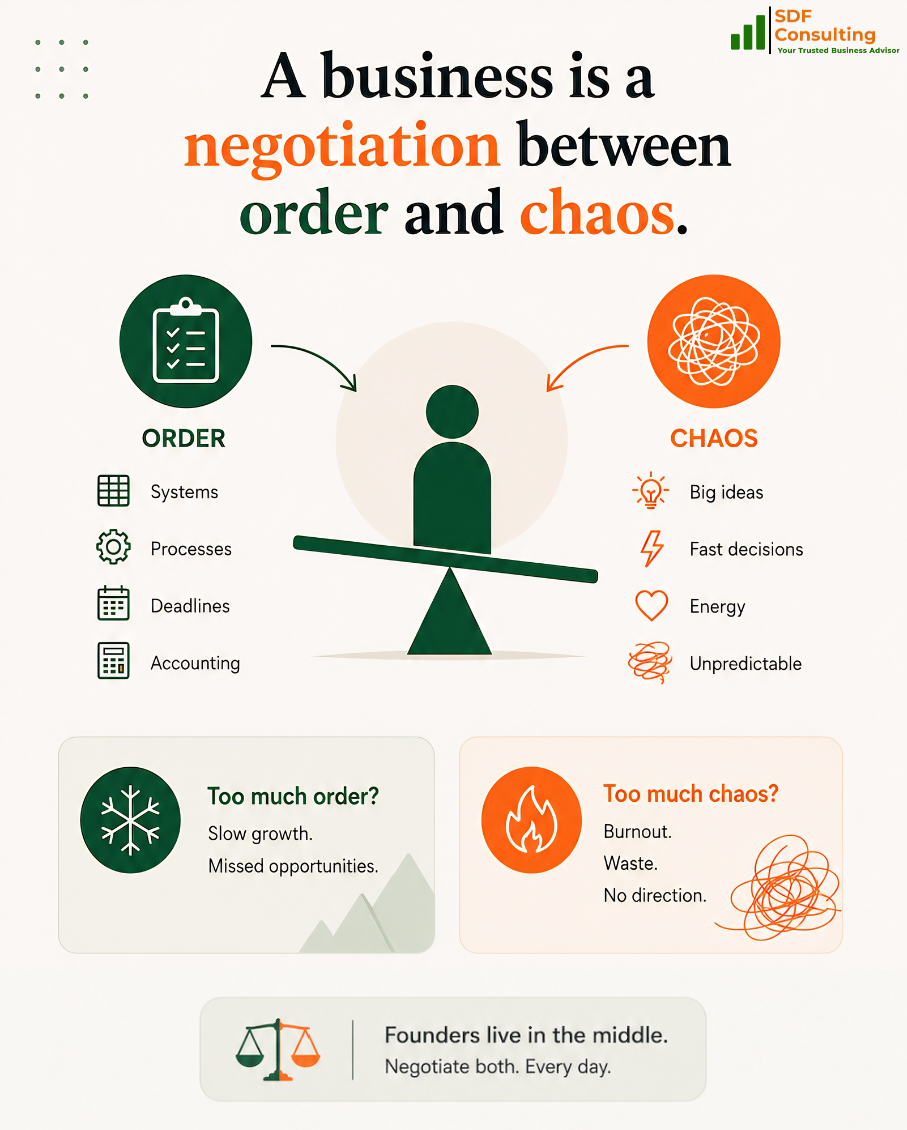
At its core, a small business is not a fixed system—it is a continuous negotiation. A negotiation between two opposing forces that must coexist for growth to happen: order and chaos.
On one side, there is chaos.
This is where ambition lives.
It’s where ideas are generated, decisions are made quickly, and opportunities are seized without overthinking. It sounds like: “Let’s try it.” It feels like momentum, energy, and possibility.
On the other side, there is order.
This is where discipline resides.
Spreadsheets, systems, processes, deadlines, and accounting bring structure to what would otherwise be unmanageable motion. It represents clarity, predictability, and control.
Founders don’t get to choose one or the other.
They live in the space between them—negotiating both, every single day.
The Cost of Imbalance
The tension between order and chaos isn’t theoretical. It has real, tangible consequences for a business.
When Chaos Dominates
Too much chaos creates the illusion of progress while quietly eroding the foundation of the business.
- Time is wasted chasing unvalidated ideas
- Cash is deployed without clear return
- Teams (even small ones) lose alignment
- Decision-making becomes reactive instead of intentional
What initially feels like agility begins to turn into inefficiency. Momentum becomes noise.
Over time, uncontrolled chaos doesn’t just slow a business down—it makes every mistake more expensive.
When Order Takes Over
On the other end of the spectrum, too much structure can be just as dangerous.
- Decisions become slow and overanalyzed
- Opportunities are missed waiting for “perfect” data
- Teams lose their bias toward action
- Innovation gets constrained by process
Excessive order creates rigidity.
And rigidity, in a dynamic market, kills growth.
Businesses don’t fail only from recklessness—they also fail from over-optimization too early.
The Role of Accounting: Beyond the Numbers
Here’s where many founders misunderstand a critical function of their business:
Accounting is not the administrative burden. It is the stabilizing force.
It is not simply about compliance, reporting, or tax preparation.
At its highest level, accounting is what translates chaos into insight.
It answers three fundamental questions that every growing business must confront:
- What is actually working?
Not what feels promising. Not what generates excitement.
But what is measurably producing results.
Accounting brings objectivity into environments that are otherwise driven by intuition.
- What only feels like it is working?
Many initiatives generate activity but not outcomes.
Without clear financial visibility, it is easy to confuse motion with progress.
Accounting exposes this gap—quietly but decisively.
- How long can you sustain your current pace?
Growth is not just about acceleration—it’s about runway.
Cash flow, margins, and cost structures determine whether a strategy is scalable or temporary.
Accounting provides the line of sight required to make informed trade-offs.
Structure as an Enabler of Scale
The objective for a founder is not to eliminate chaos.
In fact, that would be a strategic mistake.
Chaos is where innovation lives.
It’s where differentiation is created.
It’s where upside exists.
However, chaos without structure does not scale.
The goal is to implement just enough order to:
- Channel energy into high-impact areas
- Reduce avoidable risk
- Ensure sustainability of growth
- Enable repetition of what works
In other words, structure should not slow the business down—it should allow it to move faster with confidence.
The Executive Perspective: Designing the Balance
From an executive standpoint, the question is not “Do we need more structure?” or “Should we move faster?”
The question is more nuanced:
Where does structure need to exist—and where should it not?
High-performing organizations are deliberate about this distinction.
- They systematize what is proven
- They experiment where uncertainty remains
- They measure what matters
- They ignore what creates unnecessary friction
This is not accidental. It is designed.
A Continuous Negotiation
What makes this dynamic challenging is that it is never solved permanently.
As the business evolves:
- New opportunities introduce fresh chaos
- Growth introduces new operational complexity
- Market conditions force adaptation
The balance must be constantly recalibrated.
What worked at $100K in revenue will not work at $1M.
What worked at $1M will not work at $10M.
The negotiation never ends.
Final Thought: Embrace the Tension
Your business is not defined by being messy.
It is not defined by being organized.
It is defined by how effectively you negotiate between the two.
- Too much chaos creates fragility
- Too much order creates stagnation
- The right balance creates scale
Accounting, systems, and structure are not there to constrain ambition.
They exist to ensure that ambition doesn’t become expensive.
Because in the end, the most successful founders don’t eliminate tension—they learn how to operate inside it.