
How supplier payment terms quietly fund your business, and what it costs when they stop.
Ask most business owners who their lenders are and they’ll name their bank. Maybe a line of credit, a truck loan or a government program.
Very few will name their suppliers. Yet for many owner-operated businesses, suppliers provide more financing than the bank does. They just never call it that.
This post explains how supplier payment terms quietly fund your business, why that money can disappear faster than any bank loan, and what you can do this week to protect yourself.
How supplier terms become a loan
When a supplier lets you pay in 30, 60 or 90 days, they are lending you the goods for that long. You get the materials today, sell them, and pay later.
Here’s a simple example:
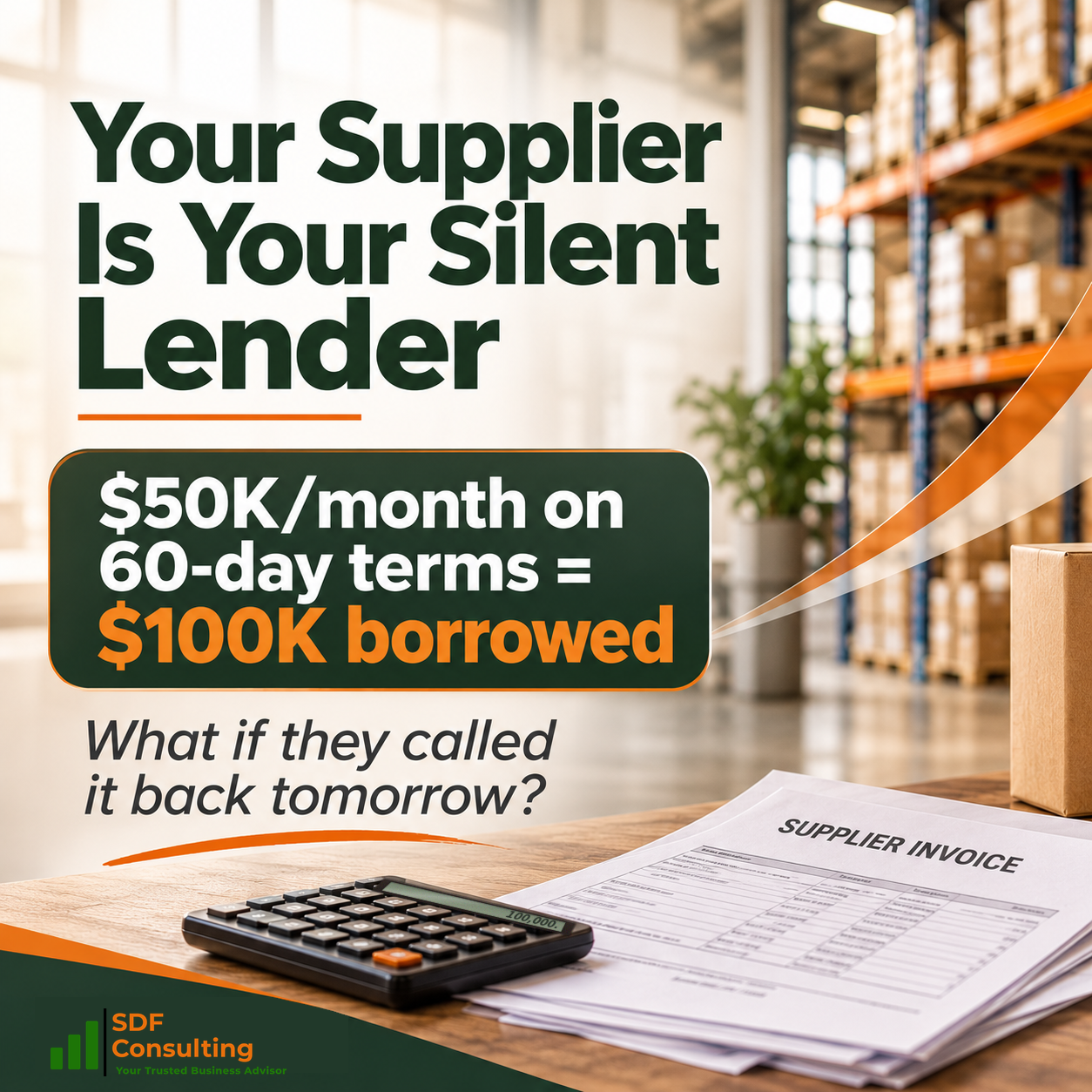
- You buy $50,000 of materials every month.
- Your supplier gives you 60 days to pay.
- At any moment, you owe them about two months of purchases: $100,000.
That $100,000 is money in your business that you haven’t paid for yet. It’s helping cover payroll, rent and inventory right now.
It works like a $100,000 loan, except there was no application, no interest rate and no personal guarantee. Your supplier is your silent lender.
To find your own number, add up every unpaid supplier invoice. Your bookkeeper may call this “accounts payable.” Whatever the name, that total is how much your suppliers are lending you today.
Why most owners never see it
A bank loan is hard to miss. You signed papers, you make payments, and the balance shows up on every statement.
Supplier credit is different. It builds up quietly with every order and shrinks with every payment. It never arrives as a lump sum, so it doesn’t feel like borrowing.
It also tends to grow without anyone deciding it should. As your sales grow, you buy more, and the amount you owe grows with it. A business doing twice the volume might owe its suppliers twice as much, often without the owner noticing.
That’s fine while things are steady. The problem is that this “loan” can be called back with almost no notice.
What if they called it back tomorrow?
A bank usually gives warning before it pulls a loan. A supplier can change your terms with one phone call. It usually happens in one of three ways:
- The supplier runs into trouble. They may need cash fast and start demanding quicker payment. If they close, you lose your source of goods overnight.
- The supplier is sold. New owners often tighten credit terms across the board, regardless of how long you’ve been a good customer.
- They lose confidence in you. A few late payments, or a credit insurer pulling coverage, can move you to “cash on delivery.”
Go back to the example. If you move from 60-day terms to cash on delivery, you now pay $50,000 up front for each new order. At the same time, you still owe the $100,000 from earlier orders.
For the next two months, you could be paying out roughly twice your normal supplier spend. Your sales haven’t changed. Your profit hasn’t changed. But your bank balance has taken a $100,000 hit.
This is how profitable businesses run out of cash. Payroll, rent and taxes don’t wait while you sort it out.
The costs beyond cash
The cash squeeze is the most obvious hit, but rarely the only one. Losing a key supplier tends to bring a chain of other costs:
- Scrambling for a replacement. Finding, vetting and setting up a new supplier takes time you don’t have.
- Worse prices and terms. A new supplier has no history with you, so expect higher prices, smaller credit limits or payment up front.
- Gaps in supply. Missed or late orders while you switch over.
- Lost customers. The customer who couldn’t get their order may not come back.
- Your time. Weeks spent putting out fires instead of running the business.
Add those up and losing one important supplier can cost far more than the money you owed them.
Warning signs a supplier may be in trouble
Suppliers rarely fail without warning. The signs are often there months ahead if you know what to look for:
- Late or partial shipments from a supplier that used to be reliable.
- Sudden discounts for paying early. It can be a sign they’re short on cash.
- Pressure to pay faster or shorter terms with little explanation.
- A revolving door of staff, especially your sales rep or their accounting contact.
- Quality slipping or cheaper substitutes showing up without notice.
- Industry chatter about layoffs, lawsuits, a sale or unpaid bills.
One sign on its own may mean nothing. Two or three together deserve a closer look and a backup plan.
Five steps to protect your business
You don’t need to stop using supplier terms. They’re one of the cheapest sources of funding a small business has. You just need to manage them like the borrowed money they are.
- Know your number. Add up what you owe all suppliers today. Check it monthly so you can see if it’s growing.
- Check your concentration. Work out how much of that total comes from your single biggest supplier. If it’s more than about a third, one phone call could hurt you badly.
- Line up a backup supplier. Find a second source for your most important items before you need it. Even a small regular order keeps the relationship warm.
- Arrange credit before you need it. Banks lend to healthy businesses, not desperate ones. Set up or increase a line of credit while your numbers look good.
- Pay on time, every time. Being a reliable customer is your best protection against having your terms cut. If you can’t pay on time, call before the due date, not after.
A simple test: ask yourself, “If my biggest supplier went to cash on delivery tomorrow, where would the money come from?” If you don’t have an answer, that’s your starting point.
The bottom line
Your suppliers are lending you money every day. That’s a good thing, as long as you know how much, from whom, and what you’d do if it stopped.
The owners who get caught out aren’t usually running bad businesses. They just never saw their supplier terms as debt, so they never planned for the day it was called back.
If you’re not sure how much you owe your suppliers, or how exposed you’d be if one of them changed the rules, SDF Consulting can help you find out and build a plan. Reach out at arshad@sdfconsulting.ca.
SDF Consulting: Your Trusted Business Advisor.