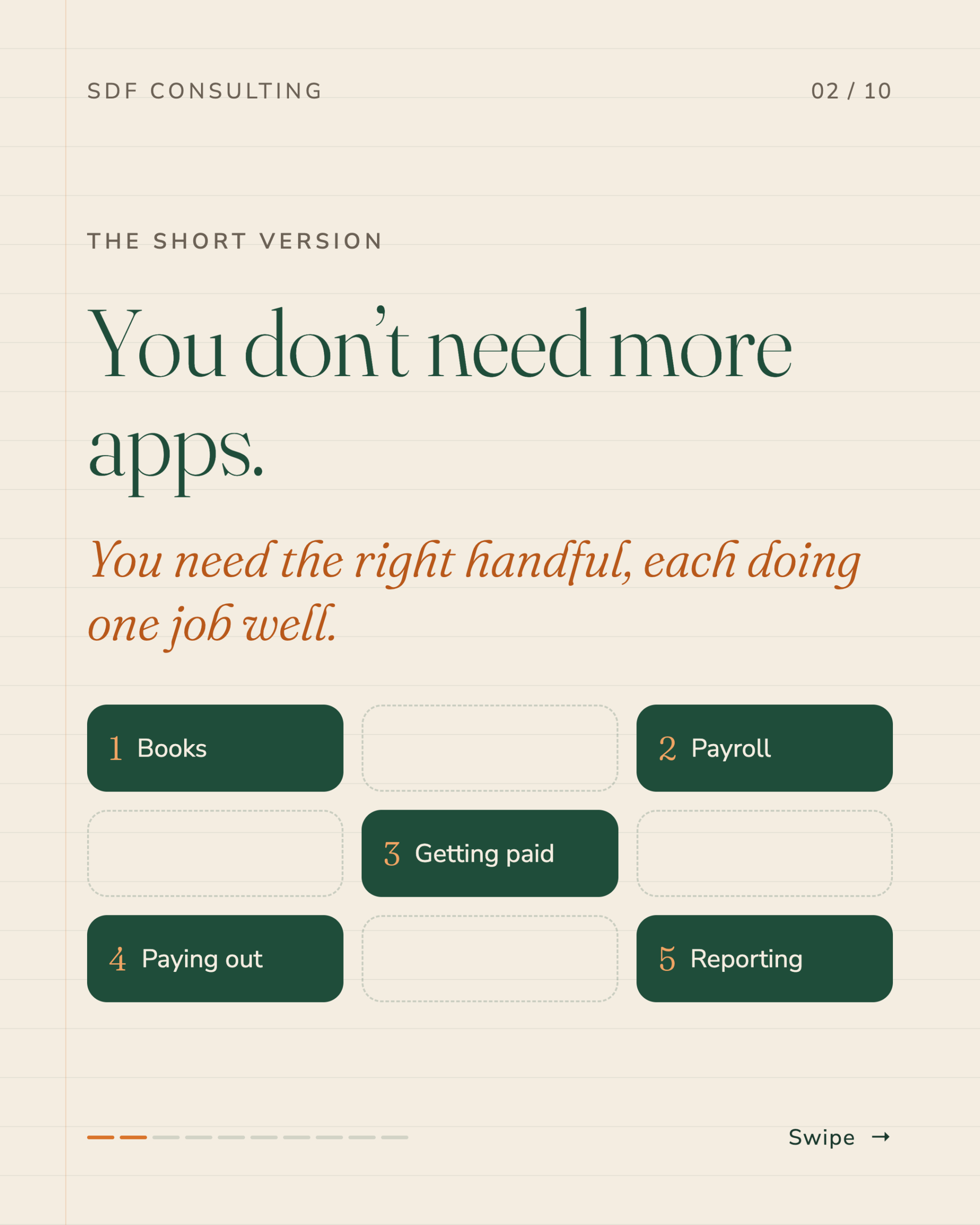

You don’t need more apps. You need the right handful, each doing one job well.
Most owner-operators don’t have a software problem. They have a coverage problem.
I meet owners every week who have signed up for half a dozen apps, a few free trials, and a spreadsheet “just for now” that has been running for four years. Yet when I ask a simple question, how did the business do last month?, the answer usually starts with “let me check a few things.”
The fix isn’t another app. It’s making sure a small set of tools covers the five jobs every business’s finances have to do, with each one done well and none left to memory.
The five jobs at a glance
A simple finance setup covers five jobs. You don’t need a separate app for each, but you do need each one handled on purpose.
- Books: recording every dollar that comes in and goes out.
- Payroll: paying your team, plus the CRA source deductions that come with it.
- Getting paid: invoicing customers and collecting what you’re owed.
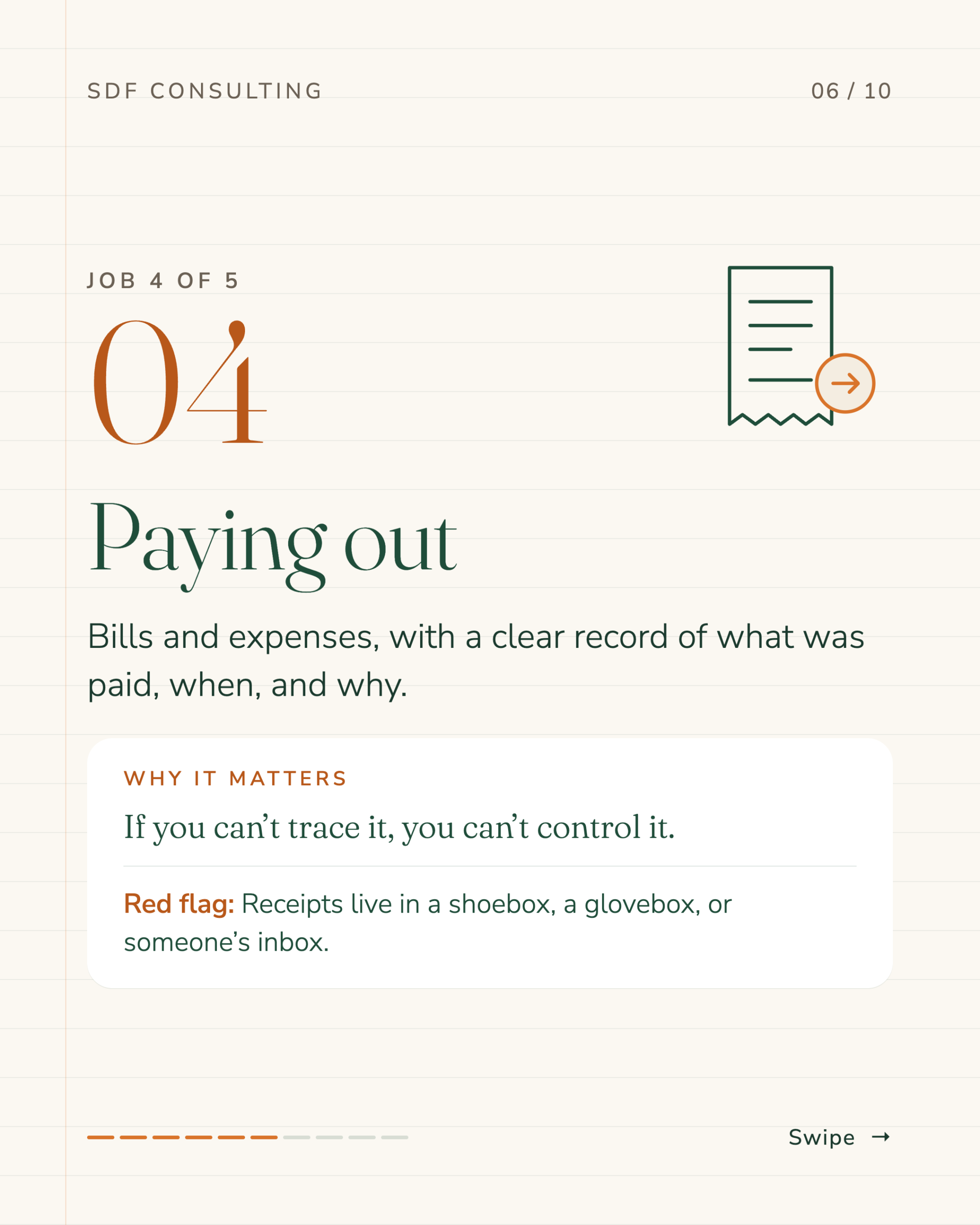
- Paying out: bills and expenses, with a clear trail.
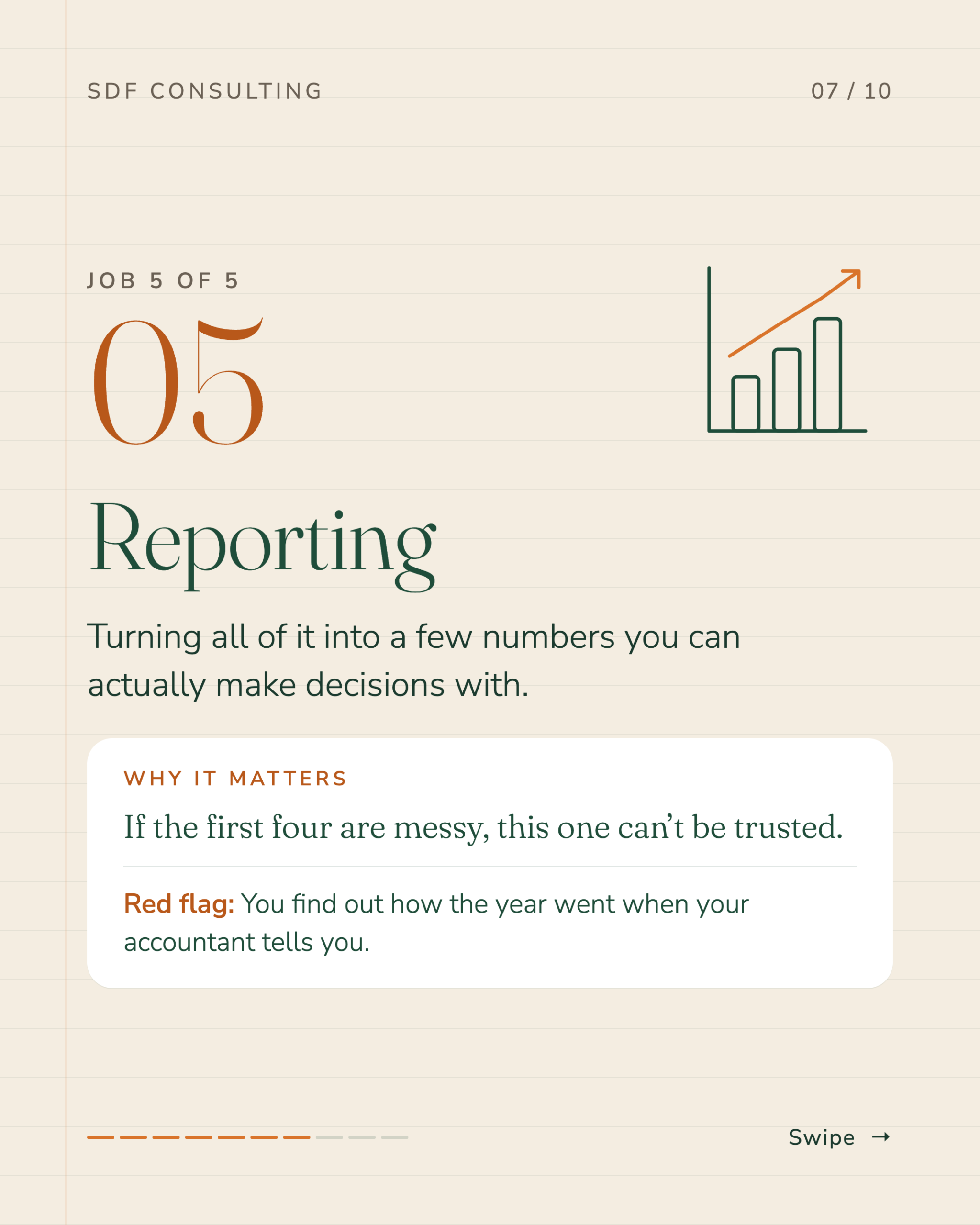
- Reporting: turning it all into numbers you can make decisions with.
1. Books: the foundation
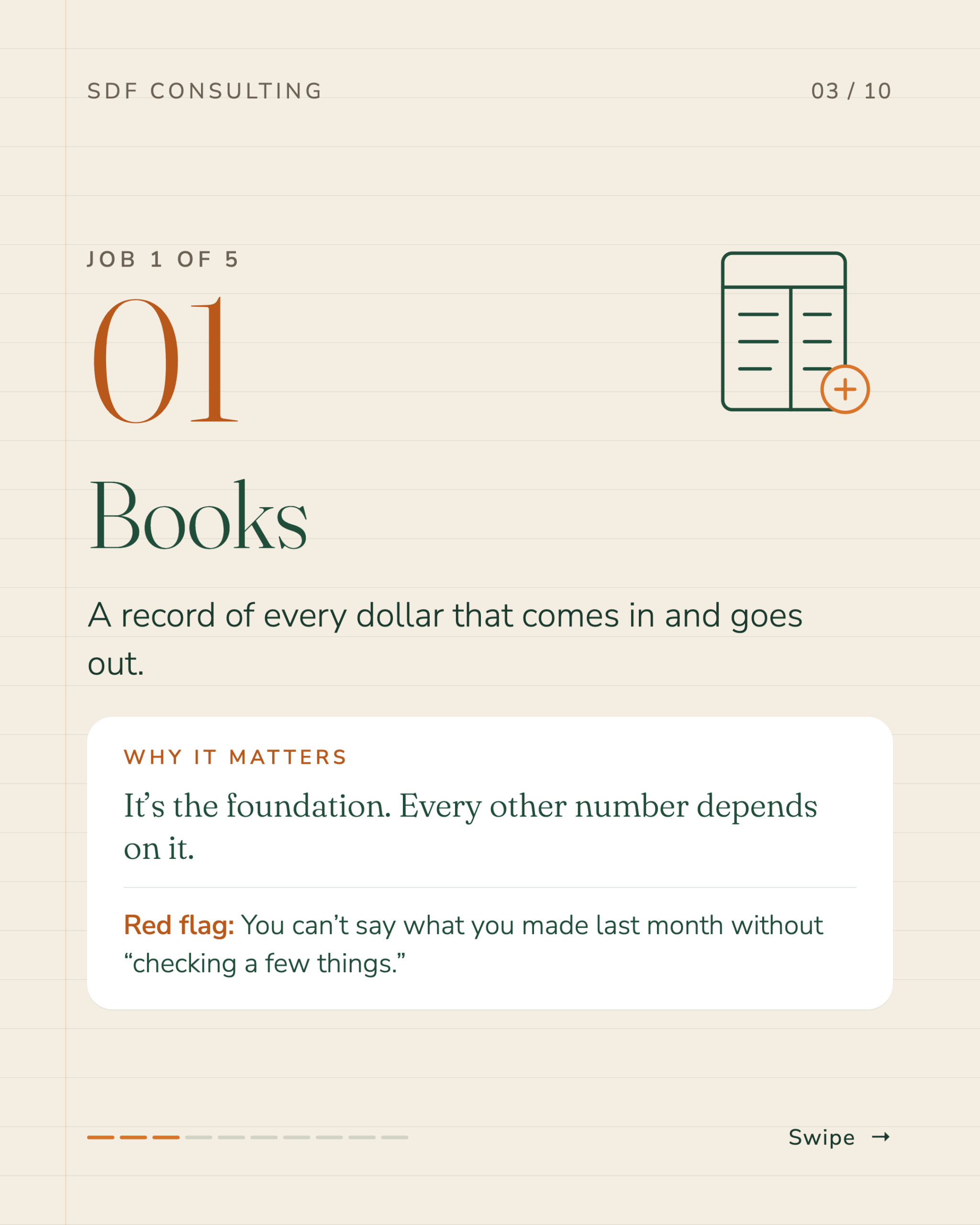
Your books are the record of every dollar that comes into the business and every dollar that goes out. Every other number you’ll ever look at, from your profit to your tax bill, is built on top of them.
Good books don’t need to be fancy. They need to be complete, categorized consistently, and matched to your bank statements every month (that matching step is called reconciliation). The CRA also expects you to keep these records, generally for six years.
Red flag: you can’t say what you made last month without “checking a few things.”
2. Payroll: your team and the CRA
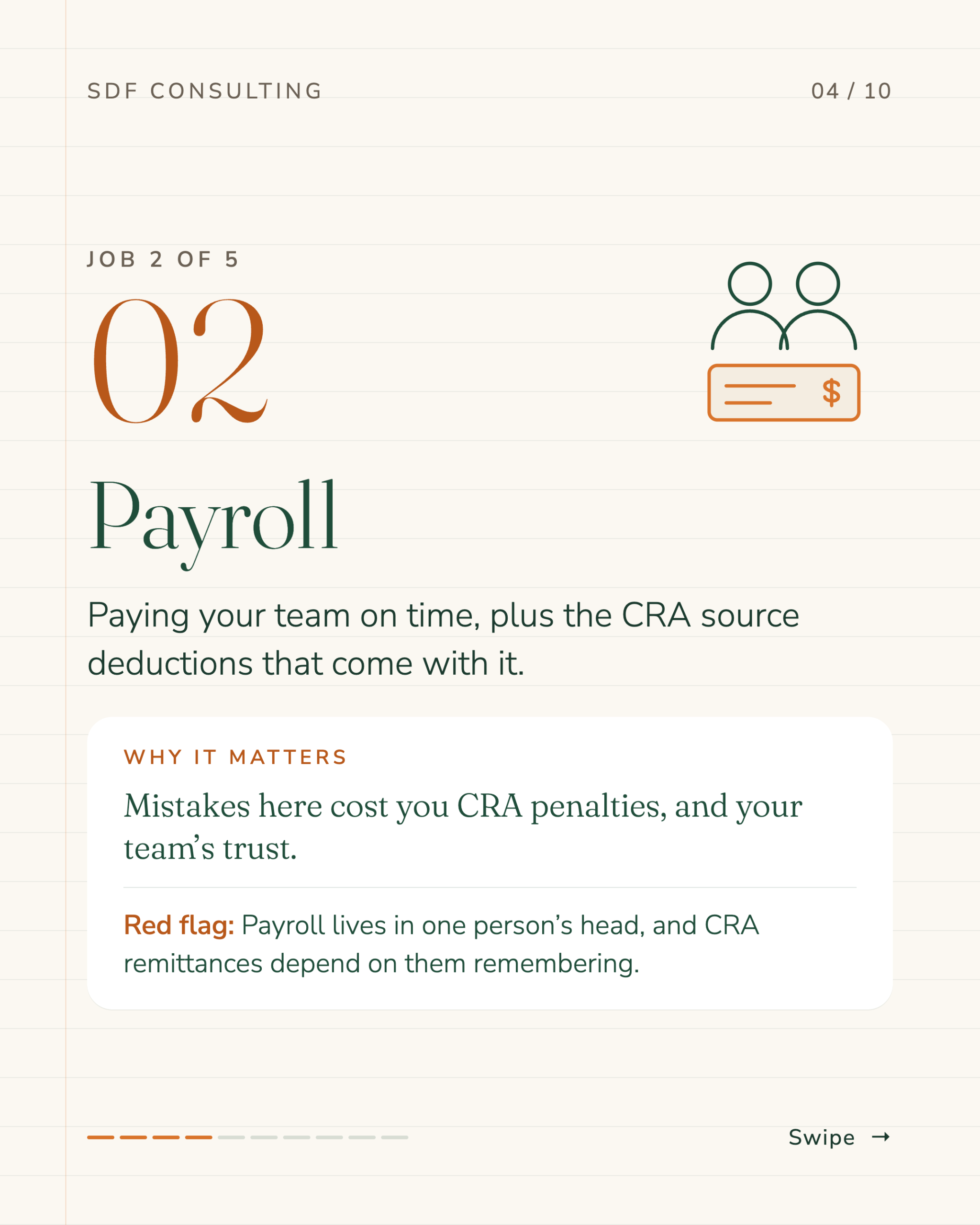
Payroll is more than paying your people on time. Every pay run, you deduct income tax, CPP and EI from each employee’s pay, add your own employer share of CPP and EI, and send it all to the CRA by its due date. At year end, each employee needs a T4 slip.
Mistakes here are expensive twice over. Late or short remittances bring CRA penalties and interest, and a missed or wrong paycheque costs your team’s trust much faster than it costs money.
Red flag: payroll lives in one person’s head, and your CRA remittances depend on them remembering.
3. Getting paid: a sale doesn’t pay the bills until it’s collected
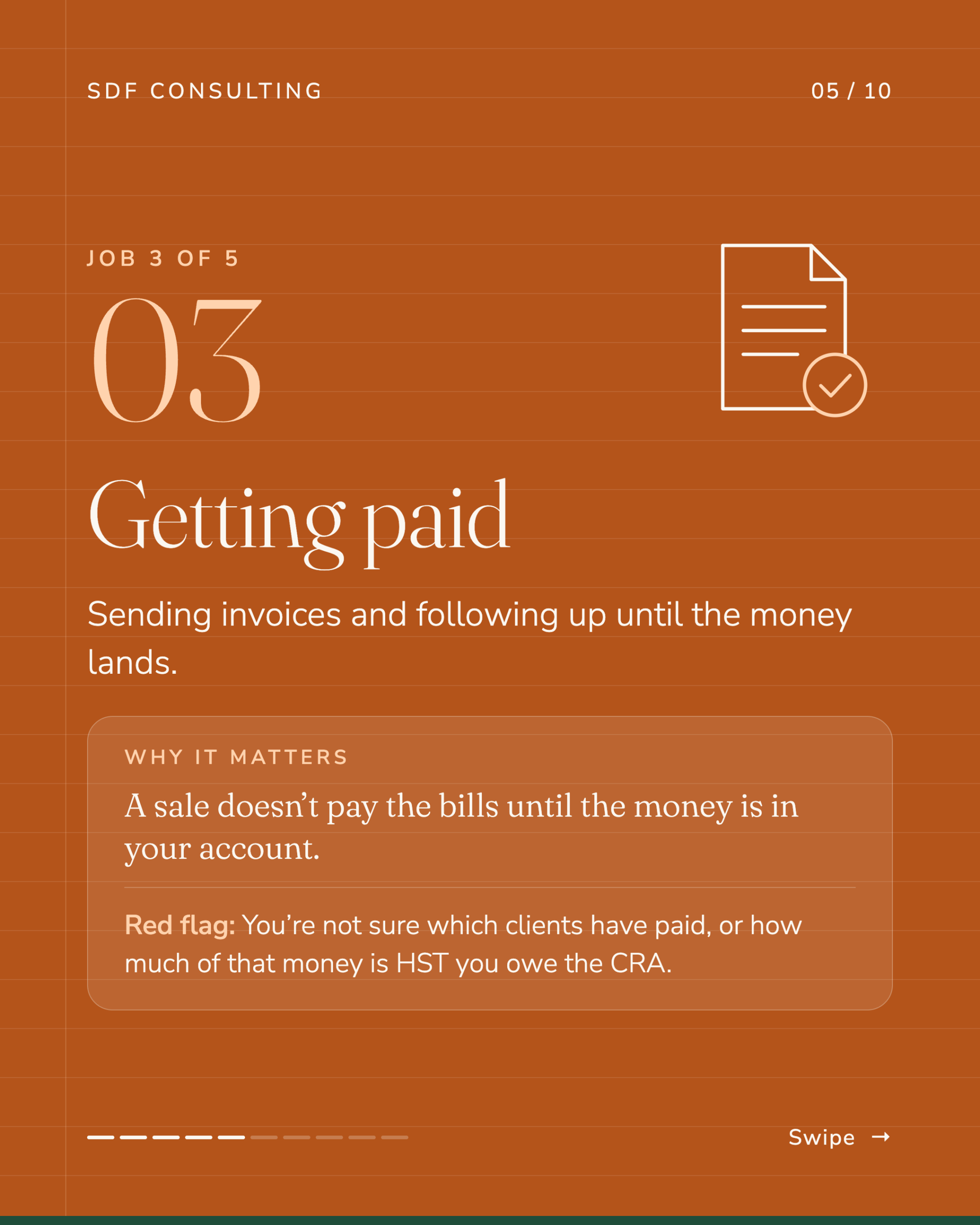
Winning the work is only half the job. Getting paid means sending clear invoices promptly, tracking who owes you what, and following up until the money lands in your account.
There’s a second piece many owners miss: if you’re registered for GST/HST, part of what customers pay you isn’t yours. It’s tax you’ve collected on the CRA’s behalf, and it has to be set aside and remitted. Treating it as spending money is one of the most common ways small businesses end up with a surprise bill.
Red flag: you’re not sure which clients have paid, or how much of that money is HST you owe the CRA.
4. Paying out: if you can’t trace it, you can’t control it
Paying out covers your bills, supplier invoices and day-to-day expenses. The goal isn’t just paying on time. It’s leaving a clear trail of what was paid, when, to whom, and why.
That trail matters more than most owners realize. Without receipts you can lose deductions, and if you’re registered for GST/HST you need supporting records to claim back the tax you paid on business purchases (your input tax credits). A clean trail also makes it obvious when costs start creeping up.
Red flag: receipts live in a shoebox, a glovebox, or someone’s inbox.
5. Reporting: numbers you can actually use
Reporting turns the first four jobs into a handful of numbers you can make decisions with. For most owner-operators, that means three things, reviewed every month:
- Profit: did we make money last month, and is it trending up or down?
- Cash: how much is in the bank, and how much is already spoken for (payroll, HST, bills due)?
- Who owes us: how much is outstanding from customers, and how old is it?
Reporting is only as good as what feeds it. If your books, payroll, invoicing or expenses are messy, the reports can’t be trusted, and you end up making big decisions on gut feel.
Red flag: you find out how the year went when your accountant tells you.
The test: memory and a spreadsheet
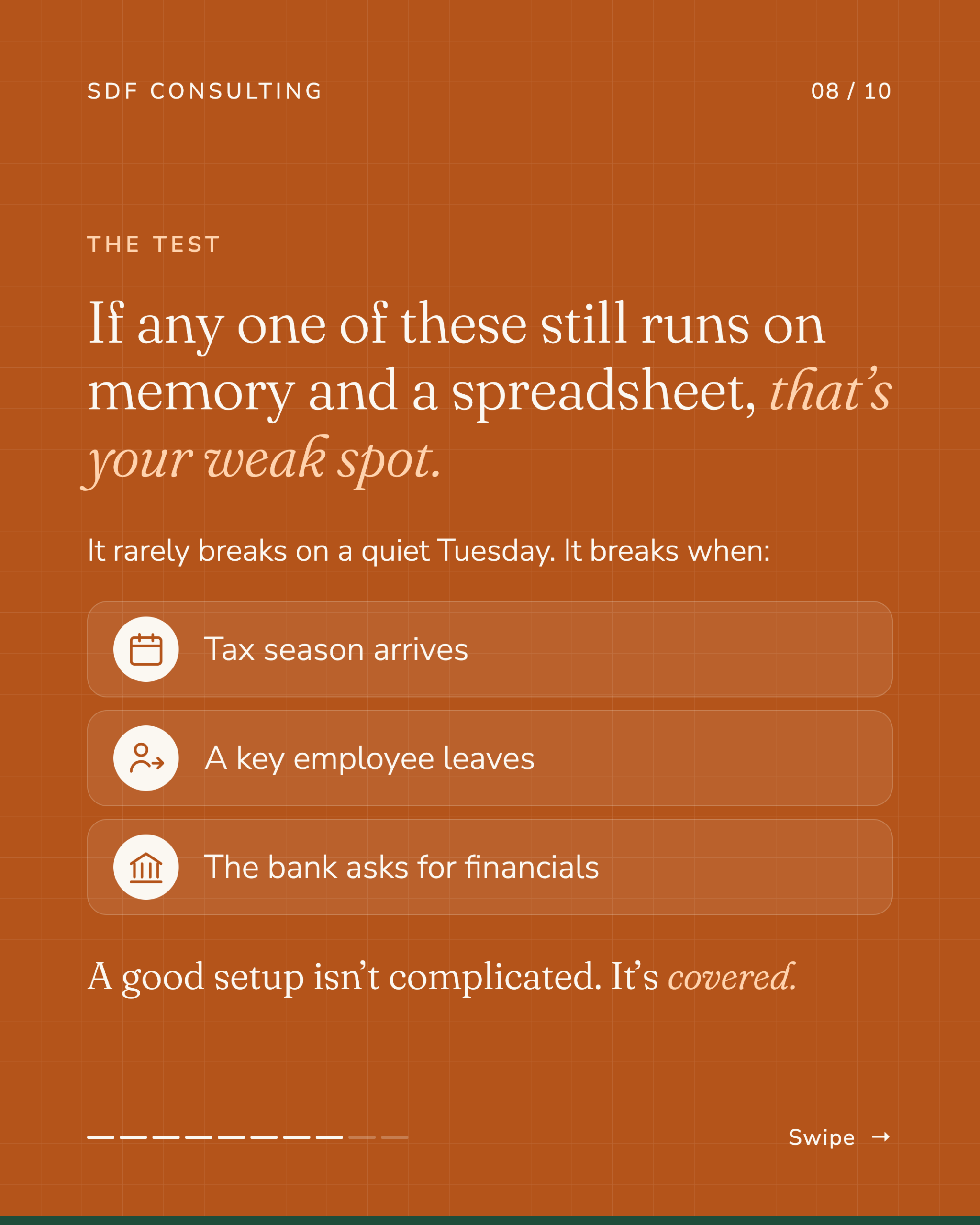
Here’s a simple way to find your weak spot: if any one of these five jobs still runs on someone’s memory and a spreadsheet, that’s the one to fix first.
Those setups work fine until they don’t, and they rarely break on a quiet Tuesday. They break when:
- Tax season arrives and the numbers have to be pulled together under a deadline.
- A key employee leaves, taking the know-how for payroll or invoicing with them.
- The bank asks for financials for a loan or line of credit, and you need clean statements fast.
A good finance setup isn’t complicated. It’s covered.
How to shore up your weakest job
You don’t need to overhaul everything at once. Pick the shakiest of the five and work through these steps:
- Write down how it works today. Who does it, what tools they use, and what happens if they’re away for two weeks.
- Get it out of one person’s head. A one-page checklist for each recurring task (pay runs, month-end, HST filing) is often enough.
- Let one tool own the job. Use the accounting or payroll software you already have properly before adding anything new.
- Put it on a calendar. Remittance dates, invoice follow-ups and month-end reconciliation should be scheduled, not remembered.
- Review it monthly. Fifteen minutes with your three key numbers (profit, cash, who owes you) will show you whether the fix is holding.
Then move on to the next shakiest job. Within a few months, all five are covered.
Which of the five is shakiest for you?
Most owners I work with are missing at least one. That’s normal, and it’s fixable, usually without buying anything new.
If you’re not sure where your weak spot is, or you know exactly where it is and don’t have time to fix it, that’s what we do at SDF Consulting. Get in touch at arshad@sdfconsulting.ca, and we’ll help you get all five jobs covered.