
What overstock really costs, and how to free the cash up
Your shelves might be holding more of your cash than your bank account.
Most owner-operators watch their bank balance closely. They know what’s coming in, what’s going out, and how much is left at the end of the month. Far fewer look at their stockroom the same way.
But every box on those shelves is money you’ve already spent and haven’t gotten back yet. Inventory isn’t just product. It’s cash that changed shape. And until it sells, that cash can’t pay staff, cover rent, or fund your next opportunity.
This article explains what extra inventory really costs you, how to tell if you’re carrying too much, and the practical steps to turn it back into cash.
What overstock really costs
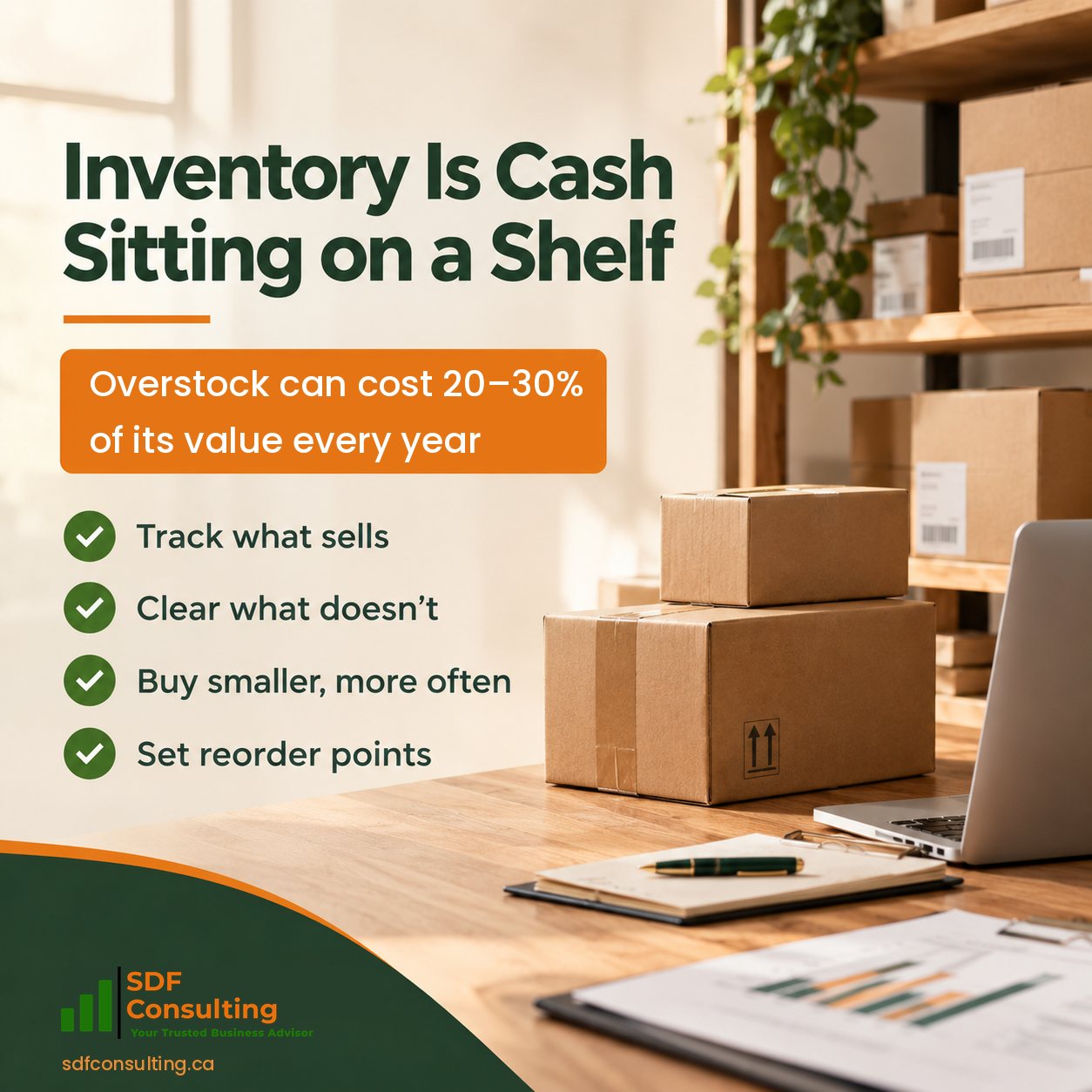
Extra inventory costs you money every month it sits there, not just on the day you buy it. Accountants call this the “carrying cost.” A common rule of thumb puts it at 20% to 30% of the inventory’s value per year.
Most of these costs never show up as one line on your statements. They’re spread across rent, payroll, insurance and interest, which is why they’re so easy to miss.
| Cost | What it means for you |
|---|---|
| Storage | Rent, shelving, utilities and the space you can’t use for something more profitable |
| Handling | Staff time spent counting, moving, organizing and working around stock |
| Insurance | Higher premiums because you’re insuring more goods |
| Shrinkage and damage | Theft, breakage, spoilage and counting errors, which grow with volume |
| Obsolescence | Products that expire, go out of style or get replaced by a newer model |
| Cost of money | Interest on the loan or credit line that paid for the stock, or the return that cash could have earned elsewhere |
The last one is the cost owners overlook most. If you’re paying interest on a line of credit while $50,000 of slow-moving stock sits in the back, you’re paying a bank to store products for you.
A simple example
Imagine a business carrying $200,000 more inventory than it actually needs. At a 25% carrying cost, that extra stock costs about $50,000 a year to hold.
Here’s how that might break down. The split is illustrative; every business is different, but the total is in the typical range.
| Cost | Share of value | Yearly cost on $200,000 |
|---|---|---|
| Cost of money (interest or lost return) | 8% | $16,000 |
| Storage | 5% | $10,000 |
| Obsolescence | 5% | $10,000 |
| Shrinkage and damage | 4% | $8,000 |
| Insurance and handling | 3% | $6,000 |
| Total | 25% | $50,000 |
For many small and mid-sized businesses, $50,000 is a full-time salary. It’s spent every year, quietly, on products nobody is buying yet.
And that’s before counting the bigger cost: the $200,000 itself. That’s cash you can’t use to hire, market, upgrade equipment or weather a slow season.
Signs you’re carrying too much
You don’t need a finance background to spot overstock. If several of these sound familiar, there’s likely cash sitting on your shelves:
- You’re profitable on paper but always short on cash. Profit is up, yet the bank balance never seems to grow.
- You keep finding items you forgot you had. Dusty boxes, old models, products from two seasons ago.
- You’re out of space. You’ve added shelving, rented a storage unit or are considering a bigger location.
- You order based on gut feel. Reorders happen when someone “thinks we’re getting low,” not from actual numbers.
- You buy in bulk for the discount. The unit price looks great, but the stock takes months to sell.
- You lean on your credit line to cover payroll or bills. Often a sign your cash is locked up in stock.
- You regularly mark down or throw out expired products. That’s carrying cost turning into a direct loss.
How to free the cash up
The goal isn’t empty shelves. It’s the right shelves: enough stock to serve customers, and no more. These six steps work for most businesses, whatever you sell.
- Know what’s moving. Pull a sales report by product for the last 12 months and rank items from fastest to slowest seller. In most businesses, a small group of products drives most of the sales, while a long tail barely moves. You can’t fix what you can’t see.
- Find the dead weight. Flag anything that hasn’t sold in 90 to 180 days. Add up what you paid for it. That total is cash you could get back.
- Turn slow stock back into cash. Discount it, bundle it with a best seller, return it to the supplier if they allow it, or sell it to a liquidator. Getting 60 cents on the dollar today usually beats getting nothing next year, and it stops the carrying costs immediately.
- Buy smaller, more often. Bulk discounts look great on the invoice and terrible on the bank statement. Before taking a volume deal, compare the discount to what it will cost to hold the extra stock until it sells. A 10% discount on stock that sits for a year often loses money.
- Set reorder points. For your key products, decide in advance the stock level that triggers a new order, based on how fast it sells and how long the supplier takes to deliver. This replaces gut feel with a simple rule anyone on your team can follow.
- Talk to your suppliers. Ask about shorter lead times, smaller minimum orders or longer payment terms. Faster delivery means you can safely carry less. Longer payment terms mean you might sell the stock before you even have to pay for it.
One number worth tracking going forward is inventory turnover: how many times a year you sell through your average stock. Divide your annual cost of goods sold by your average inventory value. If it’s going up, you’re turning stock into cash faster.
The bottom line
The healthiest businesses aren’t always the ones selling the most. They’re the ones turning their inventory back into cash the fastest.
Start small. This week, pull your slowest-moving 20 products and add up what you paid for them. That one number will tell you how much cash is sitting on your shelves, and how much you could free up.
If you’d like help reviewing your inventory, setting reorder points or improving your cash flow, SDF Consulting works with owner-operators to do exactly that. Reach out at sdfconsulting.ca or arshad@sdfconsulting.ca.
SDF Consulting: Your Trusted Business Advisor.