
The Deadlines That Trip Up Ontario Employers
Payroll isn’t finished when your team gets paid. For Ontario employers, the real deadlines come after payday: sending deductions to the CRA every month, and filing T4 slips once a year.
A lot of payroll penalties aren’t caused by bad bookkeeping. They’re caused by a missed date. The good news is that these dates are predictable, and a few simple habits keep you on the right side of them.
This guide covers what you deduct, when it’s due, what late really costs, what T4 season asks of you, and the habits that keep you safe. No accounting background needed.
That money was never yours
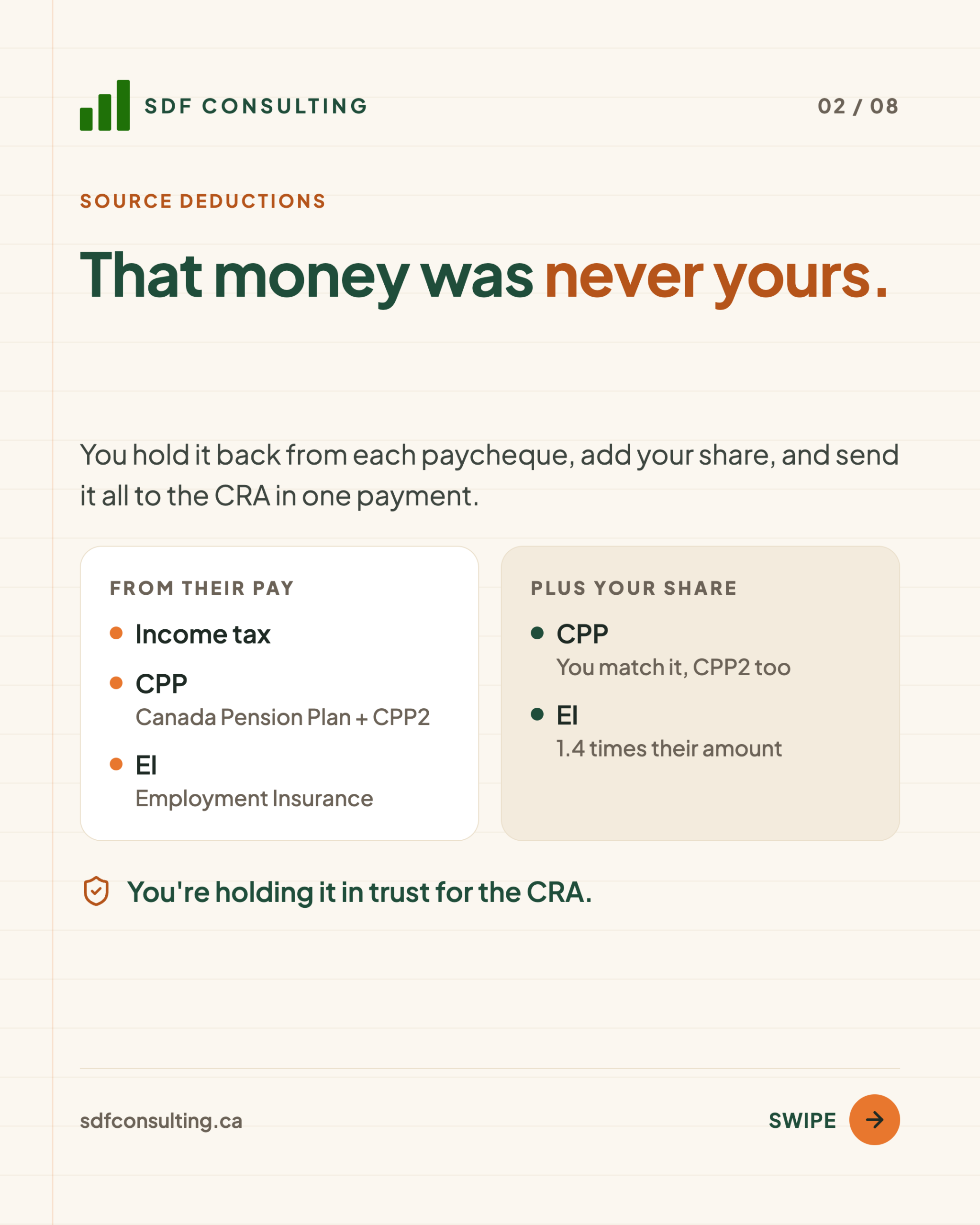
Every payday, you hold back part of each employee’s pay and send it to the CRA. These are called source deductions, and you’re holding them in trust for the government. They are not part of your working capital, even if they sit in your bank account for a few weeks.
| What you send | Where it comes from |
|---|---|
| Income tax | Withheld from the employee’s pay |
| Canada Pension Plan (CPP), plus CPP2 on higher earnings | Withheld from the employee’s pay, and you match it dollar for dollar |
| Employment Insurance (EI) | Withheld from the employee’s pay, and you add 1.4 times their amount |
All of it goes to the CRA together, in one remittance. The employer share is the part owner-operators most often forget to budget for: it’s a real cost of having staff, on top of wages.
It’s due by the 15th
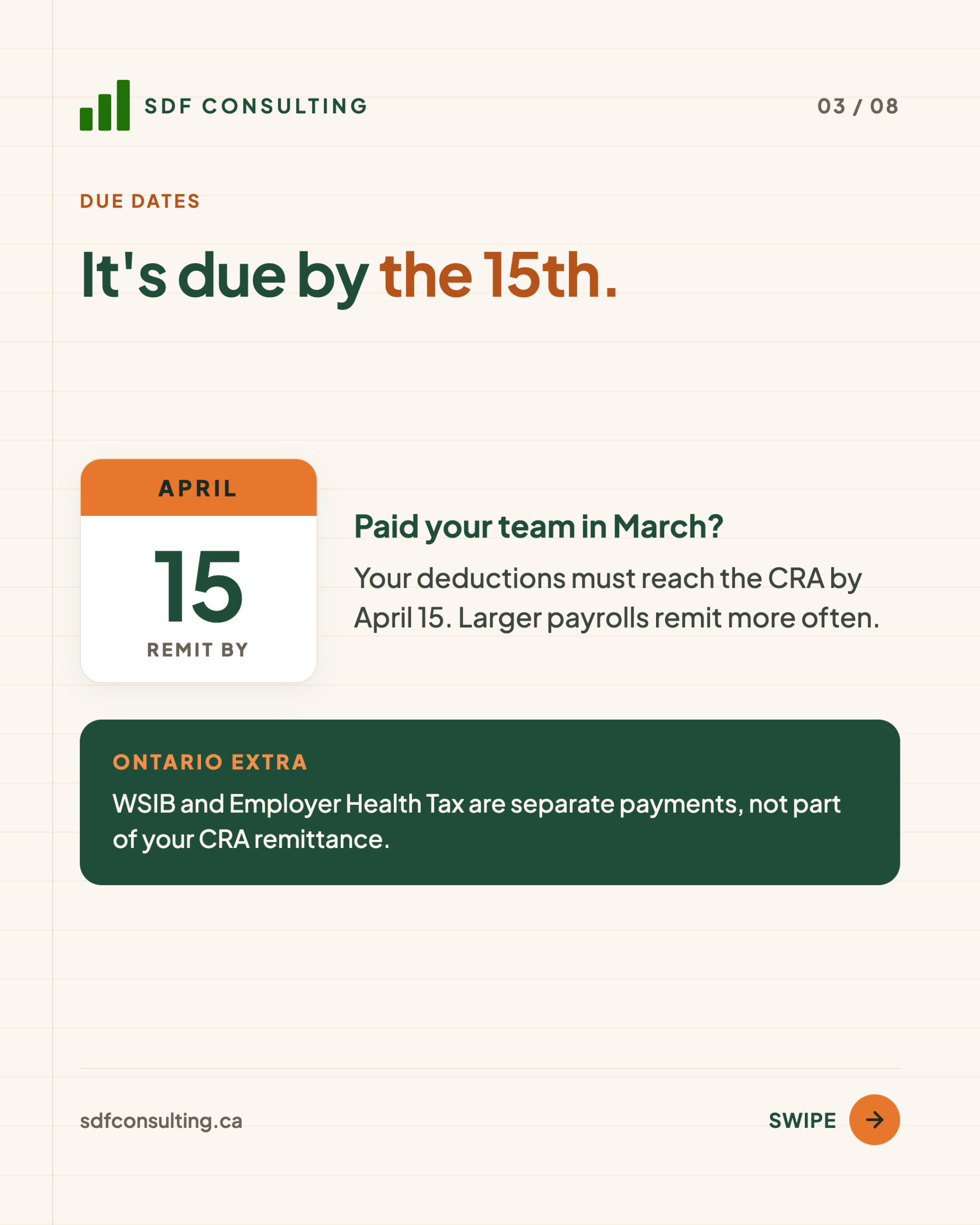
Most small employers are regular remitters: deductions from the pay you issue in one month are due on the 15th of the next month. Paid your team in March? Your deductions must reach the CRA by April 15.
Three details catch people out:
- “Due” means received, not sent. With online banking, the CRA counts the date your bank credits the payment, so don’t leave it to the last evening.
- Weekends and holidays move the date forward. If the 15th lands on a Saturday, Sunday or CRA-recognized holiday, you have until the next business day.
- Larger payrolls pay more often. The CRA assigns your remitter type from your average monthly withholdings. Bigger employers are accelerated remitters and pay up to several times a month. Check your type and schedule in CRA My Business Account.
The due date follows when you pay employees, not when they did the work. A December 31 payday counts toward December; a January 2 payday counts toward January.
Late costs you from day one
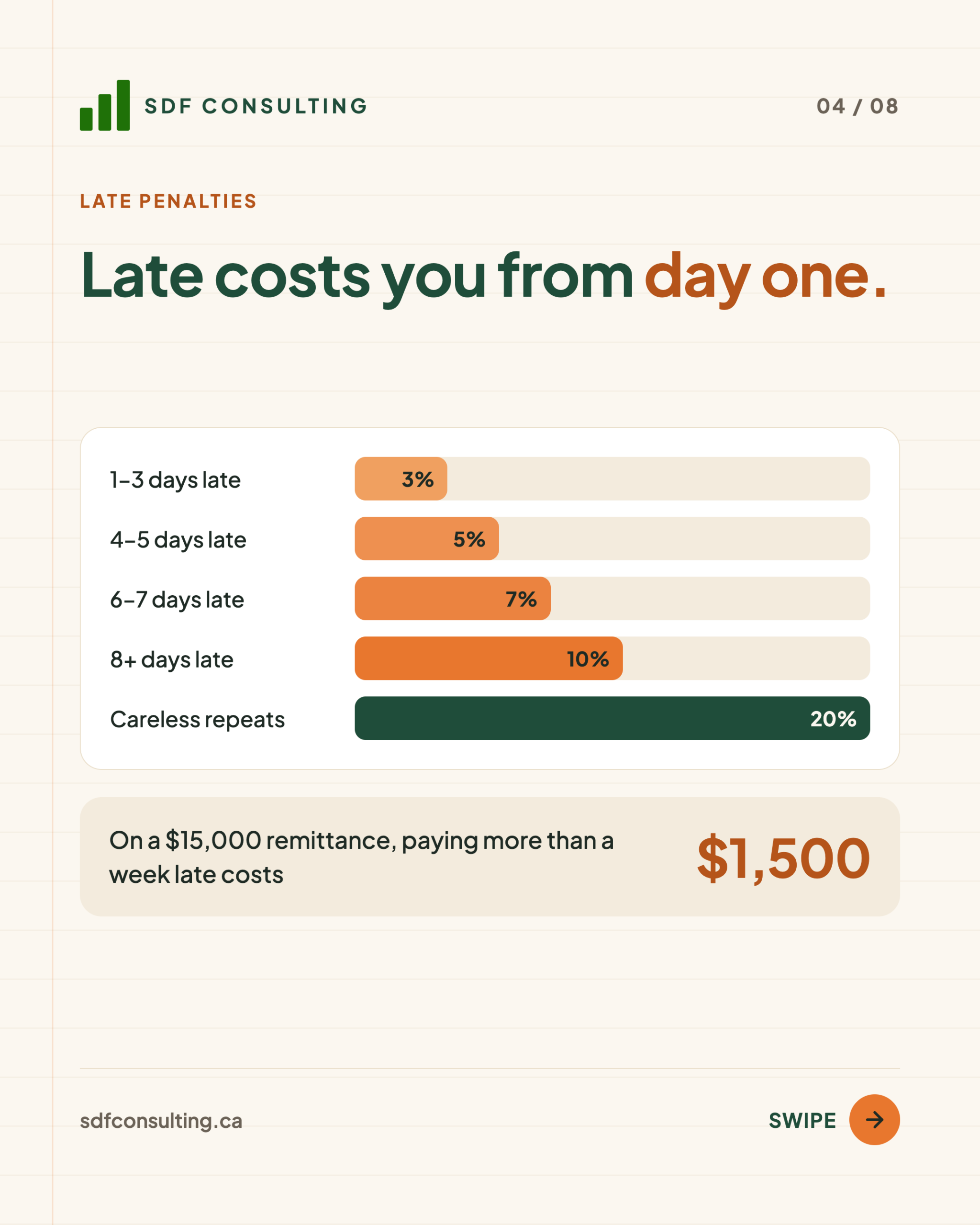
The CRA’s late-remittance penalty starts the day after the due date and climbs quickly. On a $15,000 remittance, paying more than a week late costs $1,500.
| Days late | Penalty | On a $15,000 remittance |
|---|---|---|
| 1–3 days | 3% | $450 |
| 4–5 days | 5% | $750 |
| 6–7 days | 7% | $1,050 |
| More than 7 days, or not remitted | 10% | $1,500 |
| A repeat failure in the same year, made knowingly or through gross negligence | 20% | $3,000 |
On top of the penalty, interest runs from the due date and compounds daily, and it applies to unpaid penalties too. The penalty generally applies to amounts over $500 that are late or not sent, so for most employers it’s a real risk every month.
Your T4s are due soon
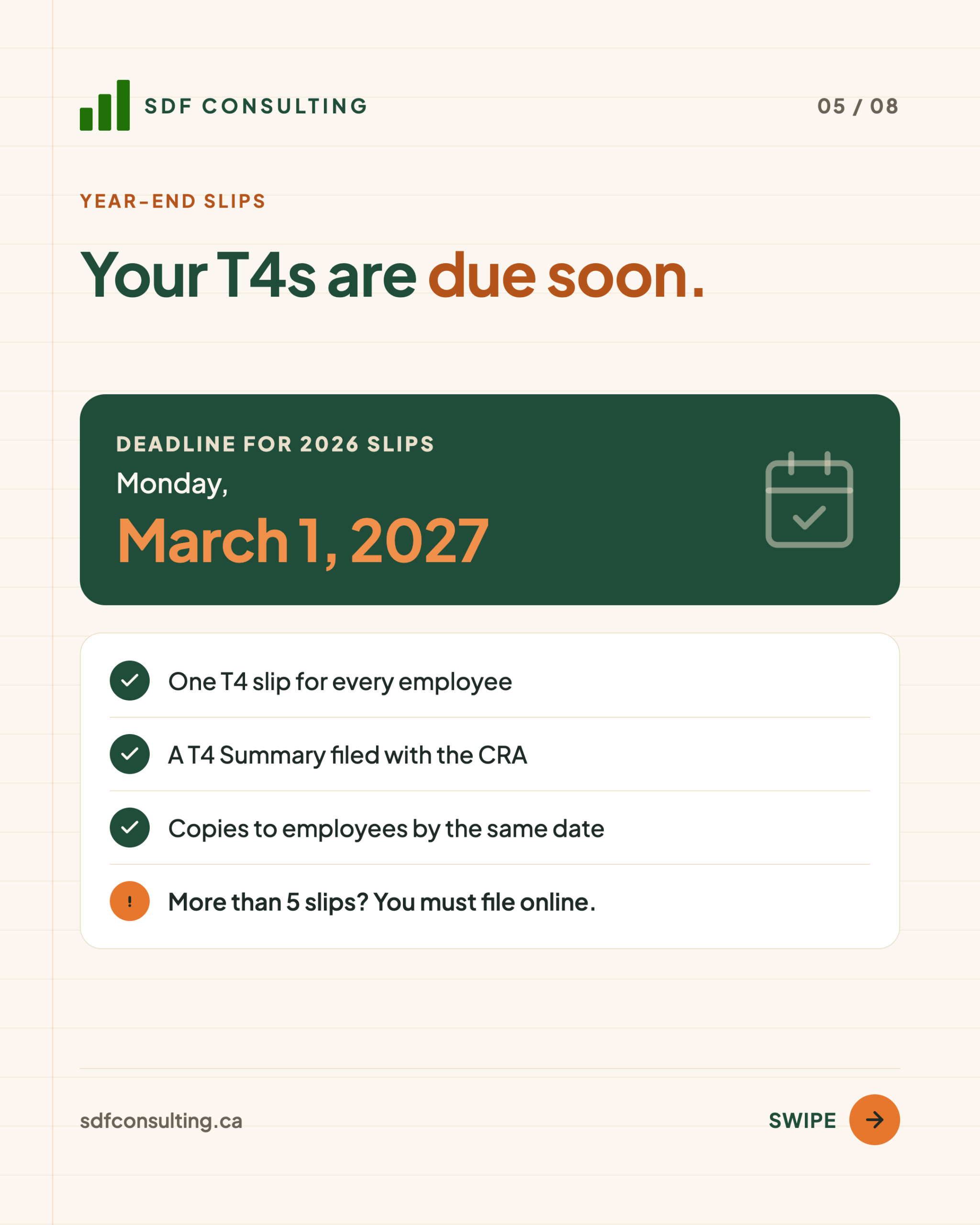
T4 slips for 2026 are due Monday, March 1, 2027. The rule is the last day of February, but February 28, 2027 falls on a Sunday, so the deadline moves to the next business day.
By that date you need to:
- Prepare one T4 slip for every employee you paid in 2026
- File the slips and a T4 Summary with the CRA
- Give each employee their copy
If you’re filing more than five slips, you must file electronically. That rule has applied since January 1, 2024, and it catches many small employers who used to file on paper.
Your T4 Summary should tie to what you remitted during the year. Differences are a common reason for CRA letters in the spring, which is why the reconciliation habit below matters.
Directors can be personally on the hook
If your corporation doesn’t remit source deductions, the CRA can collect the unpaid amount, plus penalties and interest, from the corporation’s directors personally.
Many owner-operators incorporate partly to separate business debts from personal ones. Unremitted payroll deductions are an important exception. Incorporating protects you from a lot. It doesn’t protect you from this.
Directors who took reasonable steps to prevent the failure may have a defence, but it’s far easier to stay current than to prove it after the fact. If cash is tight, remittances should be among the first payments made, not the last.
The Ontario extras
Your CRA remittance isn’t the only payroll obligation in Ontario. Two others are paid separately, to different organizations, on their own schedules:
- WSIB premiums go to the Workplace Safety and Insurance Board. Most Ontario employers with workers must register, though coverage depends on your industry.
- Employer Health Tax (EHT) goes to the Ontario Ministry of Finance. Many smaller employers are exempt below an annual payroll threshold, so check whether it applies to you.
Neither one is included in the deductions you send to the CRA, so budget and calendar them separately.
Four habits that keep you safe
None of these take more than a few minutes, and together they make missed deadlines very unlikely.
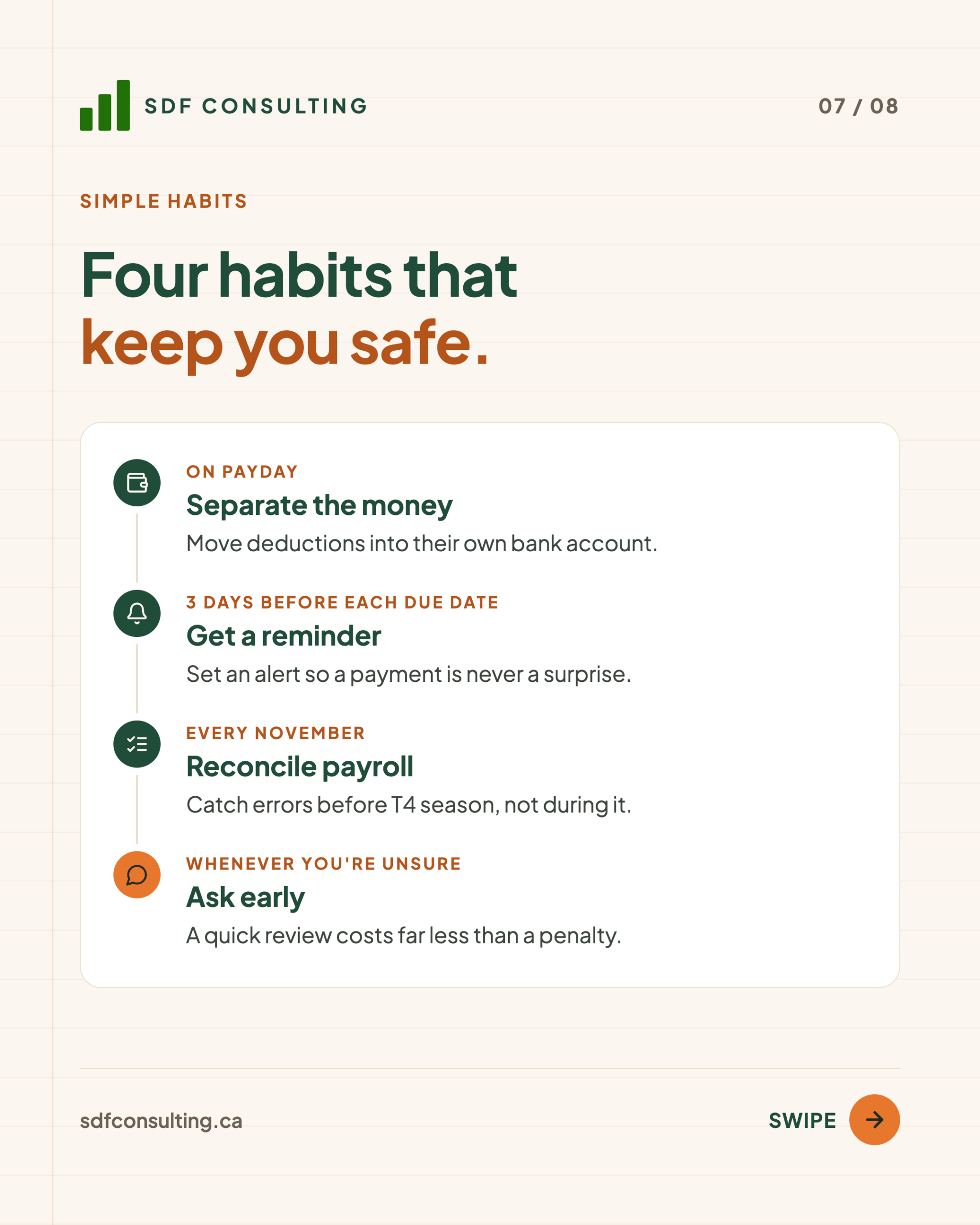
- On payday: separate the money. Move the deductions and your employer share into a separate bank account the same day you run payroll. If it isn’t in your operating account, it can’t get spent by accident.
- Three days before each due date: get a reminder. Set a recurring calendar alert so payment is sent with time to arrive, not on the 15th itself.
- Every November: reconcile payroll. Compare what your payroll records say you owed with what you actually remitted. Fixing a gap in November is easy; finding it in February, with T4s due, is not.
- Whenever you’re unsure: ask early. A quick review by your accountant or advisor costs far less than a penalty, interest and a CRA letter.
The bottom line
Payroll compliance isn’t glamorous, but it’s one of the simplest ways to protect your cash and your name. Treat deductions as money held in trust, know your due dates, and give yourself a buffer before every one.
Want a second set of eyes before T4 season? SDF Consulting helps Ontario owner-operators get remittances and year-end right, in plain language. Book a payroll check-up at sdfconsulting.ca.