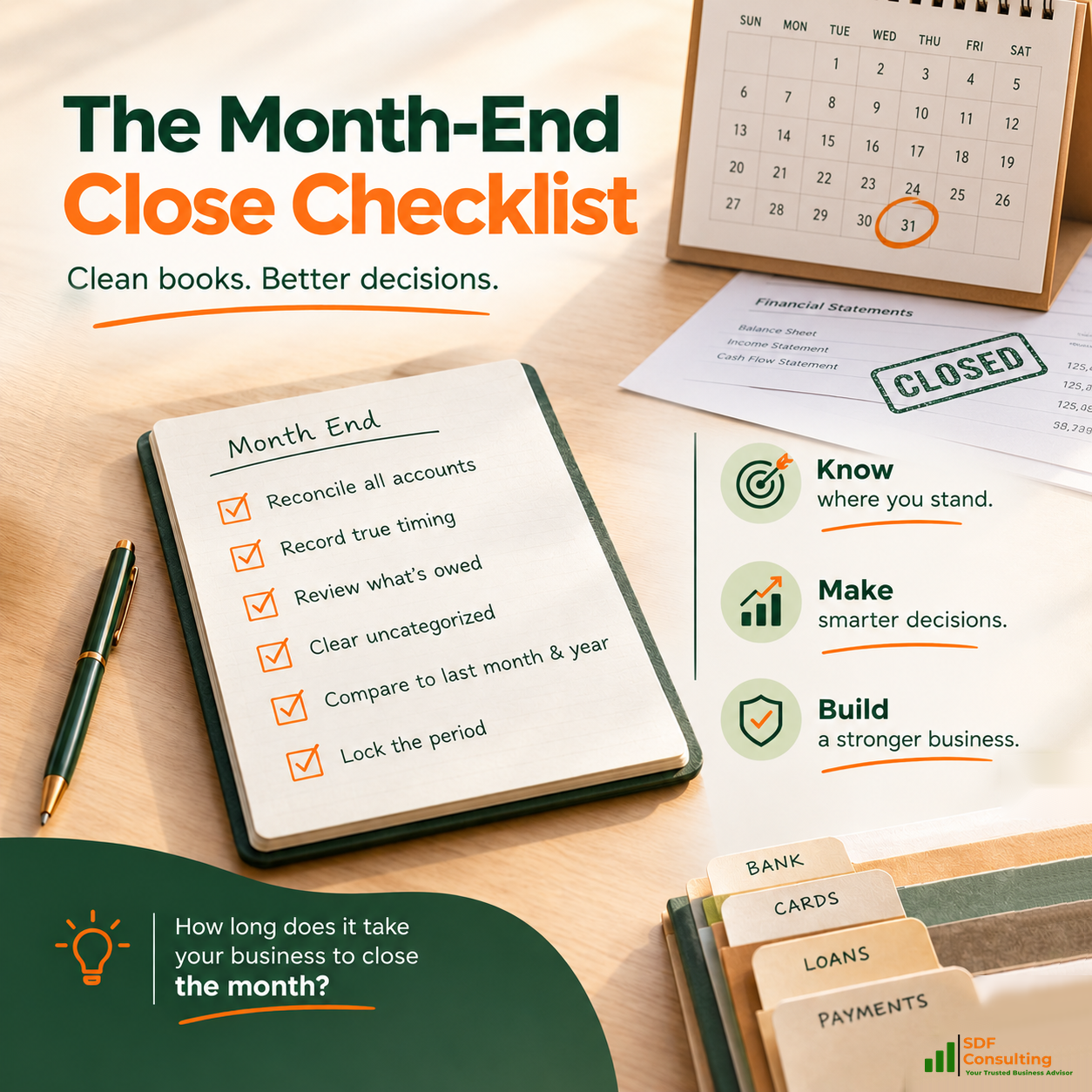

What a proper month-end close actually looks like, and the steps most small businesses skip
Most small business owners treat month-end as a quick check: log into the bank, see that the balance looks about right, and move on.
The problem is that your bank balance tells you how much cash you have today. It doesn’t tell you whether you made money last month, what you owe, who owes you, or whether your margins are slipping. Those answers live in your financial statements, and your statements are only as reliable as the process behind them.
That process is called the month-end close. Most small businesses skip some or all of it, and many don’t realize it until a banker, a buyer or the tax deadline forces the issue.
What a month-end close actually is
A month-end close is the routine of checking, correcting and finalizing your books so the month’s numbers can be trusted.
Think of it like closing out a cash register at the end of a shift. You count what’s in the drawer, compare it to the sales recorded, find any differences, and sign off. Once it’s done, that shift’s numbers are final. A month-end close does the same thing for your whole business.
Without it, your bookkeeping software is just a collection of transactions. With it, you get a profit and loss statement and a balance sheet you can actually make decisions with.
The six steps most small businesses skip
1. Reconcile every account, not just the bank
Reconciling means matching your books against the statement from the bank or lender, line by line, until they agree.
Most owners reconcile the main bank account, if anything. But credit cards, lines of credit, loans, payroll accounts and payment processors like Stripe, Square or PayPal all need the same treatment. One unreconciled credit card can hide missing expenses, duplicate entries or charges you never authorized.
2. Record revenue and bills in the month they belong to
If you did the work in March but sent the invoice in April, that revenue belongs to March. The same goes for bills: a supplier invoice for March materials belongs in March, even if you pay it in May.
Skip this step and your monthly results swing based on when money happened to move, not on how the business actually performed. A “great month” might just be the month a few big payments landed. A “bad month” might be the month you finally paid a pile of bills.
3. Review who owes you money, and for how long
Every month, look at your list of unpaid customer invoices and how old each one is. Accountants call this an aged receivables report.
A sale isn’t really complete until you’re paid. An invoice that’s 90 days late is a collections problem, and possibly a cash flow problem. Catching it early gives you a far better chance of getting paid.
4. Clean out “uncategorized” transactions
Most bookkeeping software has a holding bin for transactions nobody has sorted yet, often called “Uncategorized Expense” or “Ask My Accountant.”
Every dollar sitting there is missing from the right place on your statements. If $8,000 of fuel and repairs is uncategorized, your vehicle costs look lower than they are, and your profit looks higher than it is.
5. Compare results to last month and last year
This is the step that turns bookkeeping into insight. Put this month next to last month, the same month last year, and your budget if you have one.
The point is to ask questions. Why did margins drop two points? Why are wages up 15% when sales are flat? Sometimes the answer is a bookkeeping error, which the comparison helps you catch. Sometimes it’s a real problem you need to act on.
6. Lock the period
Once the month is reviewed and final, lock it in your accounting software so nobody can change it without a deliberate decision.
Without a lock, last month’s numbers can quietly shift every time someone enters a late transaction or recategorizes something. Then you never have a stable baseline to compare against, and reports you’ve already shared with your bank no longer match your books.
Why it matters more than it seems
Every major decision you make runs through your financial statements. Should you raise prices? Can you afford another hire? Is it safe to take on a loan or open a second location? If the numbers behind those questions are off, so are the answers.
Other people rely on your numbers too. Your banker uses them to decide on credit. Investors use them to value your business. A future buyer will dig through years of them, and messy books can lower your sale price or kill a deal outright.
Then there’s tax time. Businesses that skip the monthly close often discover problems all at once, months after they happened, when there’s little left to do but pay for the cleanup. Businesses that close every month find issues while they’re still small and fixable.
How long should it take?
For most small businesses, a good target is to have last month’s books closed within 10 business days. Well-run businesses with clean processes often get it done in five.
If your close takes longer, or only happens once a year, start small:
- Pick a fixed day each month to close the previous month, and put it in your calendar.
- Start with reconciling every account. It catches the most errors for the least effort.
- Add the other steps one at a time until the full checklist is routine.
- Review the finished statements yourself, even for 20 minutes. Your books should answer your questions, not just satisfy the tax filing.
The first few closes take the longest. Once your accounts are clean, each month gets faster.
Clean books are a leadership tool
A proper month-end close isn’t busywork for your bookkeeper. It’s how you find out, every month, whether the business is really doing what you think it’s doing.
Owners who close their books properly know where they stand within days. Owners who don’t usually find out at tax time, when it’s too late to change the result.
If you’re not sure your month-end process is giving you numbers you can trust, SDF Consulting can help you review your close, fix the gaps and build a routine that fits your business. Get in touch to start the conversation.