
Growth Alone Is Not a Measure of Success
Growing a business is often synonymous with increasing sales. Revenue targets become the primary measure of success, and many organizations invest significant time, energy, and capital into acquiring new customers and expanding market share.
While revenue growth is important, it tells only part of the story.
The reality is that growth alone does not guarantee profitability, financial stability, or long-term success. In fact, some businesses experience the greatest financial strain during periods of rapid growth. Sales increase, but cash becomes tighter. Operations become more complex. Margins begin to shrink. Decision-making becomes reactive rather than strategic.
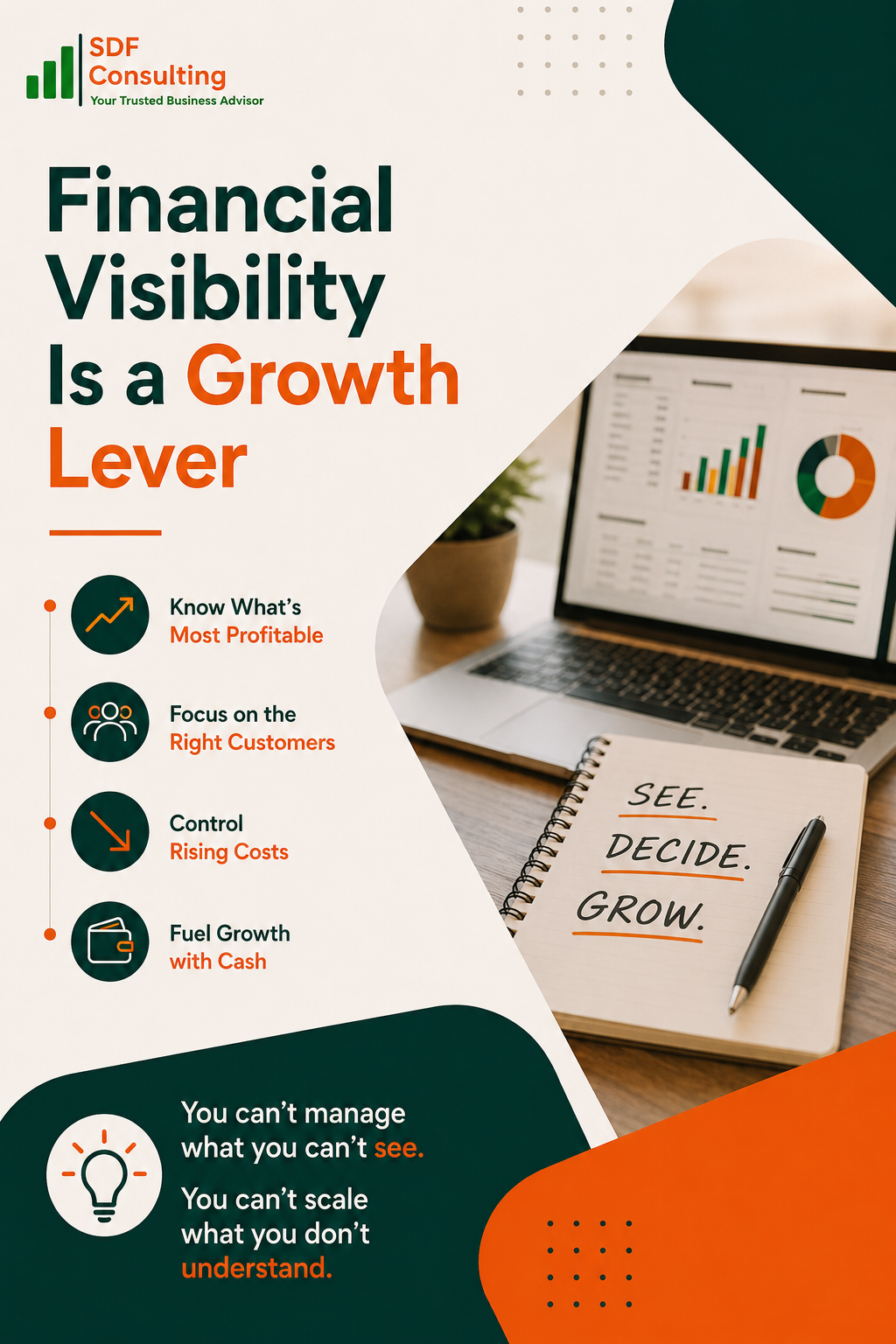
The difference between businesses that simply grow and those that grow sustainably often comes down to one critical factor: financial visibility.
Looking Beyond Revenue
Many business owners are surprised to discover that strong sales performance does not automatically translate into strong financial performance.
It is entirely possible for a company to achieve record-breaking revenue while simultaneously facing cash flow pressures, declining margins, and rising operational costs. Without visibility into the underlying financial drivers of the business, these issues can remain hidden until they become significant challenges.
Revenue is an important indicator of momentum, but it is not a complete measure of business health. Sustainable growth requires leaders to understand not only how much money is coming in, but also where it is coming from, how efficiently it is being generated, and how much of it ultimately contributes to the bottom line.
Why Financial Visibility Matters
Financial visibility goes far beyond reviewing financial statements at month-end. It means having access to timely, accurate, and meaningful information that supports better decision-making across the organization.
Businesses with strong financial visibility understand:
- Which products and services generate the highest margins
- Which customers contribute the greatest long-term value
- Where operational costs are increasing
- How efficiently resources are being utilized
- What cash is available to support future growth
- Which investments are likely to produce the strongest returns
When leaders have this level of insight, financial information becomes more than an accounting exercise. It becomes a strategic advantage.
Better Visibility Leads to Better Decisions
Every business decision carries a financial impact.
Whether it is hiring new talent, investing in technology, expanding operations, increasing inventory, or entering a new market, leaders must constantly balance opportunity against risk.
Without clear financial data, decisions are often based on assumptions, instinct, or incomplete information. While experience undoubtedly plays an important role, the most successful organizations combine intuition with financial insight.
When business owners have confidence in their numbers, they can make decisions faster and with greater certainty. They can identify opportunities earlier, allocate resources more effectively, and address challenges before they become obstacles to growth.
Financial visibility reduces uncertainty and creates the foundation for informed, strategic leadership.
Understanding What Actually Drives Profitability
One of the most valuable outcomes of financial visibility is the ability to understand profitability at a deeper level.
Not every customer, product, or service contributes equally to business success. Some generate healthy margins and long-term value, while others consume significant resources without delivering comparable returns.
Without proper visibility, businesses often focus their efforts on growing revenue indiscriminately. With visibility, they can identify what is truly driving profitability and concentrate resources where they create the greatest impact.
This shift in perspective can be transformative. Instead of pursuing growth for the sake of growth, organizations begin pursuing growth that strengthens profitability, improves efficiency, and enhances overall business performance.
Cash Flow: The Lifeblood of Growth
While profitability is essential, cash flow ultimately determines a company’s ability to operate, invest, and grow.
Many businesses discover that growth creates increased demands on working capital. More customers may require more inventory, additional staffing, larger facilities, or greater operational resources. If cash flow is not carefully managed, growth itself can create financial pressure.
Organizations with strong financial visibility maintain a clear understanding of their cash position and future obligations. They know when cash will be available, where capital is required, and how planned investments will impact liquidity.
This level of foresight enables leaders to pursue growth opportunities confidently without jeopardizing financial stability.
Financial Literacy Is a Leadership Advantage
Business owners do not need to become accountants, but they do need a solid understanding of the financial drivers that influence performance.
Today’s most effective leaders recognize that financial literacy is not solely the responsibility of the finance department. It is a core leadership capability.
Understanding profitability, cash flow, key performance indicators, and financial trends allows business leaders to ask better questions, make better decisions, and create stronger strategies.
The organizations that consistently outperform their competitors are often led by individuals who understand both the operational and financial dimensions of their business.
Turning Data Into a Strategic Asset
The most successful companies do not treat financial information as historical reporting. They use it as a forward-looking management tool.
They monitor performance consistently. They identify trends before they become problems. They evaluate opportunities based on data rather than assumptions. Most importantly, they use financial insights to align decisions with long-term business objectives.
In an increasingly competitive environment, this ability to turn financial data into strategic action can become a meaningful source of competitive advantage.
The Bottom Line
The businesses that achieve sustainable growth are not necessarily the ones generating the highest sales volumes. More often, they are the organizations that have a clear understanding of where they create value, how they generate profit, and what drives their financial performance.
Financial visibility provides that understanding.
It creates clarity around profitability. It strengthens cash flow management. It improves decision-making. And it gives business leaders the confidence to invest, hire, and grow strategically.
Simply put, you cannot effectively manage what you cannot see, and you cannot successfully scale what you do not fully understand.
In today’s business environment, knowing your numbers is no longer just a financial best practice. It is a leadership imperative and one of the most powerful drivers of long-term growth.
At SDF Consulting, we help business owners gain the financial clarity needed to make better decisions, improve profitability, and build sustainable growth. Because when you understand the numbers behind your business, you can lead with confidence.