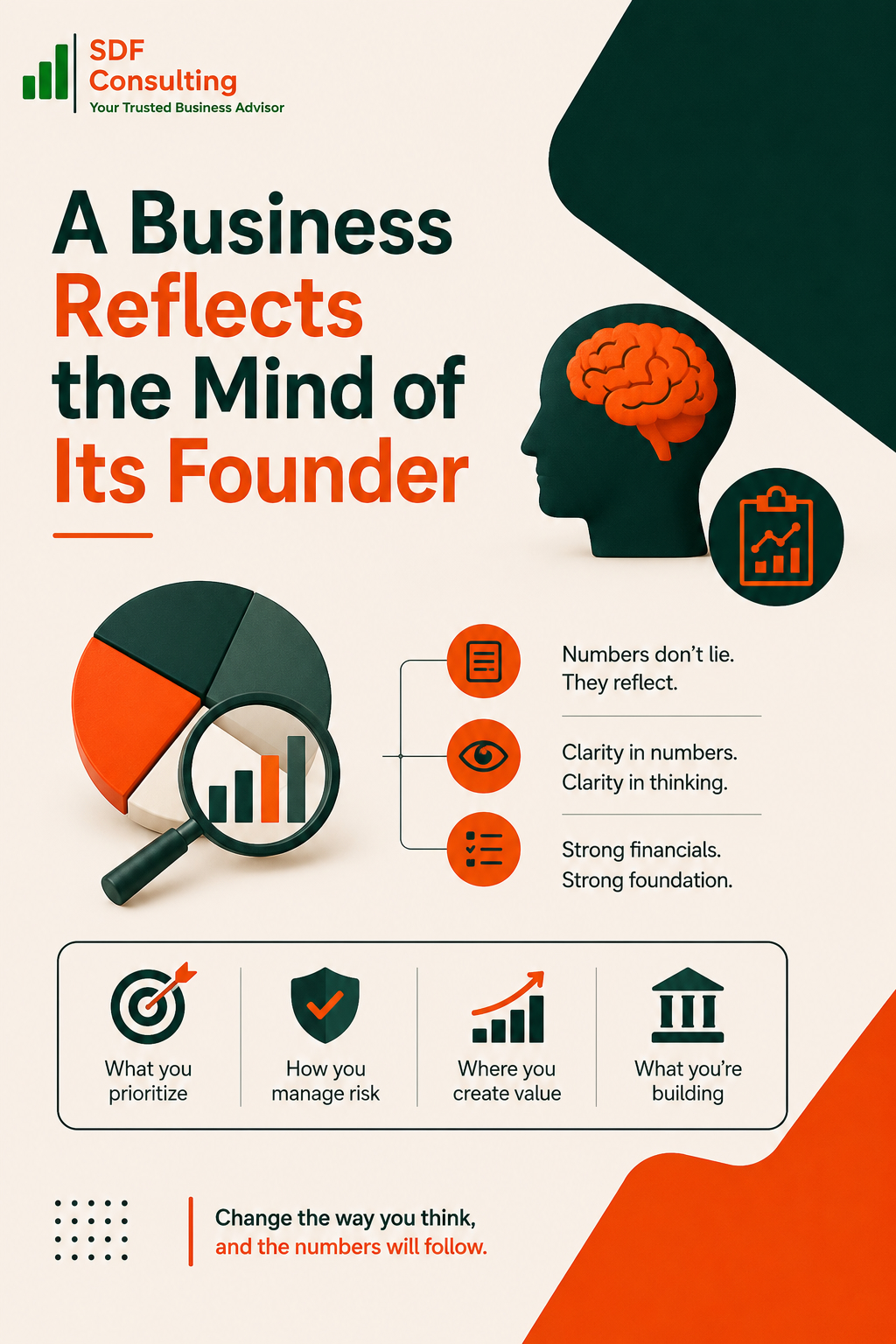

From Thought to Outcome: How Founder Discipline Shapes Financial Reality
A business is often described through its products, its people, or its strategy. These elements are important—but they are ultimately expressions, not origins.
At its core, a business is a direct reflection of the founder’s mindset: how they think, what they prioritize, and the level of discipline they bring to decision-making.
This relationship becomes most visible not in branding or narrative, but in the financials.
Financials as the Purest Signal of Leadership
Financials represent the most objective and unfiltered view of a business. They are not influenced by storytelling, positioning, or internal perception. They simply reflect reality.
More importantly, they reflect leadership.
- Disorganized financials often indicate reactive, short-term decision-making
- Lack of clarity typically points to avoided truths or insufficient rigor
- Inconsistent reporting reveals weak systems of accountability
- Strong margins and structured reporting signal discipline, control, and intent
These outcomes are rarely accidental. They are the natural byproduct of how a founder chooses to operate.
Accounting as a System of Intellectual Honesty
Accounting is frequently misunderstood as a back-office necessity—something required for compliance rather than strategy.
In reality, it is one of the most powerful tools of leadership.
Proper financial management enforces intellectual honesty. It ensures that there is alignment between what leadership believes is happening and what is actually occurring within the business. It removes ambiguity and forces clarity.
Well-structured financials do not just record activity—they create a framework for better decisions.
What Financials Reveal About a Business
Beyond performance metrics, financials provide insight into the fundamental character of a business. They answer critical questions that cannot be resolved through strategy alone:
- True Priorities
What the business claims to prioritize versus where resources are actually allocated often differs. Financials expose this gap with precision.
- Risk Management
How capital is deployed, how costs are controlled, and how variability is handled all reflect the organization’s tolerance and approach to risk.
- Value Creation vs. Value Erosion
Revenue alone is not a measure of success. Financials reveal whether growth is creating sustainable value—or quietly eroding it through inefficiency or misallocation.
- Durability of the Business Model
A business can appear active without being effective. Strong financials distinguish between momentum and true structural strength.
The Cost of Avoidance
Many founders distance themselves from financial detail under the assumption that they are delegating effectively.
In practice, this often results in disengagement.
Avoiding financials is rarely about complexity—it is about discomfort. Numbers force difficult conversations, expose inefficiencies, and challenge assumptions. Without engagement, visibility declines, and decision-making becomes less grounded.
The consequences compound over time:
- Reduced clarity leads to misaligned priorities
- Misalignment creates operational inefficiencies
- Inefficiencies weaken financial performance
- Weak performance limits strategic options
What begins as avoidance evolves into structural risk.
The Advantage of Financial Engagement
Founders who engage deeply with their financials operate differently.
They do not rely on intuition alone—they validate it. They do not react to outcomes—they shape them.
This level of engagement enables:
- Deliberate and disciplined capital allocation
- Early identification of inefficiencies and risks
- Greater predictability in performance
- Stronger control over business trajectory
Importantly, this is not about becoming a technical accounting expert. It is about developing fluency in the language of performance, risk, and value creation.
Leadership, Discipline, and Reflection
Financials are not simply outputs; they are ongoing reflections of leadership quality. Every decision—strategic or operational—ultimately expresses itself in the numbers.
Over time, patterns emerge:
- Clarity in leadership produces clarity in reporting
- Discipline in thinking produces consistency in margins
- Intentional decision-making produces sustainable growth
If financials lack structure, consistency, or direction, the issue is rarely isolated. It is a leadership signal.
Conclusion: Change the Thinking, Change the Outcome
A business cannot outperform the quality of thinking behind it.
Financials provide a continuous, objective measure of that thinking. They reflect priorities, reveal trade-offs, and expose whether the organization is building something of substance—or simply maintaining the appearance of progress.
The path forward is not purely operational—it is cognitive.
Impose greater structure. Demand transparency. Engage directly with the numbers. Make decisions with clarity and intent.
Because when the founder’s thinking evolves, the business follows—and the numbers inevitably reflect it.