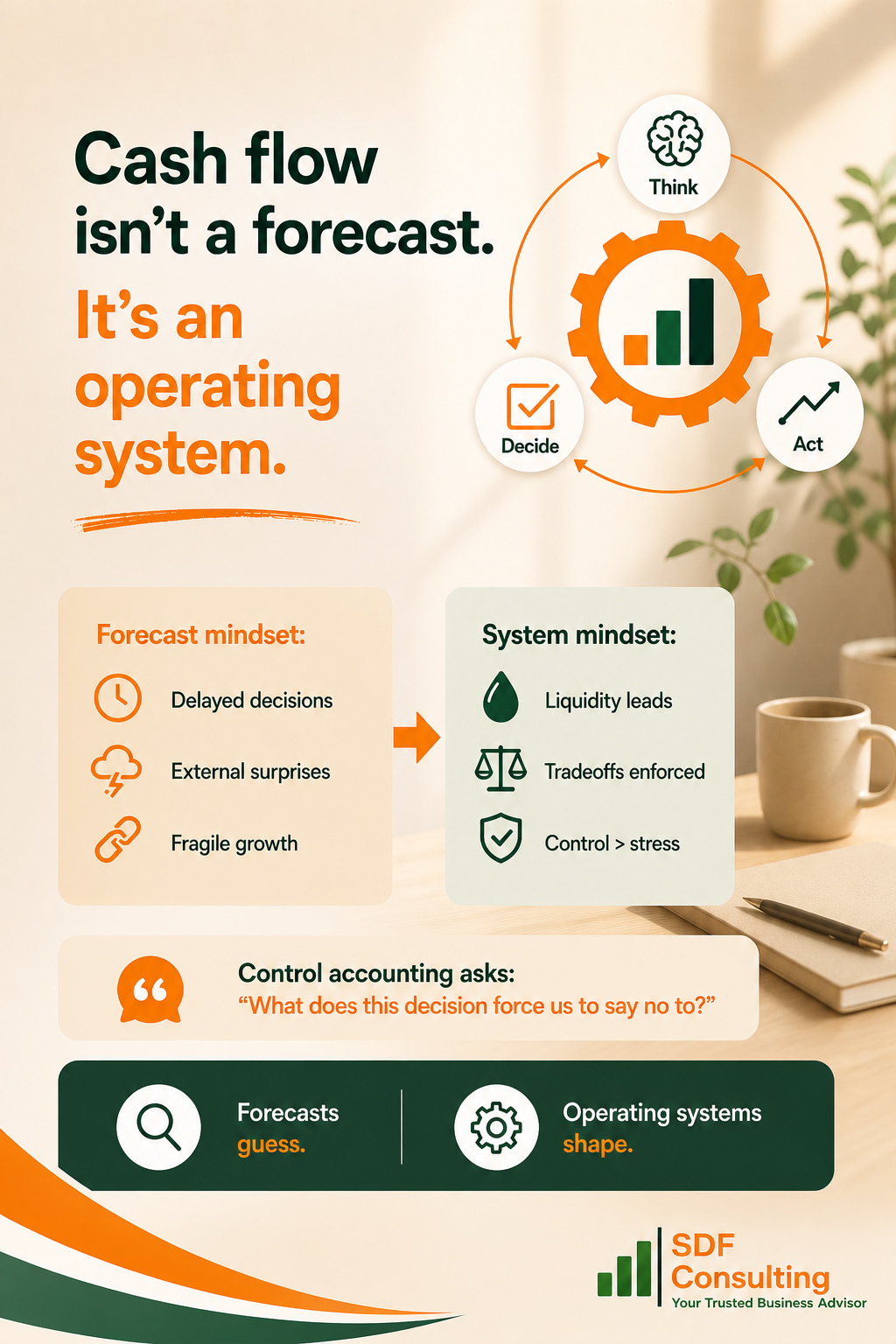

Most founders say cash flow is important.
Few operate as if it’s decisive.
In practice, cash flow is often treated like a weather report: reviewed periodically, reacted to emotionally, and trusted to “work itself out” if revenue keeps growing. The forecast gets updated. The runway gets recalculated. The business keeps moving.
Until it doesn’t.
This mindset quietly erodes control—not because the founder is incompetent, but because the system governing decisions is incomplete.
Cash flow is not a forecast.
It is an operating system.
And like any operating system, it reveals the psychology of the person running it.
The Difference Between Forecasting and Control
Forecasting answers one question:
What might happen if everything goes according to plan?
An operating system answers a different one:
What must be true before a decision is allowed to exist?
When cash is managed as a forecast, several predictable patterns emerge:
- Decisions are delayed because certainty is always “one more month away”
- Overspending is justified by future assumptions
- Surprises feel external—market shifts, client delays, unexpected expenses
- The business feels fragile, even when revenue is growing
In this model, cash is passive.
It reports after the fact.
Founders don’t feel in control because they aren’t structurally allowed to be.
Cash as an Operating System Changes Behaviour
When cash flow becomes an operating system, liquidity stops being an outcome and becomes a constraint.
Every meaningful decision is forced through the same gate:
- Can we afford this now?
- What does this require us to deprioritize?
- What are we explicitly saying no to?
This changes behaviour immediately:
- Tradeoffs become intentional, not emotional
- Spending authority becomes impersonal, not ego‑driven
- Speed increases because rules are clearer
- Stress decreases because ambiguity disappears
Importantly, nothing about this is technical.
The spreadsheets are not the transformation.
The decision framework is.
Why Founders Feel “Out of Control”
Founders who describe themselves as overwhelmed or reactive are often mislabeled as poor operators.
In reality, most are operating without a system that converts intent into constraint.
They know what they care about:
- Sustainable growth
- Optionality
- Competitive advantage
- Team stability
- Long‑term equity value
But without a cash operating system, those priorities remain abstract. They compete with urgency, optimism, and ego in the moment of decision.
Control accounting resolves this by embedding priorities directly into how money moves.
Not by asking:
“Do we have enough cash?”
But by forcing the real question:
“What does this decision prevent us from doing?”
That reframing is psychological.
And it is where control begins.
What a Real Cash Operating System Does
A true operating system does not predict outcomes. It shapes behaviour.
In practice, an effective cash operating system:
- Hard‑codes priorities into separate liquidity pools
So not all dollars are treated as interchangeable or available - Forces weekly decision‑making, not monthly reflection
Because control is a cadence, not a quarterly event - Makes growth earn its right to exist
By competing against stability, resilience, and optionality - Removes ego from spending authority
By enforcing rules that apply regardless of confidence or narrative
This is not about being conservative.
It’s about being intentional.
Companies don’t fail because they move too slowly.
They fail because they move confidently through decisions they never constrained.
Forecasts Guess. Systems Govern.
Forecasts attempt to estimate the future.
Operating systems govern behaviour in the present.
And behaviour—not spreadsheets, not dashboards, not narratives—is what determines whether a company compounds or collapses.
Two companies with identical revenue and runway can have radically different outcomes depending on whether cash is passive information or active structure.
One reacts.
The other decides.
That difference compounds over time.
The Leadership Shift
At an executive level, adopting a cash operating system is a leadership decision, not a financial one.
It requires accepting that:
- Constraints create clarity
- Optionality must be protected deliberately
- Confidence does not replace discipline
- Control is designed, not felt
The goal is not perfection.
The goal is repeatable, enforced decision quality.
If your cash flow does not change how you think and act every week, it isn’t control.
It’s just a prediction pretending to be one.