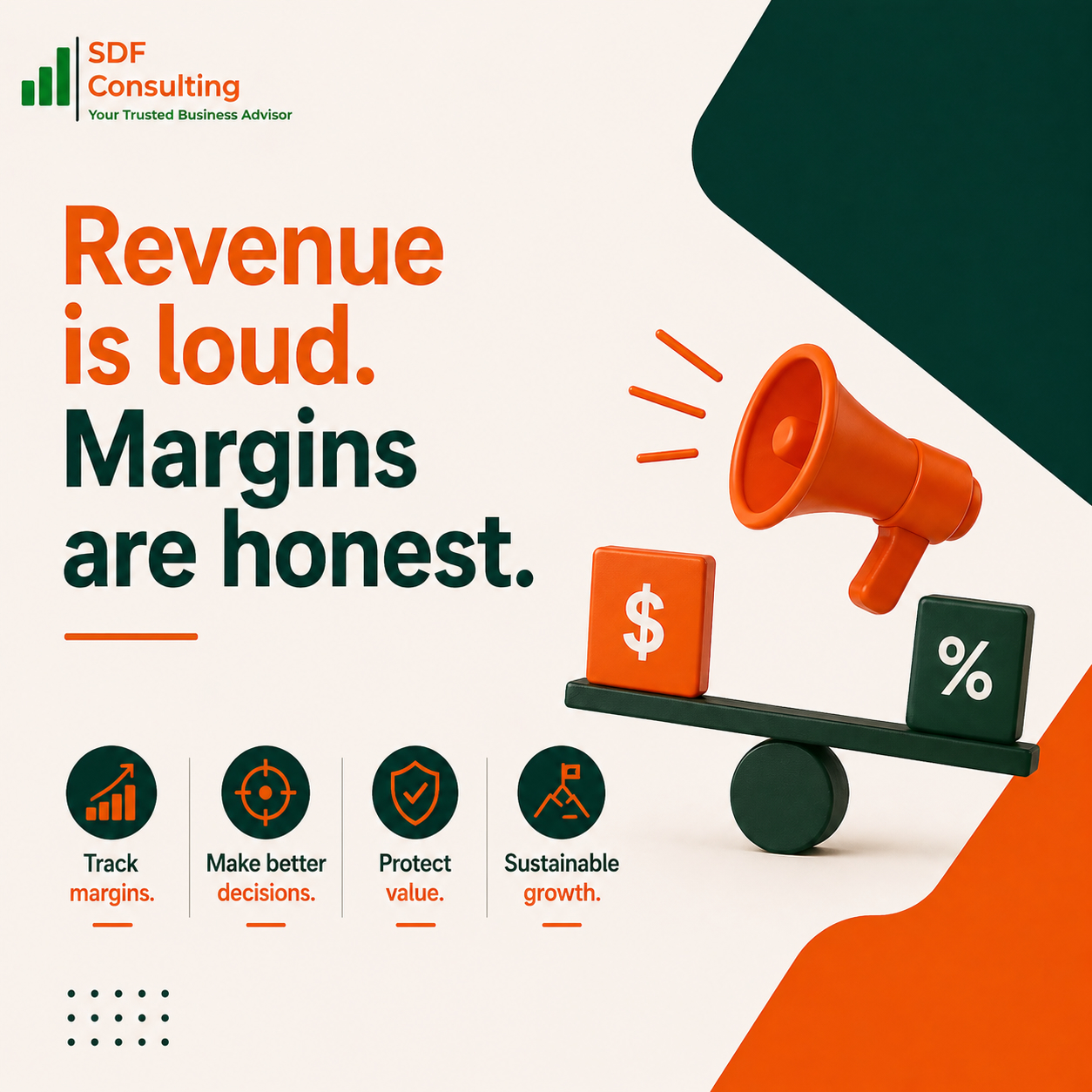

Revenue is loud.
Margins are honest.
I’ve reviewed hundreds of businesses where growth looked impressive on the surface—new customers, rising sales, bigger wins being announced.
And yet, underneath the excitement, the economics were quietly deteriorating.
This is one of the most common—and most dangerous—patterns I see in growing businesses:
Revenue goes up.
Value goes down.
The Uncomfortable Truth About Growth
Revenue growth feels good. It’s visible. It’s celebrated. It reassures teams, investors, and founders that things are “working.”
But revenue alone doesn’t tell you whether your business decisions make sense.
You can absolutely grow revenue while:
- Underpricing your work
- Training customers to expect discounts
- Taking on lower‑quality business
- Scaling costs faster than capability
In other words, you can grow busy while shrinking healthy.
That’s why revenue is a poor lie detector.
Margins aren’t.
What Margins Actually Tell You
Revenue answers one question:
How much did we sell?
Margins answer a much harder one:
Did it make sense to sell it?
When margins weaken as revenue grows, it’s usually not random. It’s a signal.
Common signals I see:
- Pricing decisions postponed “until later”
- Discount‑led growth hiding weak positioning
- Rising fulfillment, labor, or acquisition costs
- Scale without operational leverage
None of these fix themselves with more volume.
In fact, volume often makes them worse.
Why Operators Obsess Over Unit Economics
Strong operators don’t manage businesses at the topline.
They manage them at the unit level.
They want to know:
- Gross margin by product, customer, and channel
- Contribution margin after real variable costs
- Customer payback period versus lifetime value
- Incremental margin on the next dollar of revenue
Why the next dollar?
Because averages lie.
What matters is whether the next sale improves the business—or strains it.
If every new dollar of revenue earns less than the last, scale isn’t helping you.
It’s compounding the problem.
When Scale Doesn’t Deliver Leverage
There’s a comforting myth that scale eventually fixes messy economics.
In reality, scale doesn’t create discipline.
It reveals it.
If margins compress as you grow, what you’re really learning is:
- Which decisions were avoided
- Which trade‑offs were never made
- Where pricing courage was missing
Growth amplifies design flaws. It doesn’t mask them for long.
Pricing: The Decision Behind Most Margin Problems
Most margin issues are blamed on:
- Markets
- Competition
- Cost pressure
- “The economy”
In practice, most margin issues trace back to pricing decisions not made clearly—or not revisited often enough.
Pricing isn’t a sales tactic.
It’s a leadership decision.
And you can only make good pricing decisions if your accounting tells the truth.
Optimistic forecasts don’t create clarity.
Clean, disciplined reporting does.
Why This Matters More in Uncertain Markets
In stable markets, inefficiencies can linger.
In uncertain markets, they don’t.
Revenue momentum can buy you time.
Margins determine whether you survive long enough to use it.
When capital is tight and costs are sticky, businesses with weak margins don’t fail suddenly.
They drift—until options quietly disappear.
The Real Question Founders Should Be Asking
The question isn’t: “Are we growing?”
It’s: “Are we getting healthier as we grow?”
If you’re reviewing revenue trends every month but not margin trends with the same intensity, you’re flying blind.
And growing while blind is rarely a strategy.
It’s usually a gamble.