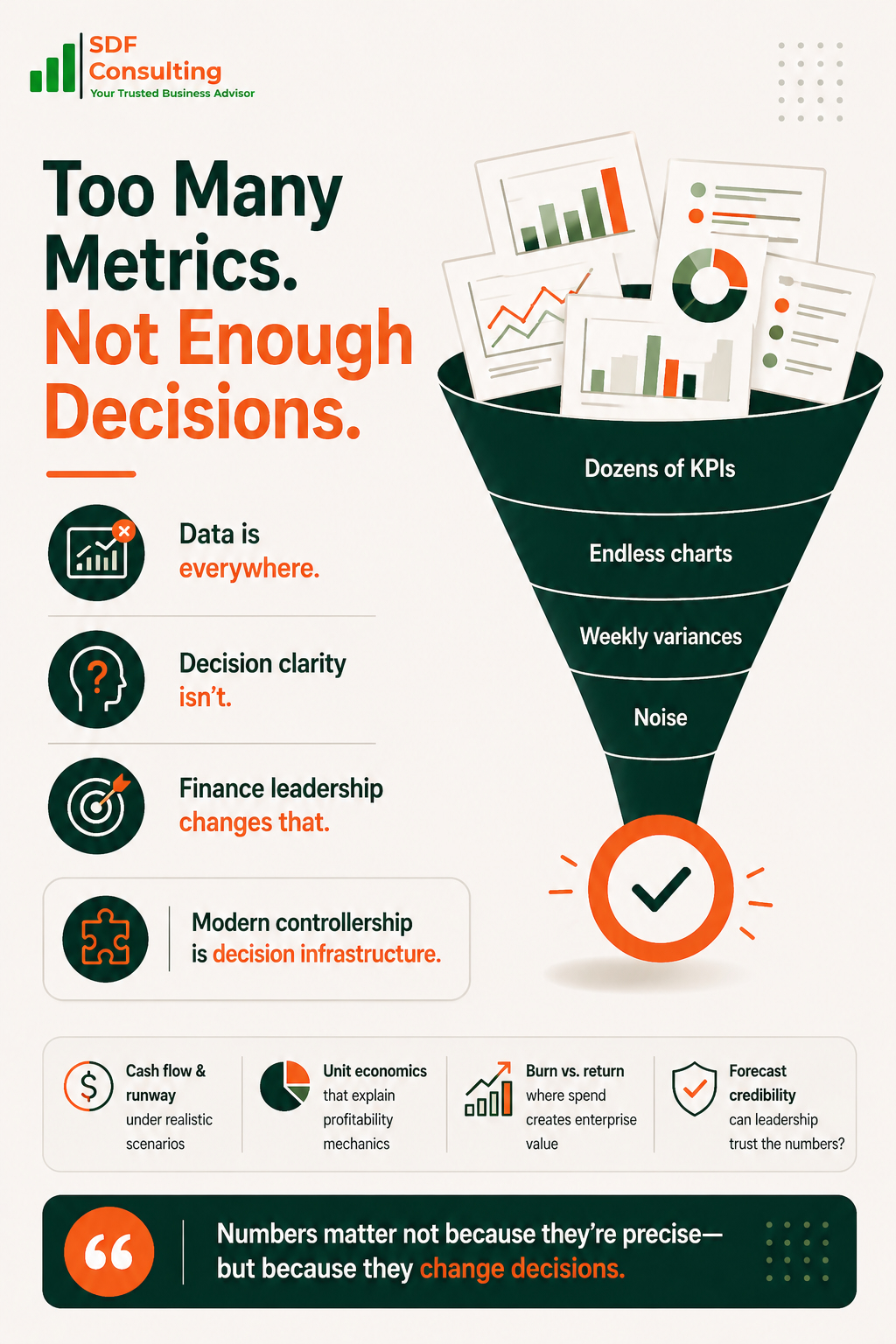

Why Modern Finance Leadership Must Move Beyond Reporting
Founders today are not short on data.
They are drowning in it.
Dashboards overflow with KPIs. Weekly variance reports land faithfully in inboxes. Charts multiply. Metrics cascade across tools, teams, and meetings.
Yet when the moment of decision arrives—Should we hire? Cut spend? Raise capital? Accelerate growth? Pause?—clarity often evaporates. Confidence gives way to gut instinct. Debate replaces direction.
This is not a data problem.
It is a decision problem.
And it is exactly where modern finance leadership—specifically controllership—should step in.
The Illusion of Insight
Most companies equate more metrics with better management. The logic seems sound: if we measure everything, we’ll see problems sooner and make smarter choices.
In practice, the opposite often happens.
Teams accumulate dozens of KPIs without alignment on purpose. Metrics become artifacts of process rather than instruments of direction. Reporting turns into a routine—performed diligently, questioned rarely, and disconnected from the decisions leadership actually needs to make.
The result is a subtle but dangerous illusion: visibility without insight.
When executives ask, “What are the numbers telling us?” and the room goes quiet, the issue isn’t analytical sophistication. It’s that the metrics were never designed to answer the question in the first place.
Why This Isn’t a Reporting Issue
Reporting answers what happened.
Leadership requires clarity on what to do next.
That gap isn’t solved by prettier dashboards or tighter month-end closes. It’s solved by reframing the role of finance—from historical record keeper to decision architect.
This is a controllership opportunity, not a tooling problem.
High‑impact controllers don’t start with:
“What should we report?”
They start with:
“What decision does this enable?”
That single shift changes everything.
From Accounting Output to Decision Infrastructure
Traditional controllership has been anchored in accuracy, compliance, and retrospection. Those foundations still matter—but they are no longer sufficient.
Modern controllership is not about perfect numbers for their own sake.
It is about building decision infrastructure.
That means:
- Designing metrics that frame tradeoffs
- Structuring forecasts that expose risk, not hide it
- Translating complexity into executable choices
- Creating confidence—not just precision
In other words, numbers matter not because they are exact, but because they change behaviour.
The Executive Metric Fallacy
At the executive level, very few metrics actually drive decisions. Yet leadership teams are routinely presented with dozens.
This overload creates two predictable outcomes:
- Decision paralysis – leaders hesitate because the signal is buried in noise
- Intuition dominance – leaders ignore the data and rely on instinct instead
Both outcomes undermine finance’s role as a strategic partner.
In reality, most leadership teams only need a small set of metrics, rigorously defined and relentlessly connected to decisions.
The Four Metrics That Actually Matter
While every business is different, high‑performing leadership teams tend to anchor decisions around the same core dimensions.
1. Cash Flow and Runway (Under Realistic Scenarios)
Not a static runway number.
Not a best‑case plan.
Leaders need to understand:
-
- How long cash lasts if growth slows
- How runway changes under hiring acceleration
- What decisions shorten or extend survival
Scenario‑based cash visibility turns fear into planning. Without it, runway becomes either ignored or obsessively watched—neither of which leads to good decisions.
2. Unit Economics That Explain Profitability Mechanics
Gross margin alone is not insight.
What matters is whether leadership truly understands:
-
- Where profit is created—or destroyed
- Which activities scale favorably
- What must be true for growth to be sustainable
When unit economics are clear, strategy becomes grounded. When they’re opaque, growth turns into a gamble.
3. Burn vs. Return: Where Spend Creates Enterprise Value
Burn rate is easy to report.
Value creation is harder to explain—but far more important.
The question executives are really asking is:
“What are we buying with this spend?”
High‑impact finance teams connect spend to outcomes:
-
- Which investments accelerate learning
- Which ones compound future returns
- Which are simply consuming cash
This reframes cost discussions from “How much are we spending?” to “Is this spend worth it?”
4. Forecast Credibility
Perhaps the most underrated metric of all.
Leaders don’t need perfect forecasts. They need forecasts they can trust.
Forecast credibility answers questions like:
-
- Can we rely on this model to make irreversible decisions?
- Do plan vs. actual variances teach us something?
- Does the forecast improve over time—or just repeat mistakes?
Without credibility, forecasts become theater. With it, they become a foundation for speed and confidence.
The Discipline of Subtraction
One of the most valuable finance leadership skills is knowing what not to measure.
If a metric does not influence:
- Timing
- Capital allocation
- Risk tolerance
- Strategic direction
…it is not a leadership metric.
It is noise.
Subtraction is not negligence. It is focus.
The goal is not fewer numbers—it is fewer, sharper decisions.
When Finance Isn’t Leading
When metrics multiply but clarity doesn’t, finance isn’t failing technically.
It’s failing strategically.
The organization ends up with:
- Elegant dashboards
- Precise reports
- No shared conviction
And when finance only reports, leadership fills the gap with instinct.
The Real Mandate of Modern Finance Leadership
Finance leadership today is not defined by closing the books faster or reconciling more accurately—important as those are.
It is defined by:
- Framing decisions before they are debated
- Making tradeoffs explicit
- Turning uncertainty into structured options
- Helping leadership act with confidence, not just hope
That is controllership at its highest impact.
Because in the end, metrics don’t matter because they exist.
They matter because they change decisions.
And when finance owns that responsibility, it stops being a back‑office function—and becomes true leadership.\